
BUSINESS
Nestlé Faces FSSAI Cases Over Claims It Still Publishes
FSSAI opened three Nestlé India formula cases over 5 HMOs and whey claims still on Nestlé’s own FAQ, plus a separate biotin sample.

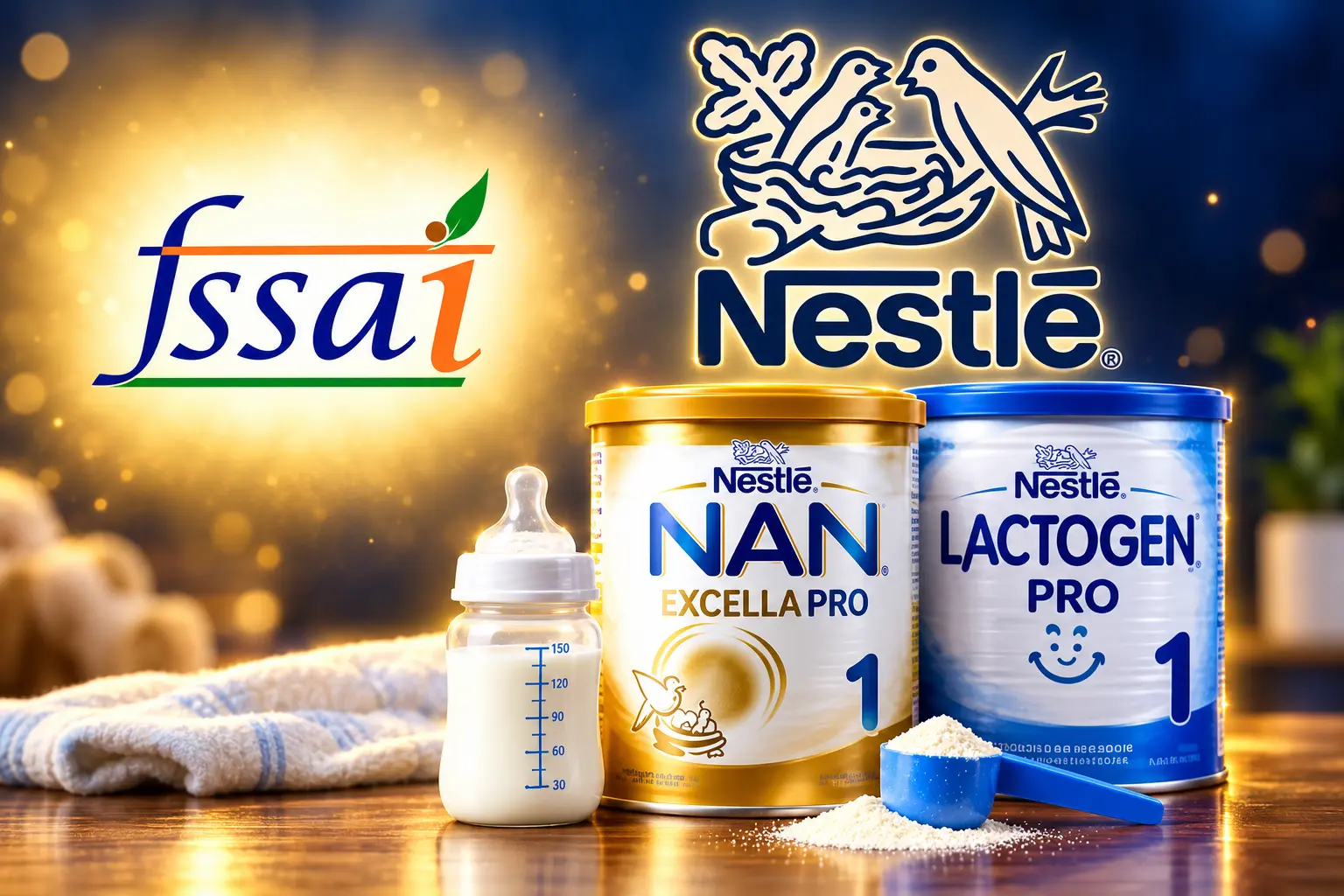
India’s food regulator opened three adjudication cases against Nestlé India on 18 September 2026 over infant formula claims and a biotin lab test. The Food Safety and Standards Authority of India said it had looked at NAN Excella Pro Stage 1, Lactogen Pro 1 and a follow-up formula, plus sales copy on e-commerce sites.
Nestlé India said those packs and their labels were already cleared by an FSSAI expert committee, and that the lines on the label are factual. FSSAI has not said it will pull the tins from shops. The biotin sample is a separate fight, and the product name has not been published.
Three Cases Split Nestlé’s Formula Fight in Two
FSSAI said in a social media post that it had started legal action against Nestlé India Ltd over several non-compliances under the Food Safety and Standards Act. The notice runs against Nestlé India’s Unit I and Unit II. Two files are about sales claims. The third is a laboratory finding on biotin, also called vitamin B7.
On NAN Excella Pro Stage 1, the regulator said it saw claims relating to “5 HMOs” and “Whey Protein”. On Lactogen Pro 1, it saw a claim that whey protein is easy to digest. HMO stands for human milk oligosaccharide, a group of complex sugars found in breast milk. FSSAI said it asked Nestlé India for clarifications, then held that both products broke the infant-nutrition rules and the 1992 infant-milk law.
THE THREE ADJUDICATION CASES
| Product | What FSSAI flagged | Rule cited |
|---|---|---|
| NAN Excella Pro Stage 1 | 5 HMOs and whey protein claims | Regulation 4(2) and IMS Act section 3 |
| Lactogen Pro 1 | Whey protein “easy to digest” | Regulation 4(2) and IMS Act section 3 |
| Follow-up formula, name not given | Biotin found non-conforming in two labs | Foods for Infant Nutrition Regulations, 2020 |
The regulator did not call the science false in the public note. It said the claims were promotional material meant to help sell infant foods. Nestlé’s reply talks about statements on the label. Those are not the same object, and both sides are using that gap.
Nestlé Says FSSAI Already Approved the Packs
Nestlé India’s defence is blunt. The company says the same authority now filing cases had already signed off on the products and the packs through an expert committee, and that it has sent another detailed reply on the wording.
Our products are fully compliant with all the applicable regulations. The said products (i.e., NAN EXCELLA PRO & LACTOGEN PRO) and their labels were approved by the expert committee of FSSAI. In response to the notice, we have again submitted our detailed response to the authorities regarding statements appearing on the label, which are factual in nature, and supported by scientific literature.
Nestlé India spokesperson, statement, 18 September 2026
The company added that it follows the rules on labels and will keep working with FSSAI on consumer awareness. It did not, in the public replies, walk through the biotin sample in detail.
That stance collides with Nestlé’s own sales story. The FY26 annual report tells shareholders the company offers the advanced NAN ExcellaPro with 5 Human Milk Oligosaccharides and probiotics. The 5 HMO line is not a stray marketplace flourish. It is how Nestlé India has been describing the premium tin to investors.
A 1992 Ad Ban Now Reaches E-Commerce Pages
FSSAI said it examined the infant products “and their promotional material available on e-commerce platforms”. That sentence is doing the legal work. India does not run a normal advertising market for formula. The Infant Milk Substitutes, Feeding Bottles and Infant Foods (Regulation of Production, Supply and Distribution) Act, 1992, in force from 1 August 1993, prohibits advertising and promotion of infant milk substitutes, feeding bottles and infant foods.
A 2003 amendment widened the net. Advertisement includes a notice, circular, label, wrapper or any other document, and any announcement by electronic or audio or visual transmission. Promotion means using, directly or indirectly, any method of encouraging a person to buy or use those products. Section 3 then says no person shall advertise them, give the impression they are equal to or better than mother’s milk, or take part in their promotion.
WHAT SECTION 3 BANS
- Paid ads: No person shall advertise, or take part in publishing an ad, for the sale or supply of infant milk substitutes, feeding bottles or infant foods.
- Better-than-breast claims: No person shall create a belief that these products are equivalent to, or better than, mother’s milk.
- Any promotion: No person shall take part in the promotion of those products, a phrase the 2003 change left deliberately wide.
FSSAI’s 2020 infant-nutrition rules fold that statute in. Regulation 3(8) says foods for infant nutrition must meet sections 3, 4, 5, 7, 8, 9 and 10 of the IMS Act on ads, marketing and promotion. Infant-food ads must follow the 1992 Act, the Advertising and Claims Regulations say in so many words, before they set any other claim rules.
The 2020 labelling clause FSSAI is now using is Regulation 4(2). It says no container or label of food for infant nutrition shall carry a picture of an infant or a woman, or “picture or other graphic materials or phrases designed to increase the saleability” of the product. Terms such as “humanised” or “maternalised” are barred. So are lines such as “full protein food” or “health food”.
FSSAI is reading “5 HMOs”, “whey protein” and “easy to digest” as phrases designed to increase saleability. Nestlé is reading them as composition facts that an expert committee already allowed on the tin. Shop pages sit in the middle. A listing that repeats the 5 HMO line, with comparison tables and “easy to digest” copy, looks a lot like promotion as the 2003 definition wrote it, even if no television spot ever ran.
What the Biotin Test Failure Means
The third case is not about copy. FSSAI said a sample of follow-up formula made by Nestlé India was sub-standard with respect to biotin in laboratory analysis. Follow-up formula is the milk drink meant for infants after six months up to 24 months, used as the liquid part of a mixed diet. The sample went to a referral laboratory, which also found it non-conforming with the biotin requirement in the 2020 rules.
Those rules set biotin in follow-up formula at 7.50 to 50.00 micrograms per 100 grams, or 1.60 to 10.60 micrograms per 100 kcal. The two figures are the same range on two bases, not two different limits. A maker may sit 10 percent below the value declared on the pack, but it may not go outside the maximum in the composition table. FSSAI has not published the number the labs found, so it is not possible to say from the public file whether the sample sat under the floor, over the ceiling, or off the declared value.
FSSAI has, in a separate track, revised infant-formula limits that include biotin, along with selenium, manganese and iron. The public case against Nestlé still cites the 2020 biotin requirement. The exact lab reading remains unpublished.
WHAT WE KNOW
- Two labs: The first lab and the referral lab both found the follow-up sample non-conforming on biotin.
- No recall order: FSSAI has not said it will order the product off shelves.
- No penalty yet: The regulator’s note files adjudication cases; it does not record a fine.
WHAT IS UNCONFIRMED
- The SKU: The follow-up formula is unnamed, so parents cannot match the lab file to a tin.
- The biotin number: Neither lab figure has been released.
- Label versus listing: FSSAI’s public note stresses e-commerce material; Nestlé’s reply stresses the approved physical label.
That missing number is doing more reputational damage than the advertising files, because a failed vitamin test reads as unsafe food even when the tin and the reading stay off the page. The advertising cases are the larger legal point. They reach every formula listing that sells with science copy. The biotin file, as published, reaches one unnamed batch.
Infant Nutrition Still Funds a Third of Sales
Shares of Nestlé India fell as much as 2.85 percent on 18 September 2026, to an intraday low of ₹1,332.80, after the FSSAI note moved. The stock had climbed earlier in the session before the legal news hit.
Milk Products and Nutrition remains the largest slice of the India company even as it has faded as a growth engine. In the year ended 31 March 2026, the group recorded sales of ₹77.2 billion, 33 percent of product sales. Volumes in that group fell 2 percent. Nestlé India’s total sales were INR 23,071.5 crore, with net profit of INR 3,544.6 crore, according to the 21 April 2026 results note from Nestlé House.
That same note is where the 5 HMO claim sits in corporate language. Nestlé India said it had advanced its infant range with NAN ExcellaPro with 5HMOs and probiotics, expanded the Cerelac no-refined-sugar line, and pushed the toddler range through multi-channel communication. Chairman and Managing Director Manish Tiwary used the April note to mark the company’s strongest quarterly growth in nearly a decade. The infant science line was part of how the company explained the year, not a footnote on a marketplace tile.
India is a core growth market for the Swiss parent. A legal fight that treats the premium HMO story as banned promotion lands on the slice of the business that still pays a third of the bill, and on the story Nestlé has been telling parents and shareholders at the same time.
Maggi’s 2015 Ban Still Shapes the Panic
Nestlé has been here with FSSAI before, on a different aisle. In 2015, Indian authorities banned Maggi noodles over alleged excess lead and labelling lapses, and a large recall followed. Maggi later returned after fresh tests. That episode is why a food-safety notice against Nestlé still moves the share price before anyone has seen a penalty order.
The Nestlé formula files also sit inside a wider FSSAI push. The regulator’s recent drive across India’s food industry, a market put at $100 billion, has included surprise factory visits and product testing. In July 2026 it went after drinks firms over flavour declarations, including Associated Alcohols and Breweries, and it looked at energy-drink claims at Red Bull, PepsiCo, Reliance Consumer Products and Coca-Cola. In August it told Dabur India to stop selling some foods over organic label claims; Dabur then won a freeze from the Delhi High Court. United Spirits, controlled by Diageo, said it would sue FSSAI over a ban tied to flavour tests on rum and whisky.
FROM THE 1992 ACT TO THE NESTLÉ FILING
- 1 August 1993: The IMS Act comes into force, banning ads and promotion of infant milk substitutes.
- 1 November 2003: The amendment adds a wide definition of promotion and extends advertisement to electronic transmission.
- 2015: Maggi is banned over lead and labelling, then returns after retesting.
- 1 July 2021: Food businesses must comply with the 2020 infant-nutrition regulations, including Regulation 4(2).
- 21 April 2026: Nestlé India presents NAN ExcellaPro as a 5 HMO and probiotics range in its year-end note.
- 18 September 2026: FSSAI files the three adjudication cases on claims and biotin.
Other companies in that sweep have already taken FSSAI to court and won stays. Nestlé’s public line so far is cooperation and prior approval, not a high-court freeze. The adjudication path can still end in a penalty, a direction on labels, or a long argument over what a shop page is allowed to repeat.
The Law Treats a Nutrient Line as a Sales Pitch
The hard part of this dispute is not whether whey protein exists in the powder. It is whether naming it, and dressing it as “5 HMOs” or “easy to digest”, is a fact or a sales pitch. Indian law on infant food was written to stop the second. Packs must carry “MOTHER’S MILK IS BEST FOR YOUR BABY” in letters at least five millimetres high. They must warn that the product is not the sole source of nourishment. They must not look like a better breast.
FSSAI’s case is that e-commerce copy and the flagged phrases break that wall. Nestlé’s case is that an FSSAI expert committee already approved the tins, and that the lines are science, restated. Both can be true in the same week, which is why the files will not die as a one-day stock drop. If a regulator-approved nutrient line becomes illegal the moment a marketplace repeats it, every formula brand selling online is on the same hook. If prior committee approval is a shield, FSSAI’s own sign-off is now evidence in Nestlé’s defence.
FSSAI has not announced a recall. Nestlé says it has already sent a detailed reply. The three cases now go to adjudication, with the 5 HMO line still sitting in last year’s annual report and on the tins the regulator once cleared.
Disclaimer: This article is news reporting and analysis of a regulatory filing and company statements. It is for information only and is not medical advice, legal advice, or investment advice, and it does not tell anyone to use, stop, switch, or buy any infant formula, share, or legal strategy. Parents with questions about feeding or about a specific tin should speak to a qualified paediatrician; anyone facing an FSSAI notice or considering a trade in Nestlé India shares should speak to a licensed lawyer or a registered investment adviser. Product status, lab results, case outcomes, and prices can change from the figures and statements given in the sources dated 18 September 2026 and earlier.

John Mayer Bets Sob Rock Can Be a Record Label

H1N1 Rises Early After Last Winter’s H3N2 Wave

Human Fires Drive Amazon Carbon Emissions Even Without Drought

Charli XCX Secretly Films a Cameo in Scorsese’s Horror

Santos’s 58-Yard Kick Decides the Williams-Maye Rematch

Generation Lab’s Secret Youth Shot Has a Copycat Problem

Tesla Raises Dual Motor Prices as Texas Builds Cybercabs

The Nantucket Friendship Basket Boom Meets a Maker Shortage

Bristol Myers Quits Cellares as Autoimmune Doses Proceed

Okta Stock Jumps 20% on McKinnon’s Identity Bet
-
 NEWS2 months ago
Generation Lab’s Secret Youth Shot Has a Copycat Problem
-
 AUTO2 months ago
Tesla Raises Dual Motor Prices as Texas Builds Cybercabs
-
 LIFESTYLE2 months ago
The Nantucket Friendship Basket Boom Meets a Maker Shortage
-
 BUSINESS2 months ago
Bristol Myers Quits Cellares as Autoimmune Doses Proceed
-
 NEWS2 months ago
Okta Stock Jumps 20% on McKinnon’s Identity Bet
-

 BUSINESS2 months ago
Poland Closes Visa-Free Work for Three Fast-Growing Nationalities
-

 NEWS2 months ago
Ox Alpha Was a Chinese Chip Stress Test All Along
-

 LIFESTYLE2 months ago
Labor Day Mattress Sales Repeat a Familiar Holiday Discount