LIFESTYLE
The Nantucket Friendship Basket Boom Meets a Maker Shortage
Nantucket friendship basket orders now wait months because only six or seven full-time weavers are left on the island.

Jackie Wegner paid $2,650 for an eight-inch Nantucket friendship basket at Four Winds Craft Guild last month. The Chicago lawyer will wait six to eight months, then about $1,000 more for a carved lid.
She called it a 30th birthday present and a sign that “I’ve made it.” On Nantucket, that badge now costs a season in line.
Sales Are Up 40 Percent at Four Winds
John Sylvia, who owns the shop at 15 Main Street, said new friendship basket sales are up a little more than 40 percent this year, and vintage basket sales have risen more than 30 percent. A new lightship basket, the open-top form, or a lidded friendship basket, starts at about $2,250, depending on weaver and size. Finish work can stretch the wait to 18 months.
Lauren Lowe, a 40-year-old interior designer from Atlanta, ordered her first friendship basket at Four Winds last month as well. She wants it by Christmas, woven by Larry Brewster, and would not say what she paid. “It’s so interesting to have a piece of history and craftsmanship that you get to wear as fashion,” she said.
The guild has sold authentic island work since 1948. The Sylvia family took it over in the mid-1980s and still refuses imports. Several years ago Sylvia sold “a very unusual basket” for $35,000 under a nondisclosure agreement he will not break.
THE YEAR AT FOUR WINDS
- New baskets: Sales up a little more than 40 percent from last year.
- Vintage baskets: Sales up more than 30 percent in the same stretch.
- Private sale: One unusual piece brought $35,000 under an NDA.
- Entry price: A new basket starts at about $2,250 before custom carving.
Wegner has vacationed on the island for years and saved for the bag since 2020. The comparison shoppers keep making is the Hermès Birkin, which a Birkin 25 in Togo leather now retails around $13,500, with waits of six months or more. Jane Birkin, for whom that bag was named in 1984, was known for carrying a plain open wicker basket. The Nantucket wait looks similar on paper. The reason it exists is not a house policy. It is a head count.
Six or Seven Full-Time Makers, One Under 50
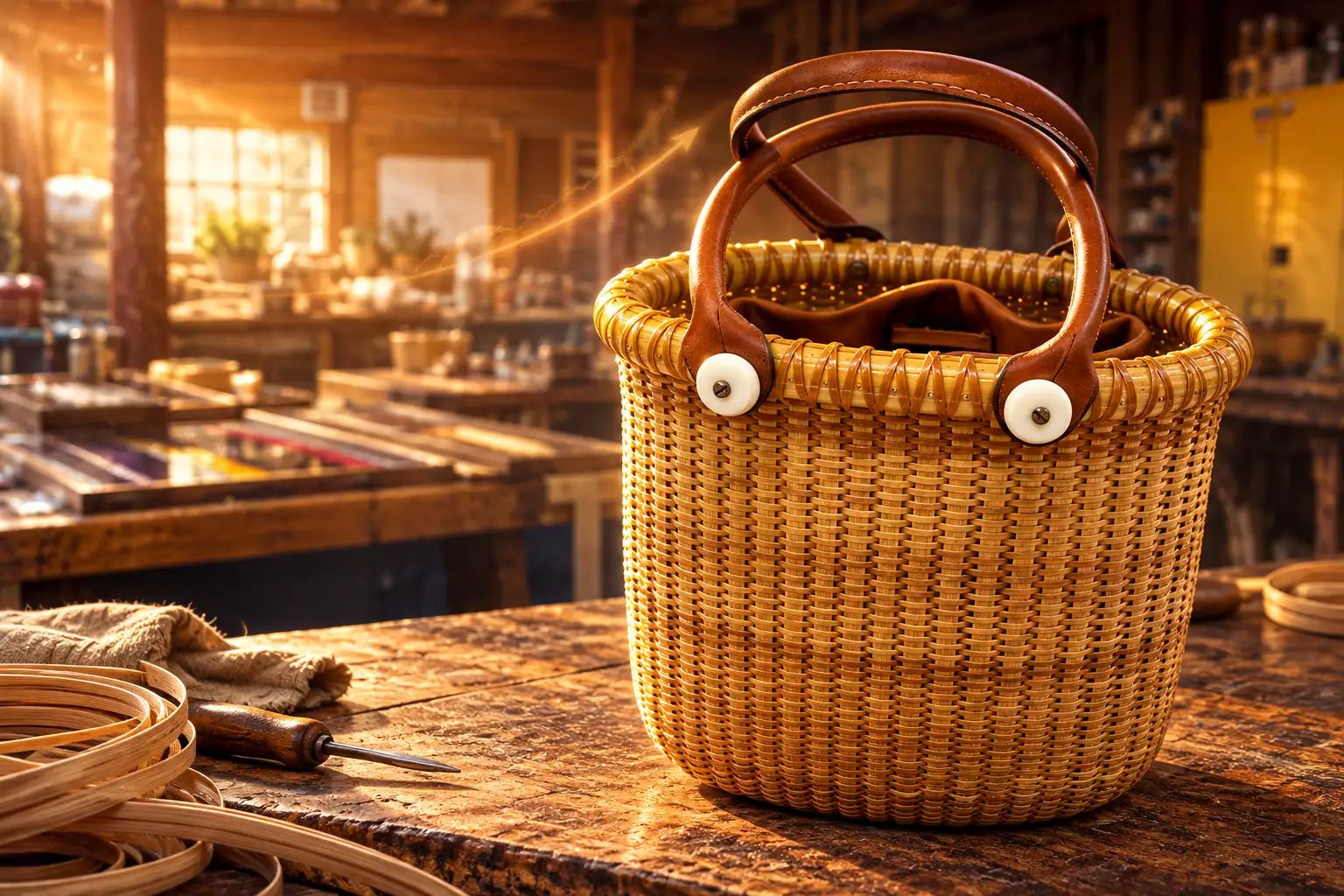
Sylvia currently represents three weavers, the youngest of whom is 75. “There’s probably only six or seven full-time basket makers on island,” he said. “And there’s only one under the age of 50.”
A year earlier he put the tighter circle, people who make their own molds and steam their own handles, at less than a dozen on Nantucket, with perhaps one under 60. Hobby classes are another country. Mary Lacoursiere, artistic director of the Nantucket Historical Association’s Heritage Craft program, has watched those classes sell out year-round while the payroll for the craft shrinks.
If the US had a Red List, I feel Nantucket baskets would be on it.
Mary Lacoursiere, artistic director, Nantucket Historical Association Heritage Craft
Years ago, she said, many Nantucket makers earned a living from waiting lists. Now only a few still do. The UK already keeps such a list. Heritage Crafts, in its 2025 Red List, added rattan furniture making as critically endangered, a cousin skill in the same cane-and-rattan family, among 12 crafts at serious risk of dying out in the next generation.
The boom on Main Street does not refill that bench. It just books the remaining hands further out.
What a True Basketmaker Still Builds by Hand
An authentic Nantucket basket, the historical association says, is woven on a mold with rattan staves, cane weavers, and a solid wood base. Plenty of people can assemble a kit on a borrowed mold. Sylvia splits those assemblers from basketmakers, the ones who cut their own molds, steam and shape the handle, and work every part.
Four Winds sells both, at different prices, but Sylvia said he only sells friendship baskets by true Nantucket basketmakers. Larry Brewster, who is making lightship baskets since 1983 and is a founding member of the Nantucket Lightship Basket Museum, is one of the names on Wegner’s and Lowe’s orders. He learned open baskets first, then handbags from Reggie Reed, and still talks about how much time the work eats.
WHAT A BASKETMAKER STILL BUILDS
- The mold: True makers design and cut their own, rather than weaving on a shop kit.
- The handle: Wood is steamed and bent by hand, then fitted to the rim.
- The body: Rattan staves and cane weavers go on over a solid wood base.
- The lid: A friendship basket gets a vaulted cover, a peg latch, and often a carved whale, seagull, or shell.
At The Basket Shop, a weaver who has done this as a sole job since 1989 prints the same warning in plainer numbers. Handbags start at $875 per inch, measured on the long side of the mold, and the current lead time is about 2 years. Repairs for normal wear are free for the original owner. A gift letter on photo stock stands in until the basket exists.
José Reyes Added a Lid After the War
Sailors on the South Shoal Lightship were weaving rattan baskets by the 1850s as extra pay. Harry Platt wrote in 1894 that every man aboard had become an expert, and that island stores sold about 500 of those baskets each summer for the crew. The government later banned the shipboard work, sometime before 1916, to stop the moonlighting. The craft moved ashore and kept the name.
José Formoso Reyes, born Sept. 15, 1902, in Santa Maria, Ilocos Sur, in the Philippines, is the person who turned that open basket into the purse now selling as fashion. He held a B.A. from Reed College and an M.Ed. from Harvard, headed languages at the Philippine Military Academy, and left the U.S. Army as a captain with citizenship in 1947. That summer his mother-in-law brought the family to Nantucket. They stayed.
He could not get a teaching job, which the historical association attributes to discrimination, so he painted houses and repaired cane chairs. Mitchell Ray, grandson of lightship captain Charles Ray, showed him the island weave and lent molds. In summer 1948 Reyes added a lid and a single wooden handle and called the result a friendship basket. Charlie Sayle and his wife suggested an ivory whale or seagull on top. From then until he retired in 1978, the association says, Reyes made over 5,000 baskets. He died at home on Dec. 24, 1980.
FROM THE SOUTH SHOAL TO THE LID
- 1850s: Crews on the South Shoal Lightship weave rattan baskets for extra money.
- 1894: Harry Platt writes that island stores sell about 500 lightship baskets a summer for the crew.
- Before 1916: The government bans shipboard weaving, and the craft moves fully ashore.
- Summer 1948: Reyes adds a lid and handle and names the purse a friendship basket.
- 1978: Reyes retires after more than 5,000 baskets.
- This summer: Search interest jumps while full-time makers on island number six or seven.
Paul Whitten, in Nantucket Baskets, told the story that stuck to the name: a Nantucket woman in Paris spotted another Reyes bag across the street and shouted “Nantucket!” The two became friends. The shout still works. It just costs more, and it takes longer.
$4,000 to $7,500 for a Reyes Basket
About 5,000 Reyes pieces are thought to survive, and they sell for about $4,000 to $7,500 on the secondhand market. Vintage friendship baskets in general tend to start around $4,000. Even factory copies have moved. Barlow sold mass-made versions in the 1970s through the 1990s for about $100 to $200. Stephen Turner, fourth-generation owner of Briggs Auction in Garnet Valley, Pa., recently sold a Barlow basket for $1,700, not including fees.
WHAT A BASKET COSTS RIGHT NOW
| Piece | Typical price | Wait or status |
|---|---|---|
| New friendship basket at Four Winds | From about $2,250 | Six to 18 months |
| Wegner’s eight-inch order | $2,650, plus about $1,000 for the lid | Six to eight months |
| Custom handbag at The Basket Shop | From $875 per inch | About 2 years |
| Vintage friendship basket | $4,000 and up | Ready if you find one |
| José Reyes, secondhand | About $4,000 to $7,500 | Ready if you find one |
| 1970s-90s Barlow copy | $1,700 at Briggs Auction | Sold |
Knockoffs from overseas still turn up cheap, often with plastic where ivory or bone should be. Ali Mahon, a Connecticut dealer who grew up around Reyes baskets, tells clients to look for a maker’s signature and to learn the name. The price gap between a kit weave and a named basketmaker is the labor that cannot be rushed.
A Badge of Belonging, Bought Off-Island
Nantucket holds about 15,000 people in the quiet months and as many as 80,000 in summer. Michael R. Harrison, chief curator of the Nantucket Historical Association, said the island is now covered in purse baskets, “and that’s when it starts becoming this badge of belonging.” His example was blunt: a legitimate Nantucket summer woman, because she has one.
So what happens when the buyer lives “off-island,” as locals put it, and still wants the badge? Connie Anne Harris, a collector and former Vogue executive, has been buying since 1997, when she got her first from Alan Reed, a master weaver on Nantucket. She is unbothered by new money in the line. “The basket has a legacy and that’s one of the reasons why it’s not like any other bag in the world,” she said.
Alexis Hardy Greene, 30, a content creator from Pinehurst, N.C., owns two and already plans to pass them to her daughter, born in April. “People who are sourcing these bags genuinely care about having something that will last a lifetime and can be passed down for generations,” she said. Nell Diamond, chief executive of Hill House Home, who spent summers on the island, got her first from an auction at 16 and later bought one for the birth of each of her three children.
Wren Alaia, the Connecticut Luxury creator who has visited for decades, said her basket videos outperform the rest of her feed. A TikTok from last month at the Baskets, Bubbles & Bourbon fund-raiser for the historical association drew more than 350,000 views. Alaia’s own read is that people want craft and scarcity, and less heavy branding.
That hunger has a nasty side in a small shop. Earlier this summer Sylvia put up a wood sign that read “No Influencers,” after groups walked in with cameras, clogged the floor, and treated the shelves as a set. “A lot of people are tired of feeling like extras in someone else’s video,” he said. “Like, f-ing talk to me.” He also said he does not hate the people with phones, and called the sign tongue-in-cheek. The public argument over who belongs never really moved to X. It stayed in the doorway, between clerks who know the weaves and visitors who want the picture.
Sylvia has watched the clientele get younger, and he has watched the motive shift. Friendship baskets were long given to island girls at graduation. Many new buyers, he said, want a fashion object and skip the history. The object still takes a year. The story on the lid still starts with a Filipino teacher who could not get hired, and with sailors killing time on a lightship.
Why Nantucket Baskets Would Make a Red List
Lacoursiere’s point is the one the sales chart hides. A craft can have packed weekend rooms and still be in trouble if almost no one can live on it. The association’s Heritage Craft program, based at the 1800 House on Mill Street, now runs more than 100 workshops. Forty were already sold out when she described the calendar in May. Basket weaving is open to students as young as 10. Off-season seats are filling with year-round residents, and grant money may lower the price for locals.
WHAT THE CLASSES CAN AND CANNOT DO
- Volume: More than 100 Heritage Craft workshops this year, with 40 sold out by May.
- The teacher: Master basketmaker Kathleen Myers leads the lightship basket sessions.
- The ship: Myers will teach a three-day weave this September aboard Lightship LV-112 in Boston Harbor.
- The kit: An online start-to-finish Nantucket lightship basket course with Myers is in the pipeline, because no such class existed.
The Basket Shop’s weaver has taught private and group classes for 20 years and puts the student count at well over 2,000. That is a lot of first baskets. It is not a farm system for six or seven full-time jobs. Niles Parker, the association’s Gosnell executive director, said the instructors have been stewards for years and that the work now needs a wider audience if the forms are going to last.
Lacoursiere, asked whether the handmade surge would fade, said “Lasting.” She tied that to skills that cannot be automated. This September, Myers will still take a small group onto LV-112 and weave where crews once passed the hours, while new orders on Main Street sit in a queue measured in seasons.


Maharashtra Grants Nana Patekar a State Funeral at His Farm

Nifty Tests 22,600 as Banks Carry a Fragile Rebound

India’s 13.3 Crore Voter Cut Lands on the Election Commission

Reflection Bets $25 Billion on Beam’s Cheaper Open Weights

India Finishes Fourth Again, 21 Medals Short of Hangzhou

Generation Lab’s Secret Youth Shot Has a Copycat Problem

Tesla Raises Dual Motor Prices as Texas Builds Cybercabs

The Nantucket Friendship Basket Boom Meets a Maker Shortage

Bristol Myers Quits Cellares as Autoimmune Doses Proceed

Okta Stock Jumps 20% on McKinnon’s Identity Bet
-
 NEWS2 months ago
Generation Lab’s Secret Youth Shot Has a Copycat Problem
-
 AUTO2 months ago
Tesla Raises Dual Motor Prices as Texas Builds Cybercabs
-
 BUSINESS2 months ago
Bristol Myers Quits Cellares as Autoimmune Doses Proceed
-
 NEWS2 months ago
Okta Stock Jumps 20% on McKinnon’s Identity Bet
-

 BUSINESS2 months ago
Poland Closes Visa-Free Work for Three Fast-Growing Nationalities
-
 LIFESTYLE2 months ago
Labor Day Mattress Sales Repeat a Familiar Holiday Discount
-

 NEWS2 months ago
Google Ends EU Spam Demotions but Keeps the Ranking Split
-

 BUSINESS2 months ago
Taco Bell’s 120-Milligram Cups Chase Afternoon Traffic