
NEWS
Rest Without Surgery Leaves Ohtani’s Two-Way Puzzle Intact
Shohei Ohtani needs rest, not surgery, yet the Dodgers still have no plan for a 32-year-old two-way season after his July shutdown.

Shohei Ohtani will not need surgery on his left knee or right biceps, and the Dodgers expect him to pitch in 2027. President of baseball operations Andrew Friedman said Wednesday that doctors prescribed rest, and that Ohtani will train as a two-way player when he starts getting ready.
That rest is real medical news. It is also a bet on the same body that threw its last pitch on July 3 and then spent October looking like a diminished version of the four-time MVP Los Angeles built its lineup around.
Will Ohtani Pitch in 2027?
Friedman did not hedge the mound question. “I fully expect him to pitch next year,” he said at Dodger Stadium, and he went further: the club is excited about it, not merely willing. When Ohtani begins his work for 2027, it will be as a hitter and a starter, not as a designated hitter waiting on another elbow reconstruction.
What that two-way season looks like is still blank. Friedman said the staff has not settled on a later first start, extra off days, or some mix of both. He also said there is no other two-way career to copy at this age, so the club and the player have to invent the plan together.
Ohtani is signed through 2033. Trading him if he insists on pitching, a line that circulated in Los Angeles on Wednesday, is not a roster tool the Dodgers actually have. The tool they do have is how they use him from spring through October, and they just spent a year showing they have not solved that.
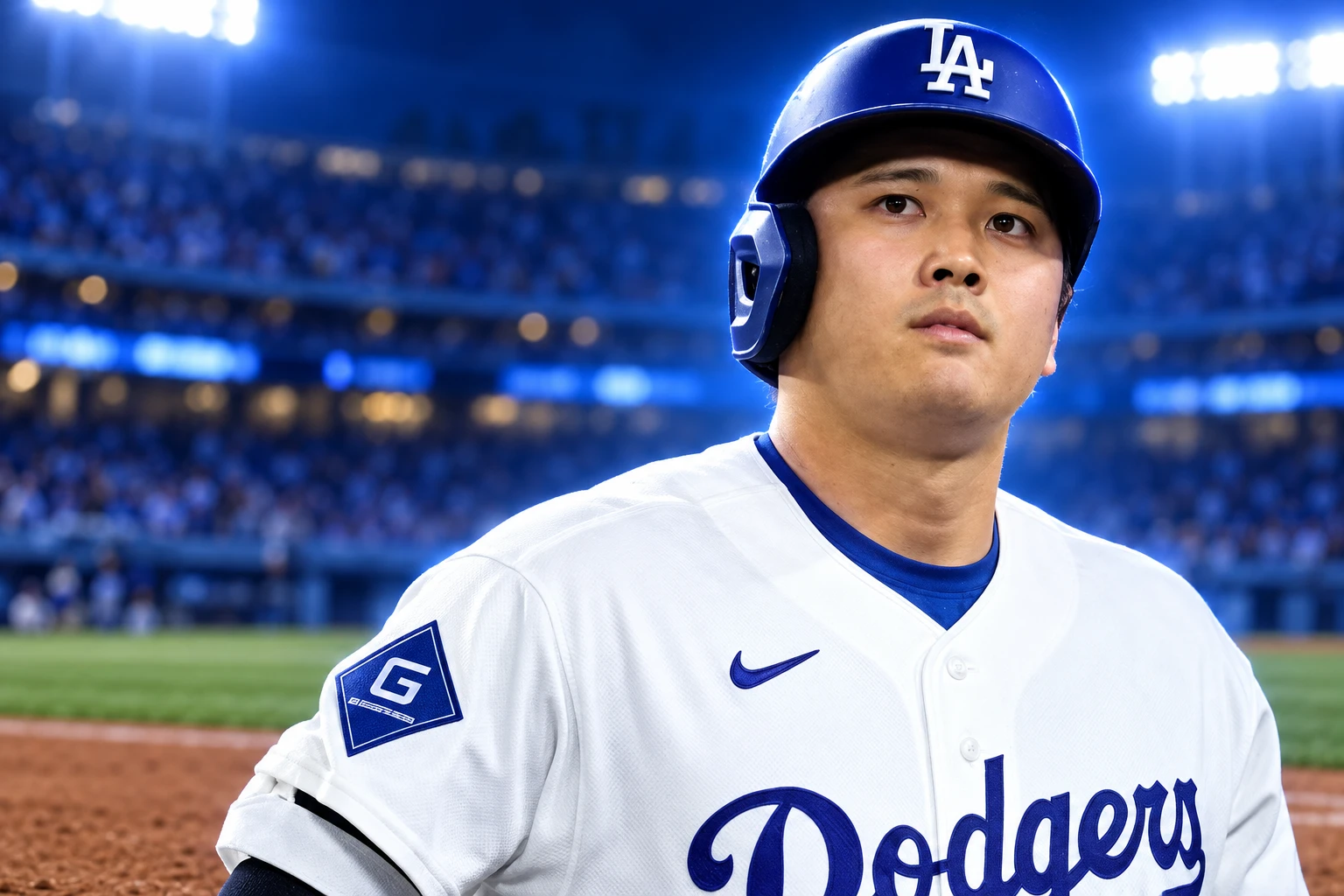
Rest Leaves the Same Left Knee in Place
Friedman described the second half as an unfortunate game of whack-a-mole. The knee would settle, then the biceps area would flare, then something that had quieted would get irritated again. Several problems were in play at once, he said, and rest is the treatment on the table rather than an operation.
Knee was bothering him off and on. It was just a little bit of an unfortunate game of whack-a-mole. The knee got to a better spot, and then just kind of the bicep area was bothering him. Just a number of different things. Some of it that would calm down for some period, some that would get re-irritated.
Andrew Friedman, Dodgers president of baseball operations, Oct. 21 press conference at Dodger Stadium
That left knee is not a new character. On Sept. 13, 2019, Ohtani had season-ending surgery for a bipartite patella, a congenital two-part kneecap that had started to bother him as he ramped up throwing after his first Tommy John operation. Dr. Neal ElAttrache and Dr. Brian Schulz performed the procedure. Ohtani said then that running and hitting were mostly fine, and that the pain showed up when he tried to throw off a mound.
The 2026 version followed the same split. He stayed in the batting order for months while the pitching work stopped. Manager Dave Roberts told reporters in July that the lower half was compromising the upper half, which is why the club shut down bullpens rather than let him create velocity with an arm that was not right. A lubricating Orthovisc injection around the All-Star break did not put him back in the rotation.
Rest can calm irritation. It does not fuse a kneecap that was already operated on, and it does not install a new biceps tendon. The 2027 two-way plan starts from that fact.
How the Two-Way Season Came Apart
Ohtani was attempting his first full-time two-way season in three years, after a 2025 return that was built as a ramp, not a regular turn. In 2025 he debuted on June 16, threw 47 innings over 14 starts with a 2.87 ERA, and often worked with six or more days between outings. In 2026 he threw 85.2 innings, nearly twice that load, and he was done as a pitcher before the All-Star break.
The dated file of Ohtani’s 2026 injuries shows how long Los Angeles waited to treat him like a player who was actually hurt.
THE 2026 INJURY FILE
- June 11, 2026: Exits with left knee inflammation the night after a start in Pittsburgh. The club first ties it to a stolen-base attempt; Ohtani later says his pitching mechanics may have been the cause.
- July 3, 2026: Makes his last start, 6 innings and 9 strikeouts on 110 pitches against San Diego, then comes out of the game as a hitter with right biceps tightness. Through 10 starts he had a 0.74 ERA; the last four, all with the knee issue, land at 4.38.
- July 19, 2026: Comes out of the rotation for good after the club scratches his final first-half start and then scraps a post-break return when the Orthovisc shot does not settle the knee.
- July 25, 2026: Shuts down throwing after a Philadelphia bullpen fails to bounce back, with both the knee and the biceps unresponsive.
- Aug. 8 to Aug. 23, 2026: Restarts catch, throws a bullpen, and faces hitters, while his bat drops to.205 with a.666 OPS over his final 29 regular-season games.
- Aug. 28, 2026: Another bullpen goes badly enough that a hoped-for inning on Aug. 30 is pulled off the table.
- Sept. 3 to Sept. 11, 2026: Misses a stretch of games, tells the club he will hit only, then finally goes on the 15-day injured list. Roberts later says, with hindsight, he would have preferred the IL move earlier. Ohtani gets five regular-season games after the stint to face big-league pitching before October.
General manager Brandon Gomes had said on Sept. 3 that putting Ohtani on the IL had not even been discussed. By then the two-way season was already over. The hitter still had a month of regular-season at-bats left, and those at-bats got worse.
The Bat Went Quiet After Aug. 18
On Aug. 18, Ohtani still looked like an MVP candidate, slashing.294/.390/.558 with 30 home runs and 7 stolen bases. He did not hit another homer in the regular season. His last 70 at-bats produced 11 hits and 29 strikeouts. In the first seven postseason games he went 4-for-22 with no extra-base hits, before a three-run homer in Game 4 of the National League Championship Series snapped a 25-game drought. Across eight playoff games he hit.192 with 1 homer, 3 RBI, and a.631 OPS.
Ohtani’s 2026 batting line still looks strong on a normal star’s scale and small on his. The three-year drop is the point of the table, not a midseason snapshot.
OHTANI’S THREE DODGERS SEASONS
| Season | G | AVG/OBP/SLG | HR | Pitching |
|---|---|---|---|---|
| 2024 | 159 | .310/.390/.646 | 54 | Did not pitch (elbow rehab) |
| 2025 | 158 | .282/.392/.622 | 55 | 14 starts, 47 IP, 2.87 ERA |
| 2026 | 135 | .275/.377/.512 | 30 | 14 starts, 85.2 IP, 1.79 ERA |
The 30 homers were his fewest in a full season since 2019. Combined WAR fell to 6.5 after 9.0 in 2024 and 6.6 in 2025. Friedman said the offensive slide “certainly had an impact” on the early exit, then noted the whole lineup slumped, posting a.590 OPS in the postseason and going 4-for-27 with runners in scoring position in the NLCS. Milwaukee swept the series. The last game was a 6-4 loss on Oct. 15.
Speaking after that game, Ohtani said he was not quite satisfied with how the pitching side shaped up, and that he had not come to grips with what the season taught him.
It’s something that I’m going to go back to the drawing board in terms of treatment, training programs and see what I can come up with for next season.
Shohei Ohtani, through interpreter Will Ireton, Oct. 15 at Dodger Stadium
Friedman Has No One to Copy
Asked whether the Dodgers could have managed the two-way role differently so Ohtani arrived in October in a better spot, Friedman said he did not know. The injuries started in early July, he noted, and through mid-August Ohtani was still, in his view, the consensus MVP. That is a true description of the first half, and it is also how a club talks itself into leaving a star in the lineup while the arm and the knee argue.
After Ohtani came off the IL, Friedman praised the back-and-forth with the player and then drew a line under it. “The fully sharing exactly how he’s feeling, maybe not as awesome,” he said. Several people in the organization believe a 2027 two-way season only works if Ohtani is more forthcoming when something hurts. Friedman said the club still has not figured out how much autonomy the player will have over that process.
He called the whole arrangement unprecedented, with no other case to study for the good and the bad. In 2025, general manager Brandon Gomes used the same idea when Ohtani first returned to the mound: there is no playbook, so the player has to drive the conversation. A year later the conversation still failed to get him on the IL until Sept. 11, and it still failed to get him a postseason bat that looked like May.
Roberts’s coaching staff will return. Friedman called the relationship with owner Mark Walter “business as usual” after a conversation in which Walter, who is under federal investigation over alleged self-dealing, asked what the club’s plans were for 2027. The plan at the top of that list is Ohtani, specifically how to get innings from him without another August collapse in the box.
Nine Months Without Rushing, and Skubal on the Market
The two-way puzzle does not sit on an empty winter. Catcher Dalton Rushing had an internal brace procedure on his right elbow on Wednesday and is expected to miss about nine months, which keeps him from catching until July 2027, though hitting can return sooner. Right-hander Will Klein had a bone chip removed and a spur cleaned up and is expected to be ready for spring training.
Los Angeles Dodgers catcher Dalton Rushing and RHP Will Klein had elbow procedures this afternoon. Rushing’s internal brace procedure will sideline him approximately nine months, while Klein’s bone chip removal and spur cleanup will have him ready for Spring Training.
— Los Angeles Dodgers (@Dodgers) October 22, 2026
Because Ohtani occupies the designated hitter spot on days he does not pitch, Rushing would not have had an easy path to at-bats even if the elbow were sound. With him out until midseason, the catching job and the depth behind it become a live roster problem rather than a development one.
THE WINTER AROUND HIM
- The ace: Tarik Skubal, the deadline pickup who posted a 2.61 ERA in 10 Dodgers starts, hits free agency as the best pitcher on the market after a 12-7 season, 2.72 ERA, 158.2 innings, and 186 strikeouts.
- The bullpen: Alex Vesia and Evan Phillips are free agents, with Blake Treinen also heading out, so the relief group that covered for a two-way starter’s extra rest is not intact.
- The age of the lineup: Friedman said the Dodgers already knew they would have baseball’s oldest position group in 2026 and 2027, and that Milwaukee’s younger club exposed it in October.
- The next wave: Josue De Paula made his debut in September and made the postseason roster, but Gomes said the outfielder still has to become a full defender before he is an everyday answer.
Friedman would not commit to bringing Skubal back, praising how the left-hander handled a midseason trade and then wishing him nothing but the best. Skubal, who turns 30 in the 2027 season, is expected to beat the $325 million pitcher record set by Yoshinobu Yamamoto. Blake Snell said he wants him in the room. The rotation behind him still includes Yamamoto, Snell, Tyler Glasnow, and Roki Sasaki, which is exactly the depth that should have made it easier to give Ohtani a lighter turn in 2026 and did not.
Later Starts and More Off Days
The mechanical options are not mysterious. Friedman listed them: start Ohtani’s pitching season later, put more days between his starts, or do both. Los Angeles already used extra rest in 2025, when six-plus days between outings and a June debut got him to October on the mound. The 2026 choice was to let him work like a regular starter into early July, 85.2 innings at a 1.79 ERA, and then spend the next three months chasing a knee and a biceps that would not stay quiet.
Extra rest is the compromise that still lets him pitch. It is also how you admit that a 32-year-old two-way season cannot be the 2021 or 2023 version, when he threw 130.1 and 132 innings for the Angels and hit 46 and 44 homers in those years. The 2026 regular season ended with 30 homers, 11 steals, and zero innings after July 3. Copying 2025’s lighter build, rather than 2023’s full starter’s load, is the only version of this experiment the last two years have actually supported.
Friedman said the value of the two-way work is incredible, which is why the club has to be deliberate on all sides about how it is done. Deliberate, in 2026, still meant a quality start on July 3, a delayed injured list, and a postseason bat that needed a Game 4 homer to look like itself. Rest over the winter can make the knee and the biceps feel better in February. It does not, on its own, write the calendar that keeps both jobs alive into October.

John Mayer Bets Sob Rock Can Be a Record Label

H1N1 Rises Early After Last Winter’s H3N2 Wave

Human Fires Drive Amazon Carbon Emissions Even Without Drought

Charli XCX Secretly Films a Cameo in Scorsese’s Horror

Santos’s 58-Yard Kick Decides the Williams-Maye Rematch

Generation Lab’s Secret Youth Shot Has a Copycat Problem

Tesla Raises Dual Motor Prices as Texas Builds Cybercabs

The Nantucket Friendship Basket Boom Meets a Maker Shortage

Bristol Myers Quits Cellares as Autoimmune Doses Proceed

Okta Stock Jumps 20% on McKinnon’s Identity Bet
-
 NEWS2 months ago
Generation Lab’s Secret Youth Shot Has a Copycat Problem
-
 AUTO2 months ago
Tesla Raises Dual Motor Prices as Texas Builds Cybercabs
-
 LIFESTYLE2 months ago
The Nantucket Friendship Basket Boom Meets a Maker Shortage
-
 NEWS2 months ago
Okta Stock Jumps 20% on McKinnon’s Identity Bet
-
 BUSINESS2 months ago
Bristol Myers Quits Cellares as Autoimmune Doses Proceed
-

 BUSINESS2 months ago
Poland Closes Visa-Free Work for Three Fast-Growing Nationalities
-

 LIFESTYLE2 months ago
Labor Day Mattress Sales Repeat a Familiar Holiday Discount
-
 NEWS2 months ago
Ox Alpha Was a Chinese Chip Stress Test All Along