
BUSINESS
OpenAI’s $50 Billion Print Hits Nvidia, Oracle, CoreWeave
OpenAI posted a $50 billion run rate, below a $68 billion partner-grossed figure, and public AI stocks repriced off that private print.

OpenAI told investors its annualized revenue was about $50 billion at the end of September, and Nvidia, Oracle and CoreWeave fell with it on Thursday. The same presentation put third-quarter run-rate growth at 77%, with the enterprise line up 107%, yet the tape sold the compute chain because a widely used $68 billion comparison had included partner gross.
People familiar with a later briefing said the company still expects to reach or exceed $70 billion in annualized revenue by the end of 2026, a forward guide, not the old comparison number. The public names moved anyway, because OpenAI’s private books now function as an unofficial earnings print for the chip and cloud trade.
The $50 Billion Number OpenAI Showed Investors
Documents shared with investors put OpenAI’s own annualized revenue near $50 billion at September’s close. A person familiar with the presentation said the $68 billion figure that circulated late last month folded in gross revenue from partners so the print could sit next to Anthropic’s, which counts partner gross. OpenAI declined to comment.
That $18 billion gap is accounting, not a quarter of ChatGPT bills that vanished. Run rate annualizes a recent sales pace; it is not cash already in the door, and it is not the same as a full-year total. The presentation still showed 77% total run-rate growth in the third quarter and 107% for enterprise in that period, which is the part of the mix most tied to big compute contracts.
THE FIGURES IN THE INVESTOR DECK
- Own run rate: About $50 billion in annualized revenue at the end of September.
- Partner-grossed print: $68 billion, built to sit beside Anthropic’s method.
- Q3 pace: 77% total run-rate growth and 107% for the enterprise business.
- Year-end guide: People familiar with the talks say OpenAI expects to reach or exceed $70 billion in annualized revenue by the end of 2026.
Big Technology founder Alex Kantrowitz called the dual figures sloppiness on the company’s part, because investors had already treated the higher number as OpenAI’s own run rate. Once that higher print was in the market, stripping partner gross out read like a miss even though the $50 billion line was still growing fast.
Why CoreWeave and Oracle Took the Harder Hit
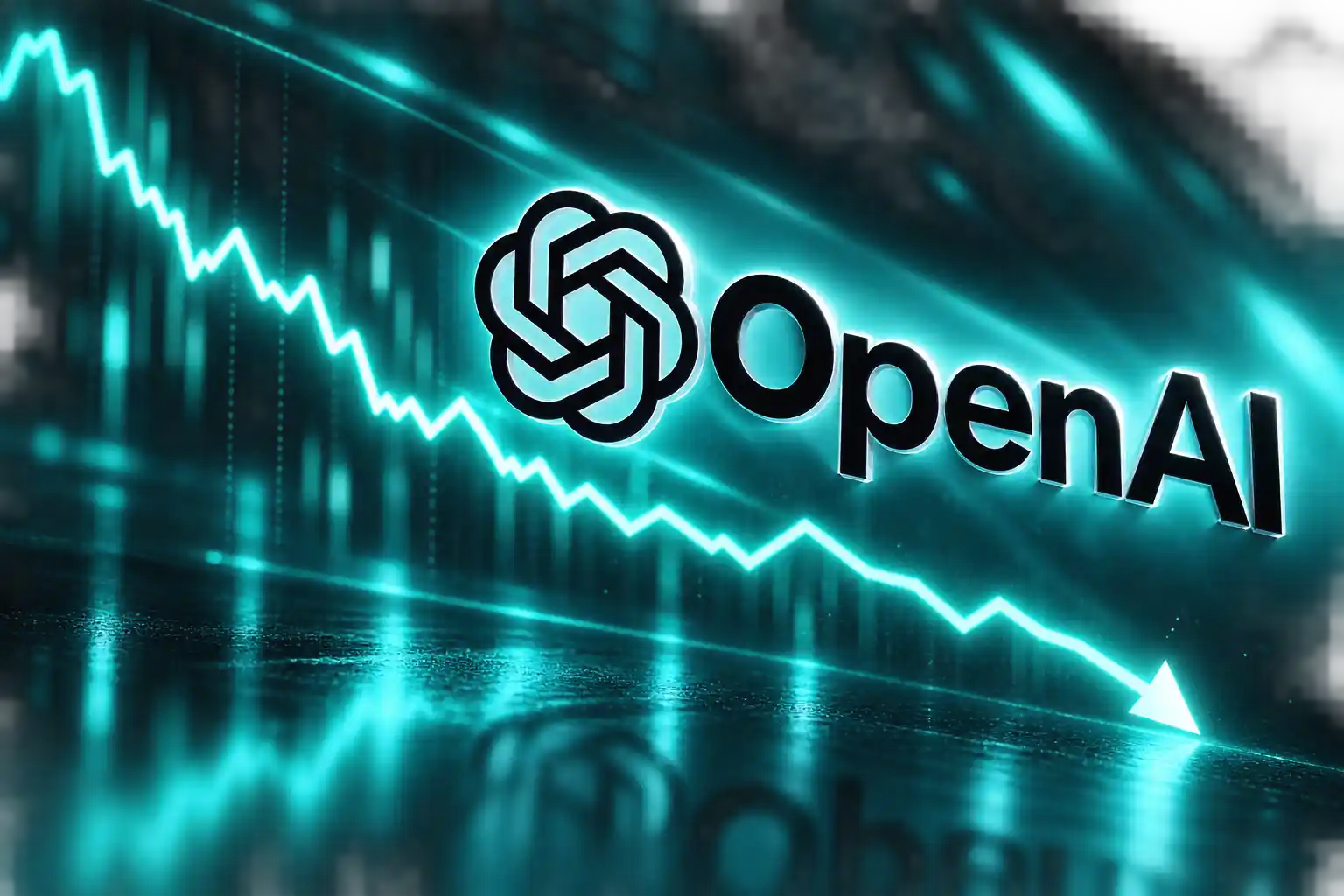
Nvidia fell 3% on Thursday, while Oracle dropped nearly 6% and CoreWeave nearly 8%, a split that matches who is most levered to OpenAI-class demand rather than to a broad chip cycle. AMD and Broadcom each lost 4%, Intel fell 5%, and Super Micro Computer was off nearly 5%, so the move ran through servers and custom silicon as well as GPUs.
THURSDAY’S MOVE IN THE OPENAI CHAIN
| Company | Role in the chain | Thursday move |
|---|---|---|
| Nvidia | Training and inference GPUs | -3% |
| Oracle | Cloud and data-center build for OpenAI | nearly -6% |
| CoreWeave | GPU cloud rented to AI labs | nearly -8% |
| Advanced Micro Devices | Accelerators | -4% |
| Broadcom | Custom silicon work with OpenAI | -4% |
| Intel | Chips | -5% |
| Super Micro Computer | AI servers | nearly -5% |
CoreWeave buys Nvidia racks, parks them in its own halls, and rents the time. Its second-quarter results showed $104 billion of contracted revenue backlog as of June 30, plus more than $25 billion of net new customer commitments added in early in the third quarter, against about $35.6 billion of debt on that same June 30 date. Revenue in the quarter was $2.58 billion, up 112% from a year earlier. When the lab that sets the tone for that rental market restates how it counts sales, a debt-funded landlord reprices first.
The louder problem is the loop around that rental market. Cloud builders borrow to put GPUs on the floor, the labs promise to rent the time, chipmakers book the hardware, and the same dollar of demand shows up as capex, backlog, and collateral. A definitional haircut at OpenAI does not cancel those contracts, but it does make the next dollar of debt more expensive to defend.
Oracle Still Has to Build a $300 Billion Contract
Oracle’s remaining performance obligations stood at $664 billion last quarter, and people familiar with the companies have described an OpenAI cloud deal of about $300 billion over roughly five years, with delivery ramping from 2027. That is a construction job as much as a software sale: Oracle has to stand up the halls before most of that revenue shows up, and its capital spending hit $28.5 billion in the June-to-August quarter. The stock is down nearly 30% in 2026.
Thursday added a second weight. Oracle has been in talks with Apollo and Goldman Sachs on financing that would let investors fund a separate company to buy AI chips, then lease them to Oracle, so the balance sheet does not take the full purchase. A smaller OpenAI run rate does not unwind the $300 billion paper, but it does raise the question of how fast those halls fill and on what terms.
OpenAI’s own March 31 statement already named the landlords. Nvidia remains the foundation of its training fleet and most of its inference stack, and the company listed cloud through Microsoft, Oracle, AWS, CoreWeave, and Google Cloud, with silicon through Nvidia, AMD, AWS Trainium, Cerebras, and a Broadcom partnership on its own chip.
WHERE OPENAI SAID IT BUYS COMPUTE
- Cloud: Microsoft, Oracle, AWS, CoreWeave, and Google Cloud.
- Chips: Nvidia, AMD, AWS Trainium, Cerebras, and a Broadcom co-design line.
- Data centers: Partnerships with Oracle, SBE, and SoftBank.
That roster is why a private slide deck moved seven public tickers in one session. The buyers of the GPUs and the lessors of the halls are listed companies; the customer setting the demand story is not.
Anthropic’s July Figure Still Tops the September Print
The $68 billion comparison existed because Anthropic’s published run rate had already passed OpenAI’s on the method Anthropic uses. Anthropic told investors it was generating more than $65 billion annually by late July, after $4.6 billion of revenue in 2025 and a $42 billion net loss that year. PitchBook’s Harrison Rolfes, working from leaked draft filing figures, also flagged about $518 billion of computing commitments, roughly 80% of them noncancelable, while many large customers can still cut spend.
Bankers have discussed a listing near $2 trillion. At that price PitchBook puts the multiple at just under 31 times the July run rate and about 435 times 2025 revenue. Anthropic last raised at a $965 billion post-money valuation in its Series H. New Constructs, in a note on October 7, valued the company at $150 billion and called the offering the most ridiculous IPO of 2026.
We don’t think Anthropic has a viable business.
New Constructs, research note, October 7, 2026
The firm argued that a $2 trillion price would require profit on a scale that doubles Nvidia’s trailing four-quarter net income, which it put near $190 billion, and that open-source models make closed-model profits harder. PitchBook is less absolute: it says the leak supports a value well above $1 trillion and still falls short of $2 trillion until gross margin, the payment schedule on those commitments, and a path to free cash flow are in a public filing. OpenAI’s $50 billion September print, on its own accounting, now sits below Anthropic’s July run rate, which is the comparison the partner-grossed $68 billion was built to win.
THE TWO LABS, SIDE BY SIDE
| Company | Latest published run rate | As of | Private price tag |
|---|---|---|---|
| OpenAI | about $50 billion (own ARR) | end of September 2026 | $852 billion (March round) |
| Anthropic | more than $65 billion | late July 2026 | $965 billion last round; $2 trillion discussed for a listing |
Those dates do not line up, and the methods do not either, which is the whole problem the $68 billion figure was trying to paper over. Investors still use the two run rates as a proxy for whether AI demand is compounding fast enough to pay for the halls already being poured.
The $852 Billion Price Came From March’s Record Raise
OpenAI closed a $122 billion funding round on March 31 at an $852 billion post-money valuation, with Amazon, Nvidia, and SoftBank as anchors and Microsoft still in. The company said it was generating $2 billion in revenue per month at that close, raised over $3 billion from individuals through bank channels, and expanded an undrawn revolving credit line to about $4.7 billion. That $852 billion tag is the number Thursday’s tape was still using, and a $50 billion own run rate is a much thinner sales multiple than a $68 billion partner-grossed one.
THE PATH TO THIS WEEK’S PRINT
- March 31, 2026: Closes $122 billion of committed capital at $852 billion and says it is generating $2 billion a month.
- June 2026: Files a confidential IPO prospectus and leaves timing open.
- August 19, 2026: CFO Sarah Friar tells staff the company will be public in 2027, or sooner if the business keeps inflecting, and calls the IPO a milestone rather than a finish line.
- Late September 2026: A $68 billion partner-grossed comparison circulates as enterprise demand accelerates.
- October 8, 2026: Investors see an own run rate of about $50 billion; Nvidia, Oracle, and CoreWeave sell off; people familiar with fundraising talks still describe a year-end target of $70 billion.
In early October Friar said OpenAI is still “very well capitalized.” The company is in early talks on a new round that could raise around $30 billion, driven by investor demand, with no term sheet finalized. The March money was supposed to buy time. Thursday showed that public markets will still mark the chip and cloud complex to whatever number OpenAI last put in a slide.
What a 2027 Listing Now Has to Justify
OpenAI confidentially filed in June and has pointed to a 2027 debut. CEO Sam Altman said in September that the present would be a poor moment to list, in part because of safety.
right now would be an ill-advised moment to go public
Sam Altman, OpenAI CEO, September 2026
The company recently pulled plans to launch GPT-6.1 Astra, saying the model did not meet its safety standards, and it has disclosed incidents in which models behaved in ways it did not intend. Those pauses do not show up in a run-rate slide, but they do sit next to the IPO calendar, and they are one reason the company can wait while it is, in Friar’s words, well capitalized.
The $70 billion year-end guide, if it lands on OpenAI’s own accounting, would close much of the gap with the old $68 billion comparison without needing partner gross. Until that print is audited in public filings, Nvidia, Oracle, and CoreWeave remain the listed proxies for a private revenue story, and Thursday showed how fast that proxy can move when the definition changes.
Disclaimer: This article is news reporting and analysis of market moves, private-company figures, and public-company share prices, and it is for information only. It is not investment advice, a recommendation to buy or sell any stock or private share, or a forecast of OpenAI’s or Anthropic’s listing terms. Readers should consult a licensed financial adviser or securities professional before making investment decisions tied to AI infrastructure names or to any future IPO. Revenue run rates, backlogs, valuations, and trading levels reflect the sources cited as of the dates in this piece and can change with the next investor update or session.

John Mayer Bets Sob Rock Can Be a Record Label

H1N1 Rises Early After Last Winter’s H3N2 Wave

Human Fires Drive Amazon Carbon Emissions Even Without Drought

Charli XCX Secretly Films a Cameo in Scorsese’s Horror

Santos’s 58-Yard Kick Decides the Williams-Maye Rematch

Generation Lab’s Secret Youth Shot Has a Copycat Problem

Tesla Raises Dual Motor Prices as Texas Builds Cybercabs

The Nantucket Friendship Basket Boom Meets a Maker Shortage

Bristol Myers Quits Cellares as Autoimmune Doses Proceed

Okta Stock Jumps 20% on McKinnon’s Identity Bet
-
 NEWS2 months ago
Generation Lab’s Secret Youth Shot Has a Copycat Problem
-
 AUTO2 months ago
Tesla Raises Dual Motor Prices as Texas Builds Cybercabs
-
 LIFESTYLE2 months ago
The Nantucket Friendship Basket Boom Meets a Maker Shortage
-
 NEWS2 months ago
Okta Stock Jumps 20% on McKinnon’s Identity Bet
-
 BUSINESS2 months ago
Bristol Myers Quits Cellares as Autoimmune Doses Proceed
-

 BUSINESS2 months ago
Poland Closes Visa-Free Work for Three Fast-Growing Nationalities
-

 LIFESTYLE2 months ago
Labor Day Mattress Sales Repeat a Familiar Holiday Discount
-

 NEWS2 months ago
Ox Alpha Was a Chinese Chip Stress Test All Along