
BUSINESS
Bristol Myers Quits Cellares as Autoimmune Doses Proceed
Bristol Myers ended its Cellares Cell Shuttle pact over commercial Breyanzi, even as autoimmune programs still use the machines.

Bristol Myers Squibb has ended a Cellares manufacturing pact worth up to $380 million after deciding the Cell Shuttle could not make commercial Breyanzi. Cellares strongly disagrees and is cutting 168 jobs as it resizes around other programs.
A company spokesperson said the finding is specific to Breyanzi and its already approved production process, not a blanket verdict on every Shuttle run.
Bristol Myers Says the Shuttle Missed Commercial Breyanzi
After what it called a comprehensive evaluation, Bristol Myers said the Cellares-partnered Cell Shuttle system could not meet the necessary requirements to make commercial Breyanzi. The blood-cancer CAR-T, whose generic name is lisocabtagene maraleucel, won U.S. approval in 2021 and is made through Bristol Myers’s own plants plus outside shops.
Cellares said by email that it strongly disagrees with that characterization of its system and that it does not discuss confidential program details. The same note said the Cell Shuttle has already manufactured GMP drug product in an FDA-regulated clinical program, with doses meeting all release specifications, delivered on time and administered to patients.
CEO and co-founder Fabian Gerlinghaus named no customer on LinkedIn on Aug. 21, 2026, when he first described the break. He still made the size of the hit plain.
A large pharmaceutical customer recently made the decision to end its partnership with Cellares. This was a decision specific to that customer. The loss of this partnership requires us to resize the company.
Fabian Gerlinghaus, CEO and co-founder, Cellares, on LinkedIn
He added that cell therapies made on the Cell Shuttle in an FDA-regulated setting in Q1 2026 were delivered on time, to specification, and given to patients. Bristol Myers’s later comment, tied only to commercial Breyanzi, sits next to that clinic record rather than erasing it.
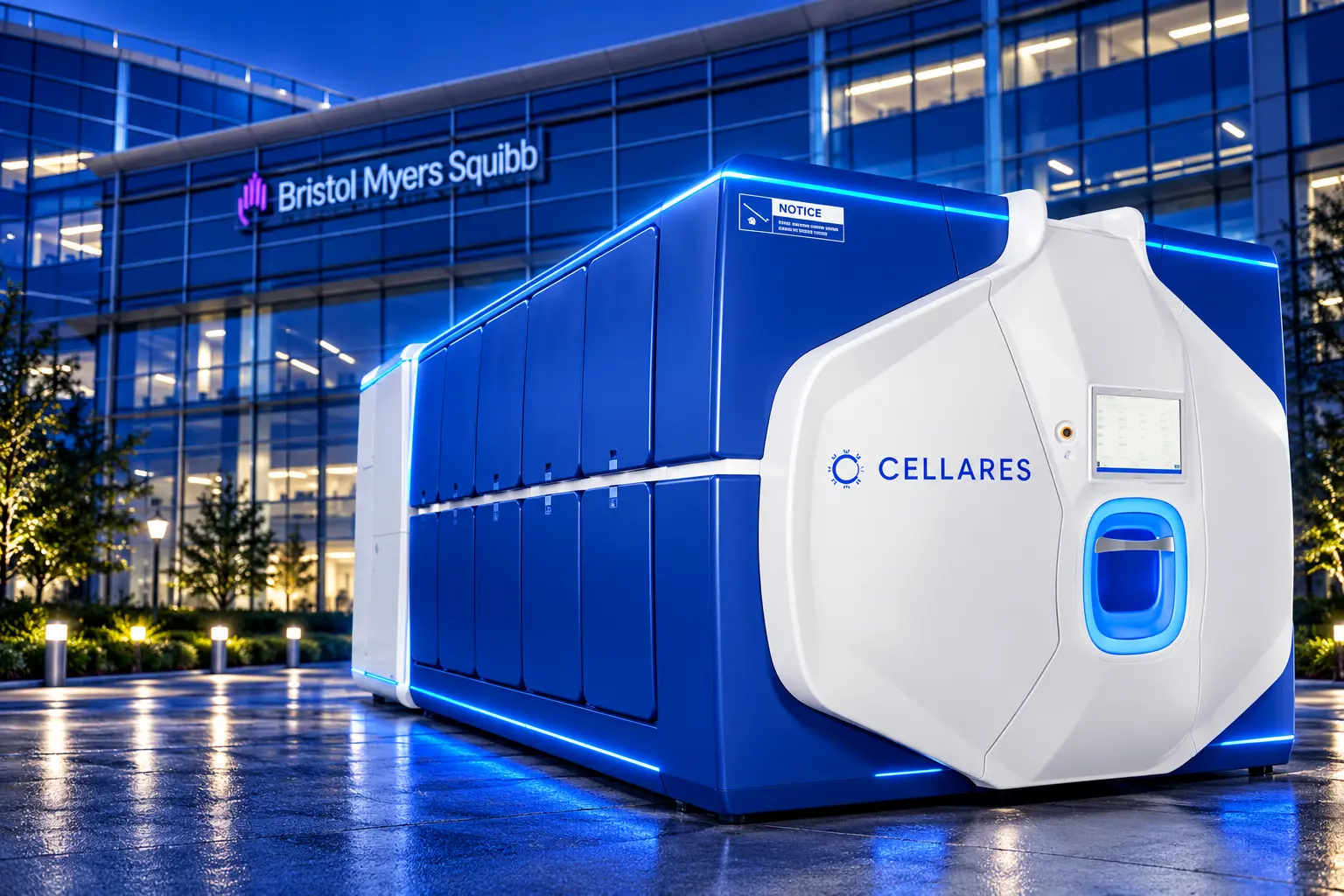
What the $380 Million Deal Reserved
On April 22, 2024, Bristol Myers and Cellares announced a worldwide capacity reservation and supply agreement valued at up to $380 million in milestone payments and upfront cash. Cellares would optimize, automate, and tech-transfer select Bristol Myers CAR-T therapies onto the Cell Shuttle, an end-to-end closed platform that runs as many as 16 batches at once, and would dedicate multiple Shuttles and Cell Q quality-control units for Bristol Myers’s exclusive use in the United States, the EU, and Japan.
Lynelle B. Hoch, then president of Bristol Myers’s Cell Therapy Organization, said the pact strengthened internal CAR-T plants by adding the first end-to-end fully automated manufacturing platform, with an eye on turnaround time. Gerlinghaus said it fit a plan to put high-throughput Smart Factories on a global grid. The reservation was layered on work that had already started a year earlier.
HOW THE BMS TIE-UP WAS BUILT
- August 2023: Bristol Myers joins Cellares’s Series C round, which the manufacturer put at $255 million, to help launch its first Smart Factory, and enters the Technology Adoption Partnership program to test the Shuttle on one CAR-T.
- October 2023: The TAP work expands to a second Bristol Myers CAR-T, with a six-month target to move a manual process onto the machine and produce comparability data.
- April 22, 2024: The $380 million capacity reservation locks exclusive Shuttle and Cell Q hardware across U.S., EU, and Japan plants for clinical and commercial-scale runs.
- January 28, 2026: Cellares closes a $257 million Series D that cites the Bristol Myers reservation as commercial-scale demand while it funds factories in South San Francisco, Bridgewater, N.J., Leiden, and Kashiwa City, Japan.
- August 2026: Bristol Myers ends the partnership; Gerlinghaus says a large customer walk forces a resize.
Cellares has long claimed a Smart Factory can turn out about 10 times as many batches as a conventional contract plant of similar size and staff. Its 118,000-square-foot Bridgewater site, a former Pfizer building at 95 Corporate Drive, was pitched at 40,000 batches a year. Those throughput claims were the point of the Bristol Myers reservation. They were not, in the end, enough to move commercial Breyanzi.
Cabaletta Already Infused Shuttle-Made Doses
The customer book did not empty. On April 28, 2026, Cellares and Cabaletta Bio, a Philadelphia autoimmune cell-therapy company, announced a 10-year commercial supply agreement for rese-cel, Cabaletta’s investigational CD19 CAR-T for autoimmune disease, pending FDA approval. Cabaletta’s securities filing also describes a clinical supply agreement signed in January that put rese-cel on the Shuttle for the RESET trials.
The companies spent more than three years adapting rese-cel, won FDA clearance of an IND amendment for Shuttle manufacturing, and then dosed patients. Steven Nichtberger, M.D., Cabaletta’s chief executive, tied that clinic work to a later commercial bet.
The first two doses of rese-cel manufactured on the Cell Shuttle met all release specifications and were delivered and infused on time to patients in the RESET clinical program, validating the automated manufacturing model and supply chain logistics we committed to in 2023.
Steven Nichtberger, M.D., Chief Executive Officer, Cabaletta Bio
Nichtberger said the 10-year pact gives Cabaletta a lower-cost base as it tries to reach thousands of patients a year with little extra capital spending of its own. Cabaletta has said it plans a biologics license application in myositis in 2027. That calendar still runs on Cellares hardware after Bristol Myers left.
The split is easy to miss if the story stops at one cancelled oncology contract. Rese-cel was written onto the Shuttle before pivotal commercial supply, with an FDA amendment in hand. Breyanzi arrived as a finished, already approved process that Bristol Myers did not want to reopen.
168 Jobs Come off the Factory Map
Gerlinghaus did not publish a headcount on LinkedIn. California and New Jersey filings did. A California WARN notice says Cellares will permanently cut about 100 South San Francisco roles on Oct. 20, 2026, with more than half of the names carrying “senior” in the title, spanning engineering, marketing, recruitment, and software, plus an alliance manager, a janitorial specialist, and the vice president of commercial operations.
A New Jersey labor archive posted in August lists 68 Bridgewater jobs effective Nov. 19, 2026. Together the two notices account for 168 people, the known total as of Sept. 1, 2026.
THE WARN CUTS BY SITE
| Site | Jobs posted | Effective date |
|---|---|---|
| South San Francisco (headquarters) | about 100 | Oct. 20, 2026 |
| Bridgewater, N.J. (Smart Factory) | 68 | Nov. 19, 2026 |
A Cellares spokesperson said the reduction is meant to concentrate people and money on clinical and commercial programs the company is still advancing, and that most teams hit were tied to immediate global expansion. Remaining customers, Gerlinghaus wrote, have restated their commitment, and several are talking about extra programs and a faster path to commercial manufacturing. A spokesperson also said Cellares has more than doubled the number of customers it serves since the start of 2026.
An Approved CAR-T Process Does Not Travel
Bristol Myers did not say the Shuttle failed every product. It said commercial Breyanzi, on the process regulators already blessed, was the miss. Cellares answers with clinic lots that met specs. Those two claims can both stand.
WHERE THE TWO SIDES SPLIT
- Bristol Myers: The partnered Cell Shuttle could not meet the necessary requirements to make commercial Breyanzi, and that finding is specific to Breyanzi and its established, regulatory-approved manufacturing process.
- Cellares: The company strongly disagrees, will not discuss confidential program details, and says Shuttle GMP product in an FDA-regulated clinical program met release specs, arrived on time, and was given to patients.
Moving an approved autologous CAR-T onto a new robotic line is a manufacturing change, which means a comparability package, fresh review, and cost, with no new indication attached. Anna McMahon, Cellares’s director of regulatory affairs, has said a platform switch is a significant investment and that companies should treat the new line as a long-term home. Automation that is designed in before a pivotal trial avoids that second file. Automation dropped onto a product that already ships from locked rooms does not.
That is a smaller market than the one Cellares sold to Series D investors, who heard about unconstrained supply for hundreds of thousands of patients a year. It is also a market that still has buyers. Cabaletta’s rese-cel work, built on the Shuttle from the TAP stage through an IND amendment, is the clean case. Breyanzi was the hard port.
Autoimmune Programs Still Need the Shuttles
Cellares kept signing process-adoption and supply pacts in 2026 while the Bristol Myers evaluation was still running. Those names now sit on a thinner company.
PROGRAMS STILL ON THE SHUTTLE
- Cabaletta Bio: Clinical supply from January 2026 and a 10-year commercial pact from April for rese-cel, with the first two RESET patients already infused on Shuttle lots.
- Sonoma Biotherapeutics: A July 13, 2026 collaboration to automate SBT-77-7101, an engineered Treg therapy, on the Shuttle.
- Papillon Therapeutics: A July 21, 2026 pact to automate PPL-001 for Friedreich’s ataxia.
- Other TAP-style tests: Gilead’s Kite unit and TScan Therapeutics have used Cellares programs to evaluate automated production, including TScan’s TSC-101, without a disclosed commercial reservation on the Bristol Myers scale.
The Cell Shuttle also holds the FDA’s Advanced Manufacturing Technology designation, which Cellares says can speed review of filings that use the platform, and the company was accepted to the agency’s first Manufacturing PreCheck cohort. Those badges did not move commercial Breyanzi. They still matter to sponsors whose chemistry, manufacturing, and controls package is being written now, not in 2021.
Series D Cash Now Funds a Narrower Build
On Jan. 28, 2026, Cellares announced a $257 million Series D co-led by investment funds managed by BlackRock and Eclipse, taking total capital raised to $612 million. New names included T. Rowe Price Investment Management, Baillie Gifford, Duquesne Family Office, Intuitive Ventures, EDBI, and Gates Frontier. Andrew Farris, a BlackRock managing director, called Cellares the industrial backbone for cell therapy at global scale. Joe Fath, a partner at Eclipse, said the automation had already met regulatory standards and could support commercial programs.
The round was meant to finish Smart Factories in South San Francisco, Bridgewater, Leiden, and Kashiwa, with clinical manufacturing in the first half of 2026 and commercial-scale output in 2027. Gerlinghaus said the barrier to treating more patients is industrial, not scientific, and that the financing put Cellares on a path toward a public listing. Seven months later the same company is deleting expansion roles and telling staff that a large pharma reservation is gone.
Bridgewater is still the commercial-scale plant, licensed as a drug manufacturer by the New Jersey Department of Health. Leiden and Kashiwa were the next nodes in the grid Bristol Myers had reserved. Those nodes are exactly the kind of immediate global expansion Gerlinghaus tied to the cuts. Cabaletta still aims to file a myositis application in 2027 on product made with the New Jersey machines. The next date on the labor calendar is Nov. 19, when the Bridgewater notices take effect.

John Mayer Bets Sob Rock Can Be a Record Label

H1N1 Rises Early After Last Winter’s H3N2 Wave

Human Fires Drive Amazon Carbon Emissions Even Without Drought

Charli XCX Secretly Films a Cameo in Scorsese’s Horror

Santos’s 58-Yard Kick Decides the Williams-Maye Rematch

Tesla Raises Dual Motor Prices as Texas Builds Cybercabs

Generation Lab’s Secret Youth Shot Has a Copycat Problem

The Nantucket Friendship Basket Boom Meets a Maker Shortage

Bristol Myers Quits Cellares as Autoimmune Doses Proceed

Okta Stock Jumps 20% on McKinnon’s Identity Bet
-
 NEWS2 months ago
Generation Lab’s Secret Youth Shot Has a Copycat Problem
-
 AUTO2 months ago
Tesla Raises Dual Motor Prices as Texas Builds Cybercabs
-
 LIFESTYLE2 months ago
The Nantucket Friendship Basket Boom Meets a Maker Shortage
-
 NEWS2 months ago
Okta Stock Jumps 20% on McKinnon’s Identity Bet
-

 BUSINESS2 months ago
Poland Closes Visa-Free Work for Three Fast-Growing Nationalities
-
 LIFESTYLE2 months ago
Labor Day Mattress Sales Repeat a Familiar Holiday Discount
-

 NEWS2 months ago
Ox Alpha Was a Chinese Chip Stress Test All Along
-

 BUSINESS2 months ago
Taco Bell’s 120-Milligram Cups Chase Afternoon Traffic