
NEWS
Altermagnetism Shows Up in a Crystal You Can Stack
UCF-led ARPES maps show g-wave spin splitting in layered Co1/4TaSe2, a van der Waals altermagnet built to stack with other quantum materials.

A University of Central Florida-led team has mapped spin-split electron bands in cobalt-intercalated tantalum diselenide, a layered crystal they identify as an altermagnet.
The maps appear in a 20 August 2026 Nature Communications paper. They place this recently named magnetic class inside a van der Waals crystal that researchers can peel and stack with other quantum materials.
Altermagnetism Already Had Its Proof in 2024
Everyday magnets are ferromagnets. Their atomic moments point the same way and make a field that leaks. Antiferromagnets cancel that field because neighboring moments point opposite ways, and they also cancel the spin-split electron bands that spintronics wants to read.
Altermagnets keep the cancelled net moment and still split those bands. Opposite-spin sublattices are linked by rotation, not by a simple translation or inversion, so the splitting changes with the direction an electron travels and sums to zero overall.
Libor Šmejkal, Jairo Sinova and Tomas Jungwirth named altermagnetism a third magnetic phase in a 8 December 2022 Physical Review X perspective, after related predictions from 2019 through 2021. They listed more than 200 candidate crystals, many already sitting in lab drawers under older labels.
Direct band proof arrived on 14 February 2024, when a Czech Academy of Sciences and Paul Scherrer Institute team published direct proof in manganese telluride crystals using spin-resolved photoemission at the Swiss Light Source. Chromium antimonide joined that bulk list soon after. The UCF result does not reopen that classification fight. It moves the same physics into a layered chalcogenide family that device groups already know how to exfoliate.
HOW THE THIRD MAGNETIC CLASS GOT A NAME
- 2019-2021: Theory groups describe compensated magnets whose spin splitting does not fit ferromagnets or ordinary antiferromagnets.
- 8 December 2022: Šmejkal, Sinova and Jungwirth publish the Physical Review X perspective that names the phase and surveys more than 200 candidates.
- 14 February 2024: Spin- and angle-resolved photoemission on manganese telluride provides direct band evidence at the Swiss Light Source.
- 18 August 2025: The Co1/4TaSe2 study is posted on arXiv.
- 20 August 2026: Nature Communications publishes the UCF-led paper as volume 17, article 9935.
- 28 September 2026: The University of Central Florida describes the layered platform in a research release.
Jungwirth said after the manganese telluride work that the phase had been in front of researchers for decades. The new paper treats that point as settled and asks a narrower question: can the same splitting be mapped in a crystal you can thin and restack.
Cobalt Atoms Double the Tantalum Diselenide Cell
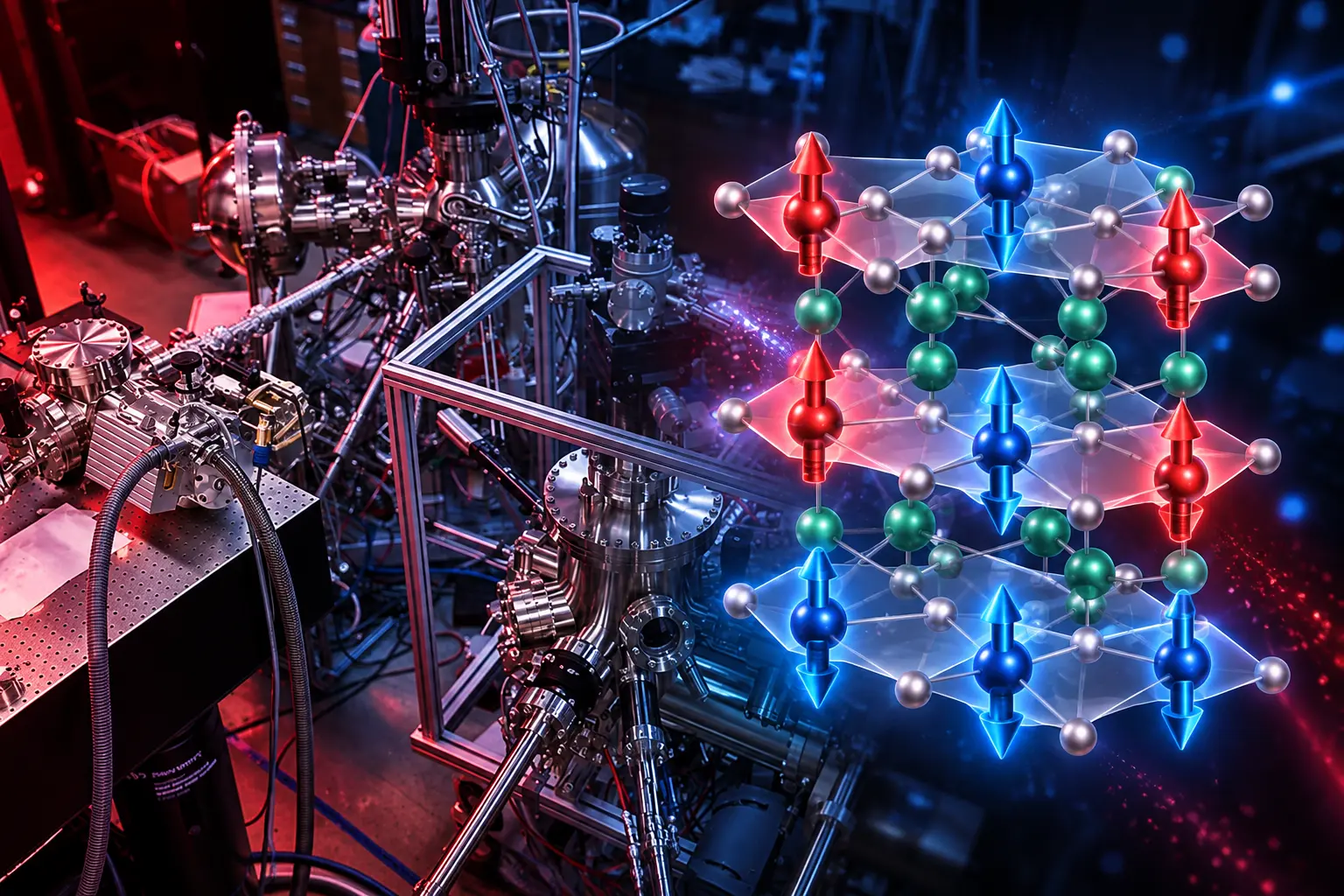
Co1/4TaSe2 is 2H-tantalum diselenide with cobalt atoms inserted between the sheets. Those cobalt atoms occupy the 2a site, keep the parent space group P63/mmc (No. 194), and double the in-plane cell. Lattice constants from prior neutron work are a = 6.8828(1) Å and c = 12.4535(3) Å.
The team grew plate-like single crystals by chemical vapor transport with iodine. A polycrystalline precursor of cobalt, tantalum and selenium was first sealed and heated at 950 °C for five days. A 10 cm ampoule then sat in a single-zone furnace with the hot zone at 940 °C for two weeks. Crystals formed at the hot end.
Magnetic susceptibility, measured in a 0.1 T field along the c axis, drops sharply below 178 K. Heat capacity shows a lambda-like peak at the same temperature. The order is type-A: cobalt moments point along the c axis, line up inside each plane, and reverse from layer to layer. Neutron diffraction had already reported that pattern, with a local cobalt moment of 1.35 μB, well below the 3 μB expected for a fully localized high-spin d7 ion. The shortfall is a clue that cobalt states mix into the valence bands with tantalum 5d orbitals.
Milo Sprague of UCF is first author. Madhab Neupane, a UCF physics professor, is corresponding author. Density-functional calculations came from Surasree Sadhukhan and George Mason University theorist Igor I. Mazin. University of Notre Dame physicists Nirmal J. Ghimire and Resham Babu Regmi are among the coauthors, with further ARPES work from UCF colleagues and Hiroshima University.
THREE MAGNETIC CLASSES, AND THIS CRYSTAL
| Class | Net magnetization | Spin-split bands | Stray field | In this study |
|---|---|---|---|---|
| Ferromagnet | Finite | Yes | Yes | Not this crystal |
| Ordinary antiferromagnet | Zero | Typically no | No | Type-A order is the starting point |
| Altermagnet | Zero | Yes, direction dependent | No | g-wave splitting in Co1/4TaSe2 |
| Co1/4TaSe2 | Zero below 178 K | Yes along Γ′-M′ | No | Layered van der Waals TMD |
The opposite cobalt sites are not related by inversion or translation. A mirror plane connects them, which is the symmetry condition the authors use to class the crystal as an altermagnet rather than a conventional compensated antiferromagnet.
The Split Appears at 7 K and Closes at 200 K
Angle-resolved photoemission spectroscopy knocks electrons out of a clean crystal face with a light beam and records their energy and direction. Spin-resolved ARPES then sorts those electrons by spin. Measurements ran at the Stanford Synchrotron Radiation Lightsource Beamline 5-2 and at the Advanced Light Source, with samples held at 7 K, deep in the ordered phase.
THE NUMBERS THAT TIE THE SPLIT TO MAGNETIC ORDER
- 7 K maps: Split bands and a six-fold spin pattern are clear on the Fermi surface.
- 178 K order: Susceptibility and heat capacity both mark the Néel point here.
- 200 K maps: The split closes 22 K above that point, then returns on cooling.
- Spin flip: Out-of-plane polarization across one pocket runs from about -13% to +13%.
The Fermi surface shows a small electron pocket around Γ′, petal-shaped pockets along Γ′-K′, and dog-bone pockets around M′. Calculated spin-up and spin-down sheets overlay those shapes with a six-fold alternation. The authors call that pattern g-wave altermagnetism. Splitting is strongest along Γ′-M′ and disappears along Γ′-K′, the nodal directions protected by symmetry.
Dog-Bone Pockets Reverse Their Spin
The spin-resolved photoemission maps of Co1/4TaSe2 focus on three momenta across the dog-bone pocket along Γ′-M′, at 0.35, 0.38 and 0.41 Å-1. On one side of the pocket the spin-down peak sits closer to the Fermi energy than the spin-up peak. Across the pocket that order reverses. Polarization derived from the measured asymmetry, divided by the Sherman function, changes sign from about -13% to +13%.
Photon energy sets the out-of-plane momentum. At 55 eV, which cuts near the kz = π/2c plane, momentum-distribution curves at the Fermi energy fit two bands. At 48 eV, nearer kz = 0, the same cut collapses toward a single peak. That kz dependence matches the calculated spin-degenerate planes and argues against a purely surface state.
Heating Past 178 K Erases the Split
Fermi surfaces and dispersions taken at 200 K, above the Néel point, show band shifts and a closing of the gaps highlighted at 7 K. Energy-distribution curves stacked along Γ′-M′ make those shifts visible in two windows of the spectrum. After the crystal is cooled again, the split structure returns. The temperature cycle is the authors’ main evidence that the splitting is magnetic, not a static lattice effect.
Neupane said the case locked in when the maps matched the calculations.
The significance became clear once the experimental measurements consistently matched our theoretical predictions. Seeing those independent pieces of evidence converge gave us confidence that we had identified a genuine layered altermagnet.
Madhab Neupane, professor of physics, University of Central Florida
He also described the measurement sequence in the 28 September UCF release: first a high-resolution, spin-insensitive pass to size the splitting, then spin-resolved ARPES to test whether those split states carried opposite polarizations. Photoemission is surface-sensitive, so the group screened crystals for ultraclean faces before the synchrotron runs. The raw ARPES data from the UCF study are posted in the university’s STARS repository.
What Makes Co1/4TaSe2 Useful for Devices?
Co1/4TaSe2 is a layered van der Waals crystal, so its sheets are held by weak forces rather than a rigid three-dimensional network. Manganese telluride and chromium antimonide, the main crystals used to prove altermagnetic band splitting, are not built that way. Weak interlayer bonding is why graphene and other dichalcogenides can be peeled, restacked, and pressed against superconductors or topological layers in a clean interface.
Neupane said altermagnets can generate and detect spin currents without the stray fields that crowd neighboring bits in a ferromagnetic stack. In the UCF release he listed spintronics, ultrafast memory, terahertz networks and lower-energy electronics as the intended uses, and he added that layered altermagnets would sit at the front of that work if the approach holds. That is a research program, not a part you can order.
Sprague, the lead graduate researcher, pointed at a more immediate use: a crystal the group can still change while theorists argue about how spin-polarized bands mix with other magnetic order.
Evidence for altermagnetism in a versatile materials platform opens a lot of new possibilities. There’s currently a lot of debate in altermagnetic theory about how the spin-polarized electronic states interact with other magnetic phenomena. Now we have a material that we can easily modify to explore these new questions.
Milo Sprague, first author, University of Central Florida
The public pitch still talks as if a new pocket magnet had arrived. The spectroscopy is a map of a crystal that orders at 178 K. The practical increment is stacking and chemical tuning, not a replacement for the magnet on a refrigerator door.
Tantalum Gives a Different Bandwidth Than Niobium
The paper is explicit that Co1/4NbSe2, a close cousin, already showed altermagnetic splitting along Γ′-M′ in the kz = π/2c plane. Neutron diffraction, susceptibility and muon spectroscopy had established type-A order there too. Co1/4TaSe2 is the tantalum analogue, not a lonely first layered example.
Tantalum’s more extended 5d orbitals, the authors write, should raise Fermi velocities, change the kz dispersion, and reduce the net spin polarization of the Fermi surface for a comparable energy split. That is a bandwidth and dimensionality test. If the g-wave pattern survives those changes, the intercalated 2H-(Nb, Ta)Se2 family is a series, not a one-off.
Partial delocalization of the cobalt moment is part of the same test. A 1.35 μB local moment and reduced magnetic entropy both point to cobalt-tantalum hybridization, so the split states are not a fully local cobalt magnet glued onto an inert host. Mazin’s group’s density-functional bands were the template the ARPES cuts were judged against, including the vanishing of the split when the cut is rotated from Γ′-M′ toward Γ′-K′ in 10° steps.
178 K Still Leaves a Cold Lab Crystal
Nothing in the maps moves the order up to everyday temperatures. At 200 K the split is already gone. Any spintronic stack built from this composition would need cooling, or a cousin with a higher Néel point. The measured polarization swing of about -13% to +13% is a clear sign reversal, not a large polarized current ready for a memory cell.
Neupane said researchers still do not fully know why this magnetic state wins over ferromagnetism or other antiferromagnetic patterns, or how completely existing theory describes real crystals. He said more advanced studies on several platforms are already underway. In the UCF release he also said the key electronic state came mainly from the bulk of the crystal rather than only the surface, which is the result that makes stacking discussions more than a hope.
OPEN QUESTIONS THE CRYSTAL IS MEANT TO ANSWER
- Why this order: Competition among electron interactions is the working theory, and it is not fully checked on this lattice.
- How it mixes: Sprague flagged unresolved arguments about spin-polarized states and other magnetic phenomena.
- What stacking does: Interfaces with superconductors and topological layers are proposed, not built in this paper.
- Whether TN can rise: 178 K is a measured ceiling for this composition, not a forecast for the whole intercalated family.
The paper’s last claim is modest on purpose. Co1/4TaSe2 is a platform for those tests, with a Néel point at 178 K and a g-wave split that can be turned off by a 22 K rise in temperature. The next maps will come from crystals the same groups can still change.
Frequently Asked Questions
What is altermagnetism?
Altermagnetism is a compensated magnetic order in which opposite-spin sublattices are connected by rotation symmetries rather than translation or inversion, so the crystal has no net magnetization while its electron bands still split in a momentum-dependent pattern; Šmejkal, Sinova and Jungwirth counted more than 200 candidate materials when they framed the class in 2022.
What is the Néel temperature of Co1/4TaSe2?
The Néel temperature is 178 K, marked both by a sharp drop in magnetic susceptibility under a 0.1 T field along the c axis and by a lambda-like peak in heat capacity, and the spin-split photoemission features tracked in this study are gone by 200 K.
How did researchers show Co1/4TaSe2 is an altermagnet?
They combined spin-integrated ARPES, spin-resolved ARPES and density-functional bands, finding g-wave splitting that is strong along Γ′-M′ at 55 eV, weak along Γ′-K′ and at 48 eV, reversed in polarization across the dog-bone pocket, and suppressed above 178 K.
How does Co1/4TaSe2 differ from manganese telluride?
Manganese telluride is a bulk two-element crystal used for the 2024 band proof, while Co1/4TaSe2 is an intercalated hexagonal van der Waals dichalcogenide in space group P63/mmc with a = 6.8828(1) Å and c = 12.4535(3) Å, grown as plates that can be stacked with other layered compounds.
Who worked on the Co1/4TaSe2 altermagnet study?
Milo Sprague led the UCF ARPES effort with Madhab Neupane as corresponding author, Igor I. Mazin and Surasree Sadhukhan supplied the George Mason calculations, and Nirmal J. Ghimire and Resham Babu Regmi at Notre Dame joined a collaboration that also included Hiroshima University and synchrotron time at SSRL and the Advanced Light Source.

John Mayer Bets Sob Rock Can Be a Record Label

H1N1 Rises Early After Last Winter’s H3N2 Wave

Human Fires Drive Amazon Carbon Emissions Even Without Drought

Charli XCX Secretly Films a Cameo in Scorsese’s Horror

Santos’s 58-Yard Kick Decides the Williams-Maye Rematch

Generation Lab’s Secret Youth Shot Has a Copycat Problem

Tesla Raises Dual Motor Prices as Texas Builds Cybercabs

The Nantucket Friendship Basket Boom Meets a Maker Shortage

Bristol Myers Quits Cellares as Autoimmune Doses Proceed

Okta Stock Jumps 20% on McKinnon’s Identity Bet
-
 NEWS2 months ago
Generation Lab’s Secret Youth Shot Has a Copycat Problem
-
 AUTO2 months ago
Tesla Raises Dual Motor Prices as Texas Builds Cybercabs
-
 LIFESTYLE2 months ago
The Nantucket Friendship Basket Boom Meets a Maker Shortage
-
 NEWS2 months ago
Okta Stock Jumps 20% on McKinnon’s Identity Bet
-
 BUSINESS2 months ago
Bristol Myers Quits Cellares as Autoimmune Doses Proceed
-

 BUSINESS2 months ago
Poland Closes Visa-Free Work for Three Fast-Growing Nationalities
-

 LIFESTYLE2 months ago
Labor Day Mattress Sales Repeat a Familiar Holiday Discount
-
 NEWS2 months ago
Ox Alpha Was a Chinese Chip Stress Test All Along