
NEWS
Okta Stock Jumps 20% on McKinnon’s Identity Bet
Okta stock jumped 20% after hours as Todd McKinnon doubled down on identity-only security for AI agents, not a big platform buy, despite a thin sales raise.

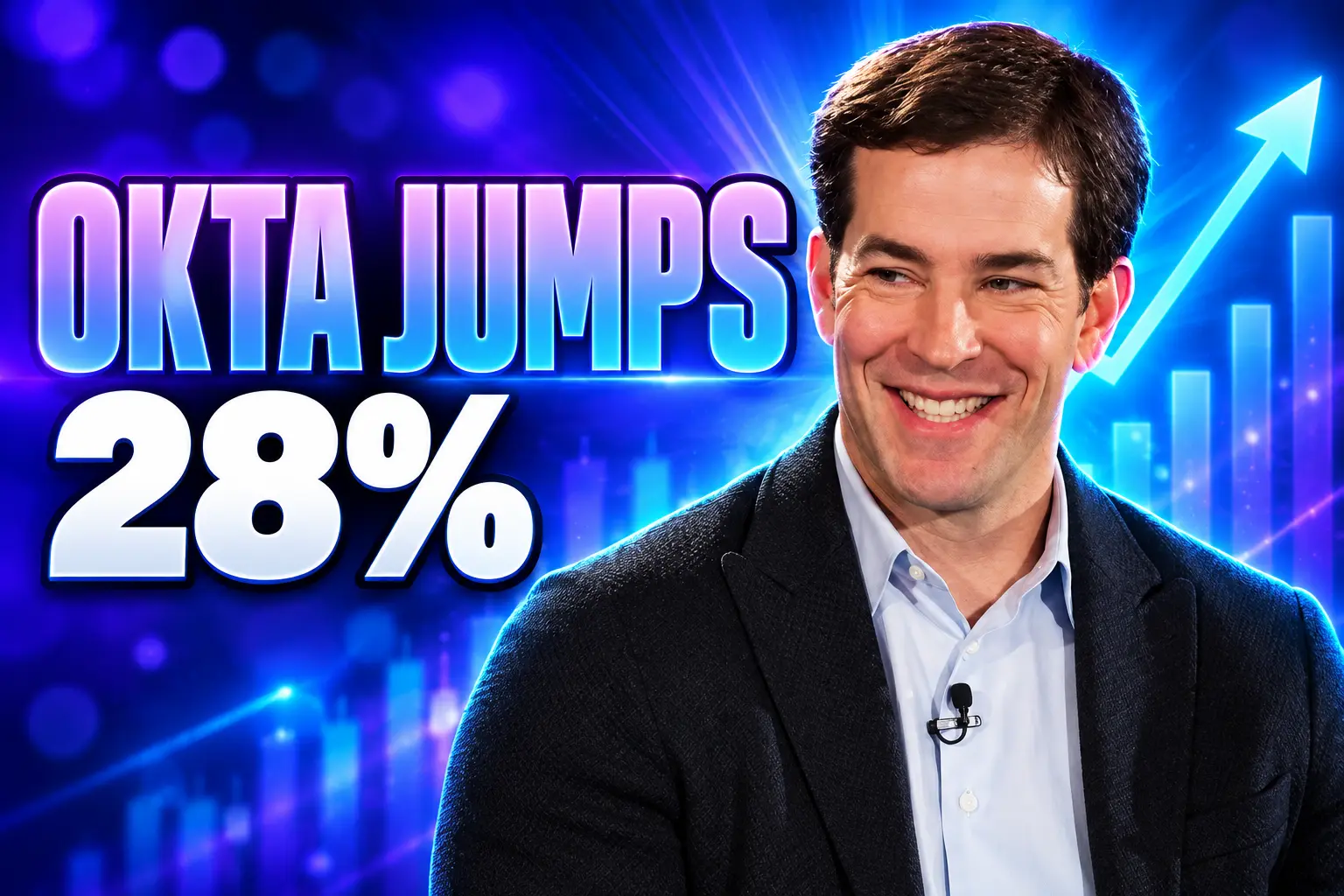
Okta stock jumped 28.63% on August 27, a day after the identity company posted $805 million of second-quarter sales and said new products were about 30% of bookings. Adjusted earnings were $1.05 a share. AI agent contracts, the story the tape paid for, are still too small to move fiscal 2027 revenue.
The raise behind that move was careful. Full-year sales growth is now 10% to 11%, one point above the 9% to 10% range set last quarter, and a planned shift of services work to partners still knocks about a point off the top line. The multiple expanded anyway, because backlog sped up and the mix inside new deals changed.
Okta Stock Jumped After a Careful Raise
The print landed after the close on August 26. Shares finished that session at $134.42, then opened the next regular session at $166.15 and closed at $172.91 on 16.36 million shares, against a recent pace nearer 2.5 million to 3 million. The high that day, $174.85, is the 52-week peak. By September 1 the stock was back at $166.43, still 23.81% above the pre-print close and 92.47% above the $86.47 finish at the end of 2025.
Estimates had clustered near $795 million of sales and 97 cents of adjusted earnings. Subscription backlog, which Okta calls remaining performance obligations, came in at $4.858 billion against estimates near $4.70 billion.
Q2 VERSUS THE STREET
| Metric | Reported | Estimate |
|---|---|---|
| Total revenue | $805 million | $795 million |
| Adjusted earnings per share | $1.05 | $0.97 |
| Subscription backlog (RPO) | $4.858 billion | $4.70 billion |
The second quarter fiscal 2027 results cover the three months ended July 31. Subscription revenue was $793 million, up 12%, and 99% of the total. Current remaining performance obligations, the slice of backlog Okta expects to turn into revenue in the next 12 months, rose 14% to $2.585 billion, faster than the 12% pace in the first quarter.
Profit caught up with the bookings talk. GAAP operating income was $107 million, or 13% of sales, versus $41 million, or 6%, a year earlier. Non-GAAP operating income was $226 million, still 28% of sales. GAAP net income was $116 million, or 65 cents a diluted share, versus $67 million, or 37 cents. Free cash flow was $227 million, a 28% margin, versus $162 million and 22% a year ago. Cash, cash equivalents, and short-term investments were $2.299 billion after Okta paid the last $350 million of its 2026 convertible notes in cash.
New Products Now Make Up 30% of Bookings
Chief Executive Officer Todd McKinnon told investors the quarter’s strength sat in large enterprises, partners, and newer products, not in a sudden AI line item. New products were about 30% of bookings. Okta Identity Governance was again the largest piece of that mix. When any of those products land in a deal, average annual contract value rises about 40%.
That attach math is what the stock re-rated. Governance, privileged access, and threat tools ride along with the workforce and customer platforms already inside more than 20,000 accounts. Conversations that start with securing AI, McKinnon said, often widen into identity modernization, which is a bigger cart than a single agent SKU.
Brett Tighe, the chief financial officer, called it a record bookings quarter outside the fourth quarter, helped by a stable sales force and partners. Channel firms touched all of the top 20 deals, and the largest deal of the quarter was partner-sourced. Professional services, which Okta is pushing to global systems integrators, fell to about 1% of revenue.
The cash engine funded the mix shift without a leverage story. In the quarter Okta bought 1,542,442 shares at an average $81.06, or $125 million, under a $1 billion authorization from January 5. Those purchases look cheap beside a $166 handle, and they are the other half of the same capital plan as the note payoff.
How Okta Plans to Badge Every AI Agent
McKinnon’s product pitch is blunt: every agent needs a trusted identity and clear limits on what it can touch. On August 24, two days before the print, Okta put Agent SSO into core single sign-on at no extra cost, registering supported agents in Universal Directory beside staff and issuing short-lived tokens instead of stored keys. That is a quiet admission the industry shipped digital labor before it shipped a badge. Only 34% of organizations already apply the same security controls to agents that they apply to people, per Okta’s own survey work.
As AI agents transform every layer of technology, every agent needs a trusted identity and clear controls over what it can access and do.
Todd McKinnon, Chief Executive Officer and co-founder, Q2 earnings webcast
Okta for AI Agents is generally available, including a Core SKU aimed at FedRAMP and HIPAA settings. Agent Gateway is meant to enforce policy at runtime across Cloud Code, Cursor, GitHub Copilot, Salesforce Agentforce, and any agent pointed at an MCP endpoint. Anthropic named Okta the first identity provider for enterprise-managed authentication on MCP connectors. More than 25 new Cross App Access integrations went out so agent-to-app connections can sit inside the same policy perimeter.
THREE AGENT DEALS FROM THE CALL
- Fortune 50 healthcare: A multimillion-dollar Okta for AI Agents contract, with Okta running agent governance, privileged access, and identity security under HIPAA rules after the buyer could not see where agents lived or what they could do.
- Global consulting firm: The firm dropped an in-house build for a single control plane that binds each agent to the employee who delegated it, with a record clients and regulators can audit.
- Large asset manager: Thousands of agents from several vendors were already in production; McKinnon said only a neutral layer could cover that mix without lock-in.
McKinnon said adoption is still in early stages, even as those deals closed. Industry notes now sketch a $33 billion agentic identity opportunity inside a wider identity pool north of $60 billion, and they do not expect an immediate P&L hit. That gap between the TAM slide and this year’s revenue is the second-order fact in the 28.63% move.
Okta’s AI Agents at Work 2026 survey of 292 executives and 492 knowledge workers across seven countries is the demand-side picture management is selling against. Ninety-two percent of those executives said autonomous agents are already in widespread or moderate use. Fifty-eight percent reported an AI-related security incident or a close call in the past year. Fifty-two percent of workers admitted using unapproved tools, often on personal accounts, while 90% of executives said they could see the AI in their shops.
Permiso Security Closed on Earnings Day
The same morning as the print, Okta closed its acquisition of Permiso Security, the cloud-native threat shop it agreed to buy on July 30. Terms were not disclosed. People briefed on the deal have put the cash price near $200 million. Okta said in July the purchase would not change the guidance issued on May 27, and Tighe did not use it as a crutch for the August raise.
Okta has signed a definitive agreement to acquire @permisosecurity! We’re excited to bring together the best identity threat detection, posture management, and runtime protection offerings to help organizations gain deeper visibility, reduce risk, and securely adopt AI at scale.… pic.twitter.com/TBEq24367f
— Okta (@okta) July 30, 2026
Permiso watches what identities do after login. The company cites more than 2,500 research-driven signals across 70-plus identity partners, covering overprivileged access, unused permissions, odd agent behavior, policy breaks, and high blast-radius moves. Ely Kahn, Okta’s chief product officer, said the team will sit inside an identity security fabric that already includes Identity Threat Protection and posture tools. Co-founders Jason Martin and Paul Nguyen, both ex-FireEye, framed the sale as distribution. Autodesk chief trust officer Sebastian Goodwin said Permiso already helps the design software firm find and watch identities across its estate.
WHAT WE KNOW
- Close date: August 26, 2026, the same day as the earnings release.
- Job of the asset: Identity threat detection and response for human, machine, and agent identities in multi-cloud shops, including a sandbox called SandyClaw for agent skills and prompts.
- Guidance hit: Okta said the deal would not change the May 27 outlook.
WHAT IS UNCONFIRMED
- Exact price: Okta has not published a figure; the near-$200 million, almost all-cash reading comes from people briefed on the talks, and a spokesperson did not dispute it.
McKinnon has said Okta will keep doing tuck-in deals and will not buy a large legacy company just to stack revenue. That is a different path from the wider cyber shopping spree, where platform vendors have been folding in whole adjacent categories. Identity still sits behind network as the largest cyber spend bucket, in his telling. Look out five or ten years, with millions of agents running, and he argues the spend moves to identity. The Permiso check is a sensor pack for that claim, not a second platform.
The 605 Accounts Above $1 Million
The money today still comes from the two core clouds. Workforce Identity annual contract value grew 11% and was 59% of total ACV. Customer Identity ACV grew 13% and was 41%. International revenue grew 12% and was 21% of the total. Trailing 12-month dollar-based net retention was 107%. Average contract length is about 2.5 years. Headcount was about 6,570.
WHERE THE CONTRACT VALUE SITS
| Book of business | Share or count | Year-over-year |
|---|---|---|
| Workforce Identity ACV | 59% of total ACV | Up 11% |
| Customer Identity ACV | 41% of total ACV | Up 13% |
| Customers at $100,000-plus ACV | 5,255 accounts, about 85% of ACV | Up 6% |
| Customers at $1 million-plus ACV | 605 accounts, more than $1 billion of ACV | Up 22% |
Those 605 accounts are the attach surface for governance and for agent SKUs. Posted commentary listed an appliance maker wrapping Okta for AI Agents around Gemini Enterprise and custom bots, a commercial insurer that wanted short-lived permissions and human-in-the-loop checks, a North American bank putting Auth0 on a dedicated private cloud, and a U.S. Department of Defense organization buying Customer Identity for zero-trust work. A federal agency added Workflows. That is not an AI P&L. It is the installed base the new SKUs are supposed to climb.
The non-human identity security market is the longer backdrop, with one tally putting it at $9.67 billion in 2026 and $28.47 billion by 2031. Machine identities already outnumber people by wide ratios depending on whose survey you read, and AI agents are the fastest new slice. Okta’s bet is that the directory already on the wall is the place those extra identities get a name, an owner, and a kill switch.
Okta Lifts Full-Year Revenue to $3.226 Billion
Guidance stayed “prudent,” in the company’s word, and still moved up. Third-quarter revenue is $813 million to $817 million, or 10% growth. Current backlog for the next 12 months is $2.590 billion to $2.600 billion, or 11% to 12%. Non-GAAP operating income is $196 million to $200 million, a 24% to 25% margin, and adjusted earnings are $0.92 to $0.94 on about 184 million diluted shares and a 21% non-GAAP tax rate. Free cash flow is $175 million to $185 million.
THE RAISED YEAR AND THE NEXT QUARTER
| Item | Q3 fiscal 2027 | Full year fiscal 2027 |
|---|---|---|
| Revenue | $813 million to $817 million | $3.216 billion to $3.226 billion |
| Revenue growth | 10% | 10% to 11% |
| Non-GAAP operating income | $196 million to $200 million | $830 million to $840 million |
| Non-GAAP operating margin | 24% to 25% | 26% |
| Adjusted EPS | $0.92 to $0.94 | $3.90 to $3.94 |
| Free cash flow | $175 million to $185 million | $910 million to $930 million |
The year still carries two one-point drags Okta called out in advance: the partner shift on professional services, and lower interest income after the buyback and the cash note payoff. Free cash flow margin for the year is 28% to 29%. Management has said AI-related revenue should stay immaterial in fiscal 2027, with a chance it starts to show in fiscal 2028. That is the tension inside last week’s tape. The identity-first case after the print is the same thesis; the new evidence is the 30% new-product mix and a 14% current-backlog print, not a disclosed AI revenue line.
Oktane, the customer conference, is set for September 23 in Las Vegas, with a livestream, and McKinnon has teed it up as the next product dump on agent security. The next scheduled earnings date is around December 2. Until then the stock is holding a gap that paid for attach rates and a five-to-ten-year category call, while this year’s guide still reads like an 11% identity company with a cleaner balance sheet.
Frequently Asked Questions
What period does Okta’s fiscal second quarter cover?
Okta’s fiscal year ends on January 31, so fiscal 2027 runs from February 1, 2026, through January 31, 2027. The second quarter is May, June, and July, and this print closed on July 31, 2026. The third quarter now underway is August through October, which is why September’s Oktane event falls inside the current fiscal period rather than after year-end.
What is current remaining performance obligation, or cRPO?
Remaining performance obligations are contracted subscription backlog not yet recognized as revenue. Current RPO is the portion Okta expects to recognize in the next 12 months, and it ended the quarter at $2.585 billion, up 14%. The rest of the $4.858 billion total sits further out on contracts that last about 2.5 years on average, so cRPO is the nearer tell on next year’s subscription revenue.
Is Agent SSO a separate paid Okta product?
No. Agent SSO is bundled into core Okta single sign-on plans at no additional cost and applies to agents that support the Cross App Access standard, registering them in Universal Directory and handing out short-lived tokens. Okta for AI Agents is the broader paid suite for discovery, lifecycle, and runtime control, including agents and secrets that Cross App Access does not reach.
How much of Okta’s $1 billion buyback is still available?
$555 million remains under the Class A authorization approved on January 5, 2026. The program has no expiration date, does not require Okta to buy a set amount, and can be changed or stopped by the board. During the second quarter the company spent $125 million on 1,542,442 shares at an $81.06 average, well below the post-earnings price.
Disclaimer: This article is news reporting and analysis of Okta’s published results, guidance, and related product announcements, and it is for information only. It is not investment advice, a recommendation to buy or sell OKTA or any other security, or a forecast of future returns. Readers should consult a licensed financial adviser or broker who can consider their own objectives, time horizon, and risk tolerance before acting on any figure in this piece. Revenue, earnings, backlog, share prices, and deal terms reflect the company’s statements and market prints as of September 2, 2026, and all of those items can change with later filings, guidance updates, or trading.

Maharashtra Grants Nana Patekar a State Funeral at His Farm

Nifty Tests 22,600 as Banks Carry a Fragile Rebound

India’s 13.3 Crore Voter Cut Lands on the Election Commission

Reflection Bets $25 Billion on Beam’s Cheaper Open Weights

India Finishes Fourth Again, 21 Medals Short of Hangzhou

Tesla Raises Dual Motor Prices as Texas Builds Cybercabs

Generation Lab’s Secret Youth Shot Has a Copycat Problem

The Nantucket Friendship Basket Boom Meets a Maker Shortage

Bristol Myers Quits Cellares as Autoimmune Doses Proceed

Okta Stock Jumps 20% on McKinnon’s Identity Bet
-
 NEWS1 month ago
Generation Lab’s Secret Youth Shot Has a Copycat Problem
-
 AUTO1 month ago
Tesla Raises Dual Motor Prices as Texas Builds Cybercabs
-
 LIFESTYLE2 months ago
The Nantucket Friendship Basket Boom Meets a Maker Shortage
-
 BUSINESS1 month ago
Bristol Myers Quits Cellares as Autoimmune Doses Proceed
-

 LIFESTYLE1 month ago
Labor Day Mattress Sales Repeat a Familiar Holiday Discount
-

 NEWS1 month ago
Google Ends EU Spam Demotions but Keeps the Ranking Split
-

 BUSINESS2 months ago
Poland Closes Visa-Free Work for Three Fast-Growing Nationalities
-

 NEWS1 month ago
Ox Alpha Was a Chinese Chip Stress Test All Along