
ENTERTAINMENT
Ramayana Bets on a Quiet Prayer With Jai Jai Ram
Jai Jai Ram, Ramayana’s first song, is a three-word prayer from A.R. Rahman, Arijit Singh and Shreya Ghoshal, a sincerity bet before Diwali 2026.

Jai Jai Ram, the first song from Nitesh Tiwari’s Ramayana, arrived on September 14 as a quiet prayer built on three words. A.R. Rahman composed, produced and arranged the track, with Arijit Singh and Shreya Ghoshal singing Dr Kumar Vishwas’s lines.
The makers timed the drop to Ganesh Chaturthi, after a Siya Ram poster at 7:30 a.m. IST, and they are asking a film producer Namit Malhotra has put at about $500 million, over Rs 4,000 crore for both parts, to introduce itself with a chant.
A Prayer Opens India’s Costliest Epic
T-Series posted the official video under the film’s line, “Our Truth. Our History.” The cut runs 2:09. A separate full audio listing under Rahman’s name runs 5:21, so the film they put on YouTube is a short prayer, not the whole studio track.
Rahman’s brief was narrow on purpose. He said the heart of the song is the repetition of Shri Ram’s name, and that the job was to keep the intimacy of a prayer while still letting the piece grow into a film song. Vishwas said he did not try to describe Shri Ram, because the meaning would not fit in words, and that true devotion needs no ornamentation.
That is the wager. The last widely seen Ram on a multiplex screen arrived with volume, then collapsed under look, line and faith tests. This team is opening the music with santoor, flute, sitar and a refrain people can say without a lyric sheet.
Malhotra put the same idea in producer language. He said Shri Ram is the guide people turn to in darkness, doubt and joy, and that while Ramayana is being built on a great scale, its base is emotion, values and devotion. He wanted the first song to treat Ram as protector and inner strength, and he called a Ganesh Chaturthi start fitting because, in this culture, an auspicious beginning seeks Ganesha first.
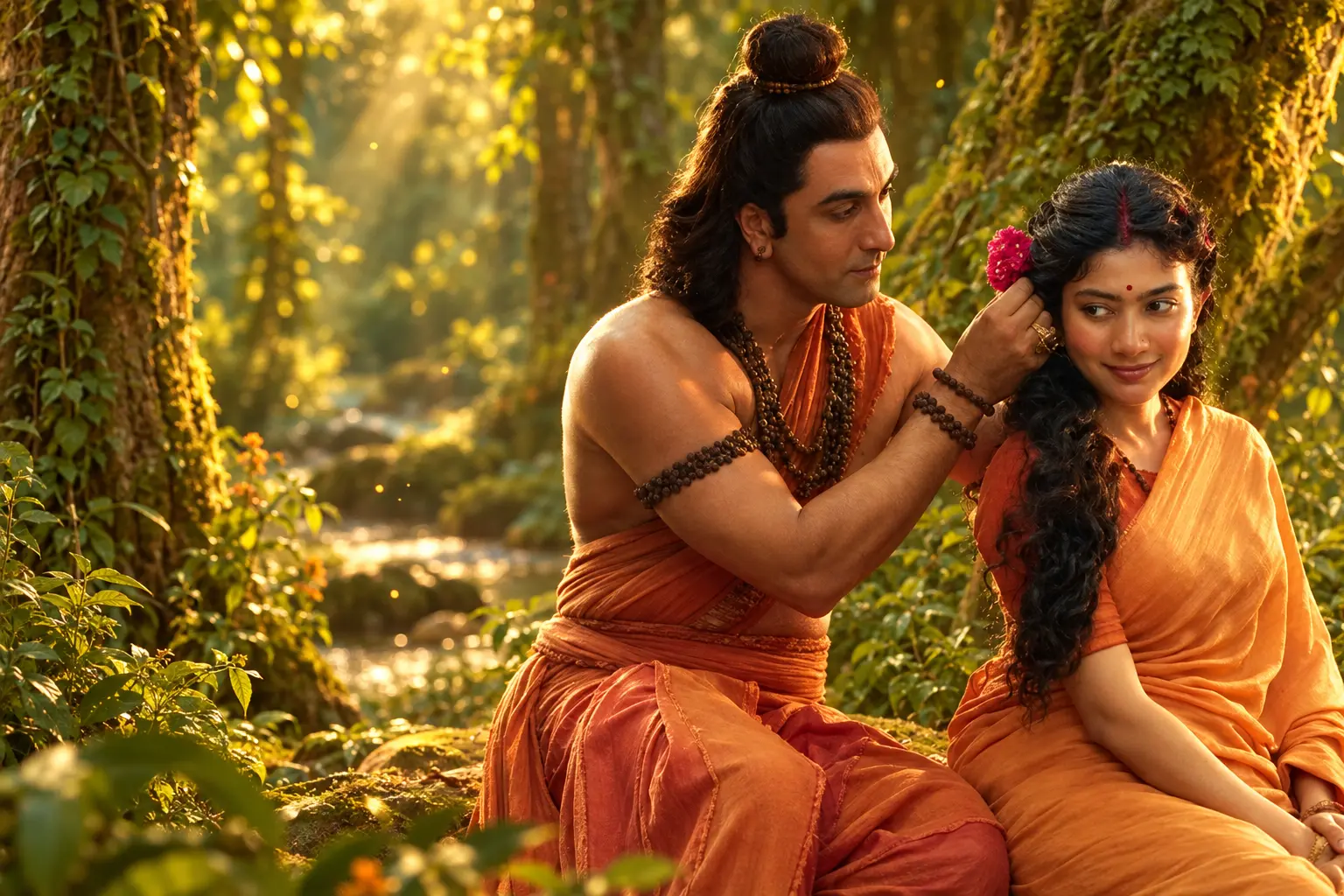
What the Jai Jai Ram Video Shows
The pictures are almost all tenderness. Ranbir Kapoor’s Rama and Sai Pallavi’s Sita carry the frame. War, Ravana and the later exile storm stay offscreen. Listeners keep returning to forest light, an Ayodhya street, and faces held in close-up long enough to read.
SCENES IN THE CUT
- The wedding: Ram and Sita’s marriage is staged as the emotional centre, not a parade of effects.
- Ayodhya return: The couple’s arrival is shot as public joy, with the city dressed in gold and lamp light.
- The father: Ram is seen with King Dasharatha, then at a river for the immersing of ashes.
- Bharat milaap: The brothers’ reunion is played as the private wound inside the epic.
- The flower: Ram sets a flower in Sita’s hair, the same gesture the morning’s Siya Ram poster froze.
The T-Series caption track keeps circling a plain vow, “My worship is my Ram,” then folds in older Sanskrit that many households already know, including Achyutam Keshavam and Janaki Vallabham. A later English line in that track is blunt: without him, there is no protector in the world. People looping the video on the morning of the drop were not arguing about bass drops. They were treating it like a prayer they could put on before work.
Yash’s Ravana, Sunny Deol’s Hanuman and Ravie Dubey’s Lakshman are billed on the same card and barely figure here. The first music is a Rama-Sita film, and that choice will please anyone who wanted stillness after the trailer’s scale. It will frustrate anyone who came for the bow, the ten heads, and the war.
Rahman Built a Prayer That Grows Into a Song
Zimmer is on this film. He is not on this song. The score partnership has been public for more than a year, and the first music out of that room was orchestral, not a bhajan. Zimmer and Rahman’s introduction theme landed on July 3, 2025, a 2:35 cue on Sony Music Entertainment India. A Rama Theme followed in April 2026. The July 30 trailer leaned on that joint score, including a stretch of Dharti Hai Ambar against Sanskrit chant.
Jai Jai Ram is credited as composed, produced and arranged by Rahman alone. Music supervisors are A.R. Ameen and Hiral Viradia. The seated Indian instruments do the spiritual work, then Sunshine Orchestra and the Chennai Strings, recorded at AM Studios, widen the prayer without turning it into a march. Shadab Rayeen mixed and mastered it at New Edge Studio in Mumbai. Arijit edited his own vocals. The label is T-Series, with Amazon Music as streaming partner.
HOW THE MUSIC HAS ARRIVED
| Asset | Date | Who is on it |
|---|---|---|
| Introduction Theme (2:35) | July 3, 2025 | Hans Zimmer, A.R. Rahman, Kumar Vishwas |
| Rama Theme | April 4, 2026 | Zimmer and Rahman |
| Trailer score | July 30, 2026 | Zimmer and Rahman; Malhotra said it crossed over a billion views in five days |
| Jai Jai Ram video (2:09) | September 14, 2026 | Rahman, Vishwas, Arijit Singh, Shreya Ghoshal |
Rahman has called Ramayana the biggest film of his career and described Zimmer as an ambassador who will pull non-Indian listeners toward an Indian story. The first song still refuses that embassy tone. It sounds like a temple courtyard that learned cinema, not like a Hollywood cue that learned Sanskrit.
At the heart of ‘Jai Jai Ram’ is the simple and powerful repetition of Shri Ram’s name. Musically, the intention was to preserve the purity and intimacy of a prayer while allowing the composition to grow into a cinematic song. Arijit Singh and Shreya Ghoshal bring their own distinct emotional expression to Dr. Kumar Vishwas’s words, while always remaining true to the devotion at the centre of the song. I hope audiences find both a sense of peace and a personal connection in it.
A.R. Rahman, composer, in a statement on the song
The Arijit-Shreya pairing is doing what that pairing usually does in Hindi film music: one voice breaks, the other steadies. On this track the break is devotion, not romance, and that is why the comments under the video keep talking about tears at breakfast.
Adipurush Still Shadows This First Drop
Om Raut’s Adipurush went out in 2023 with Prabhas as Rama, a Rs 550 crore budget, and a first single, Jai Shri Ram, from Ajay-Atul. The film opened, then word of mouth turned. It finished over Rs 200 crore short of recovering its cost. Dialogue writer Manoj Muntashir later said there should be no shame in calling it a failed attempt, and he asked people to stop lining it up against Tiwari’s film. He also said he was proud the music reached people, and that he hoped Ramayana’s music would match it and go further.
That split is the trap this song is trying to walk around. Adipurush proved a Ram bhajan can live on after the movie is argued to death. It also proved that look, costume and line readings can poison a myth before the interval. After Tiwari’s trailer, old Adipurush jokes came back, Sai Pallavi’s costume drew heat, and the Shri Ramlila Mahasangh asked the director for a special screening, citing a fear of distortion.
A calm song does not close that file. Some of the morning traffic still arrived ready to dislike the faces and the clothes, even while calling the tune sweet. The other half treated the upgrade in the jungle and Ayodhya frames as proof the VFX house had heard the earlier complaints. Both readings can sit in the same comments thread. The film still has to survive both.
Tiwari has already said, on the Prime Focus unveiling of Rama, that the epic’s greatness lies in emotion, in choices and in the cost of doing what is right. Ranbir said he was not there to represent Rama so much as to learn from him, and that the simplicity was humbling. Those lines match the song better than they match a $500 million war machine. The bet is that audiences will believe the first of those films is the one they are buying.
On Diwali Sunday, India Gets Part One
Malhotra, who is also DNEG’s founder, confirmed the split calendar. International markets take the film on Friday, November 6, because that is how foreign distribution dates a weekend. India takes it on Diwali, Sunday, November 8. Part Two is aimed at Diwali 2027. Dharma Productions is leading North India’s Hindi-speaking markets, with Sony Pictures handling the release outside India, including an English-language version.
The film is produced by Malhotra’s Prime Focus Studios with DNEG and Yash’s Monster Mind Creations. DNEG, an eight-time Academy Award winner for visual effects, is both producer and VFX house. The adapted screenplay is by Shridhar Raghavan and Tiwari, with dialogues by Shreyas Jain and Tiwari. Pankaj Kumar and Mahesh Limaye shot it. Action is billed to Terry Notary and Guy Norris. Production design is by Ramsey Avery and Ravi Bansal. It is filmed for IMAX.
Arun Govil, who played Ram for a generation on television, appears as Dasharatha. Rakul Preet Singh is Surpanakha. The rest of the billed company includes Lara Dutta, Kajal Aggarwal, Vivek Oberoi and Kunal Kapoor. Yash is co-producer as well as Ravana, which ties the biggest Kannada star of this decade to a Hindi-led epic that wants South screens as badly as it wants overseas IMAX.
FROM FIRST CUE TO DIWALI
- July 3, 2025: The Introduction Theme goes out as the first official music.
- April 4, 2026: The Rama Theme follows as a second score single.
- July 30, 2026: The trailer lands globally, with Malhotra citing over a billion views in five days.
- September 14, 2026: The Siya Ram poster at 7:30 a.m. IST, then Jai Jai Ram.
- November 6, 2026: Part One opens overseas.
- November 8, 2026: Part One opens in India on Diwali.
- Diwali 2027: Part Two is scheduled to follow.
Suriya’s Scene is also dated November 6, so the overseas Friday is not an empty corridor in the South. Ramayana will still be the event film of that fortnight if the devotion the song is selling holds until the lamps go up.
Kumar Vishwas Kept the Language Bare
Vishwas is a Hindi poet who spent years in public life, and he is an unusual first-song lyricist for a film of this size. He wrote as a devotee, not as a court poet. On the morning of the drop he posted the same thought he gave the makers, with links to Apple Music and Spotify, calling Jai Jai Ram three simple words, yet a complete prayer.
While writing the song, my endeavour was not to describe Shri Ram, because his meaning cannot be contained in words, but to express the relationship every devotee shares with him: as our guide, our strength and our refuge. The language has been kept simple and direct because true devotion needs no ornamentation. I hope that when people hear the song, they do not merely listen to it, but find their own prayer within it.
Dr Kumar Vishwas, lyricist, in his statement on Jai Jai Ram
Replies to that post thanked him for keeping the soul of the movie in the words, and one listener heard Achyutam Keshavam as the stotra already running in the house. That is the audience this drop is built for: people who do not need the epic explained, only honoured. The harder room is the one that watched the trailer, argued over costumes, and will judge November on whether Ranbir’s Rama and Yash’s Ravana can carry a story this old without the film becoming another meme.
Jai Jai Ram is now out, a 2:09 prayer on a T-Series page and a longer audio beside it. Part One still has to hold a Diwali crowd that has already fought over faces, clothes and fidelity. The chant was the easy opening. The film is the rest of the bet.

Maharashtra Grants Nana Patekar a State Funeral at His Farm

Nifty Tests 22,600 as Banks Carry a Fragile Rebound

India’s 13.3 Crore Voter Cut Lands on the Election Commission

Reflection Bets $25 Billion on Beam’s Cheaper Open Weights

India Finishes Fourth Again, 21 Medals Short of Hangzhou

Tesla Raises Dual Motor Prices as Texas Builds Cybercabs

Generation Lab’s Secret Youth Shot Has a Copycat Problem

The Nantucket Friendship Basket Boom Meets a Maker Shortage

Bristol Myers Quits Cellares as Autoimmune Doses Proceed

Okta Stock Jumps 20% on McKinnon’s Identity Bet
-
 NEWS2 months ago
Generation Lab’s Secret Youth Shot Has a Copycat Problem
-
 AUTO2 months ago
Tesla Raises Dual Motor Prices as Texas Builds Cybercabs
-
 LIFESTYLE2 months ago
The Nantucket Friendship Basket Boom Meets a Maker Shortage
-
 NEWS2 months ago
Okta Stock Jumps 20% on McKinnon’s Identity Bet
-
 BUSINESS2 months ago
Bristol Myers Quits Cellares as Autoimmune Doses Proceed
-

 LIFESTYLE2 months ago
Labor Day Mattress Sales Repeat a Familiar Holiday Discount
-

 BUSINESS2 months ago
Poland Closes Visa-Free Work for Three Fast-Growing Nationalities
-

 NEWS2 months ago
Google Ends EU Spam Demotions but Keeps the Ranking Split