
NEWS
Cyclospora Cases Rise After Recalled Lettuce Leaves Stores
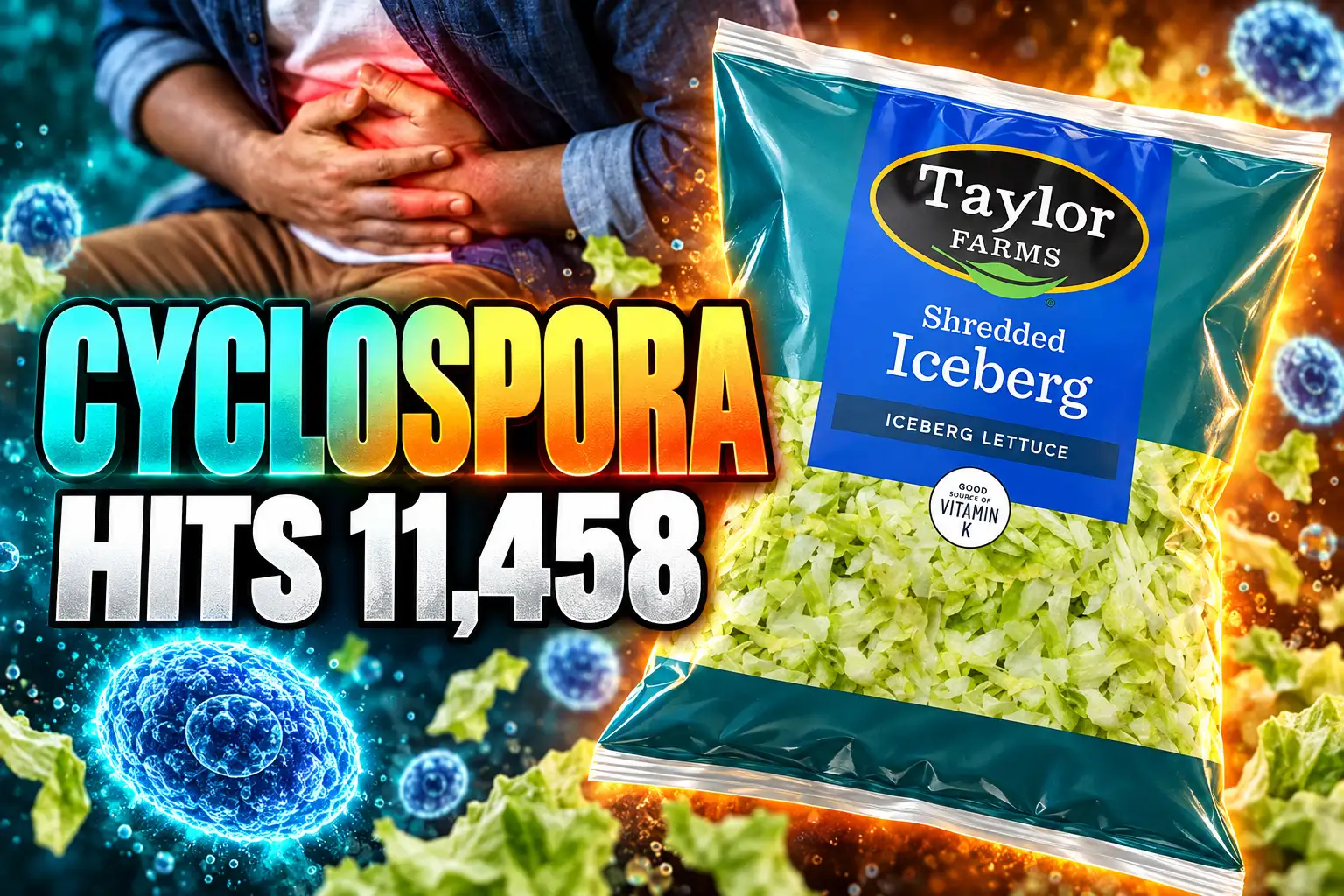
Georgia, Tennessee and Texas joined an 11,458-case cyclospora outbreak tied to Taylor Farms lettuce, even as product tests stayed negative.

Federal health officials have tied 11,458 laboratory-confirmed cyclospora illnesses in 20 states to iceberg lettuce from Taylor Farms de Mexico. Georgia, Tennessee and Texas were added in the August 27 update, weeks after the company pulled the lettuce and after best-by dates had passed.
The Food and Drug Administration says the recalled bags are off the market and has given the recall its gravest label. No confirmed product sample has shown the parasite, and Mexico’s tests at the named plant were negative.
Georgia, Tennessee and Texas Join a Count Built on Interviews
The Centers for Disease Control and Prevention and the FDA now report 11,458 laboratory-confirmed illnesses in 20 states, with 495 hospitalizations and two deaths. Illnesses in this cluster began on June 14, and onset dates run through August 15. The two deaths were in Michigan. The Michigan Department of Health and Human Services said both people had significant underlying health conditions that may have been harmed by cyclosporiasis and dehydration, and both got sick before the July 17 recall.
This is not a Taco Bell-only list. After more interviews, the outbreak grew to include people who reported Taylor Farms de Mexico iceberg lettuce at other restaurants, retailers and food-service sites. Taco Bell told the FDA it stopped using that lettuce on July 17. The count also includes people who traveled into one of the 20 states but live elsewhere.
CDC and FDA are publishing only laboratory-confirmed cases. State dashboards often look larger because they add probable illnesses and refresh on different calendars. The agencies have said the true number of sick people is likely higher, because some recover without a test.
HOW THE OFFICIAL CLUSTER GREW
| Update | Illnesses | States | Hospitalizations | Deaths |
|---|---|---|---|---|
| July 24, 2026 | 1,947 | 9 | 98 | 0 |
| August 5, 2026 | 6,358 | 15 | 278 | 2 |
| August 13, 2026 | 9,481 | 17 | 398 | 2 |
| August 20, 2026 | 10,930 | 17 | 454 | 2 |
| August 27, 2026 | 11,458 | 20 | 495 | 2 |
The jump from 10,930 to 11,458 added 528 confirmed illnesses and three states in a week. CDC investigators say genotyping on samples from sick people shows the parasites that caused these illnesses are genetically related, which they treat as extra evidence of a shared source. That work is done on people, not on lettuce still in a bag.
Class I Label on Lettuce Already off the Market
Taylor Farms de Mexico, in Guanajuato, announced a voluntary recall on July 17 of all iceberg lettuce sourced from central Mexico. Retail lots included Marketside Iceberg Salad in 12 oz and 24 oz packs and Shredded Lettuce in 8 oz and 16 oz packs, with best-if-used-by dates from July 18 through August 3, sold at select Walmart stores in 15 states. Food-service bags went out from June 29 through July 16 to 31 confirmed states, with possible extra reach into places such as D.C. and Puerto Rico. The firm also sold recalled product to consumers in Mexico.
On August 28 the FDA classified this recall as Class I. Cyclospora recalls more often land in Class II, the middle rung, because the illness is usually time-limited. The agency said the size of this outbreak and the strength of the epidemiology met the higher bar.
The FDA has classified this recall as Class I, meaning the agency deemed the recall a situation in which there is a reasonable probability that the use of, or exposure to, a recalled product will cause serious health consequences or death.
U.S. Food and Drug Administration, constituent update, August 28, 2026
The same week, the agency said it remains confident that all recalled iceberg lettuce tied to this outbreak is off the market. Best-by dates had already passed. Taylor Farms said it suspended iceberg sourcing from central Mexico and, as of July 18, halted production of all products at the central Mexico plant while outside experts review the site. The company says it spends more than $200 million a year on food-safety programs.
WHAT LEFT THE MARKET
- Retail packs: Marketside iceberg salad and shredded lettuce at select Walmart stores in 15 states, best-if-used-by July 18 through August 3.
- Food-service bags: Chopped, shredded and blended lettuce under several house codes, shipped June 29 through July 16 to 31 confirmed states.
- Chain cutover: Taco Bell stopped using Taylor Farms de Mexico lettuce on July 17, the day of the recall.
- Plant pause: Taylor Farms halted all production at the central Mexico facility on July 18.
Class I is a risk label on a product the FDA already says you cannot buy. That pairing is the odd center of the case.
Mexico’s Labs Did Not Find the Parasite
Cofepris, Mexico’s sanitary regulator, inspected the Taylor Farms de Mexico plant from July 18 through July 20 with epidemiologists from the health ministry and food-safety staff from Senasica. Inspectors took 10 iceberg samples, five whole heads and five finished lots that had been chopped, washed and disinfected, plus four water samples. Real-time PCR at the national reference lab, using the method in the Bacteriological Analytical Manual, came back negative for Cyclospora cayetanensis in all 10 samples. Water tests found no fecal coliforms and met national chemical limits. The company told inspectors it uses drip irrigation and its own certified wells.
Epidemiologists checked plant workers and did not find a diarrheal outbreak that required a health response. The firm’s traceback records pointed U.S. officials to a lot held at the Laredo, Texas, crossing that never entered the United States. That lot produced the sample the FDA later called a false positive.
On July 19 the FDA said there were no confirmed positive product results for Cyclospora. Taylor Farms, citing the FDA, repeated that line as of August 20. The agency’s public position is that the withdrawn border test does not move the traceback, which still converges on shredded iceberg from central Mexico.
WHAT MEXICO TESTED IN GUANAJUATO
- Finished lettuce: Five chopped, washed and disinfected lots, all PCR-negative.
- Whole heads: Five intact iceberg samples taken at the plant, also negative.
- Water: Four samples with no fecal coliforms and chemistry inside national limits.
- Workers: No diarrheal outbreak found among plant staff.
- Border lot: The Laredo shipment never entered U.S. commerce and is the lot tied to the false-positive result.
On August 5 the Secretaría de Salud said Mexico had 33 confirmed cyclospora cases under follow-up. It also said naming a country as the preliminary origin of a product during an international investigation “does not, in itself, constitute evidence that the contamination occurred in that place.” After notices from the United States and the United Kingdom, five brigades finished sanitary visits at 16 hotels in Quintana Roo on August 4 and took fruit, vegetable and water samples. Those hotel results were still pending in that statement.
U.S. officials are still doing on-site inspections and sampling at iceberg growers and the processing plant in Mexico, in coordination with Mexican officials. The empty plant tests sit beside a U.S. case that now carries a Class I stamp. Both can be true at once only if the contamination was transient, missed by the later sampling, or happened somewhere the inspectors have not yet pinned down.
A Six-Week Clock Still Feeds the Map
New states on a federal outbreak map read like fresh danger. For cyclospora, they often mean old meals catching up with paperwork. The FDA and CDC have said it can take as long as six weeks to decide whether a sick person belongs in this cluster. That is why confirmed counts kept rising after the recall and after the bags were gone.
Most illnesses in this outbreak began before July 17. Onset dates still reached August 15, 29 days after the recall and 12 days after the last listed best-by date. Some of that tail is incubation. Some of it is the slow path from a clinic test to a state interview to a federal line on a spreadsheet.
On August 6 the FDA said as much in public, while repeating that the lettuce tied to this outbreak was already off the market.
Today, FDA and @CDCgov are providing an update on the multi-state Cyclospora outbreak linked to recalled iceberg lettuce from Taylor Farms de Mexico. https://t.co/X8VHuadvCL
Important things to know:
➡️ Cyclosporiasis can be a serious illness. We encourage anyone who suspects… pic.twitter.com/12LUHA59Ck— U.S. FDA (@FDA) August 6, 2026
The lag is why Georgia, Tennessee and Texas can appear in late August on a product that left stores in July. It is also why a shopper reading only the state count can think the lettuce is still circulating when the FDA says it is not.
THE SEASON SO FAR
- May 1, 2026: U.S. cyclospora season opens, the window CDC uses for domestic surveillance.
- June 14, 2026: Earliest illness onset later placed in the Taylor Farms iceberg cluster.
- June 29, 2026: Recalled food-service iceberg begins moving through the distribution window that runs through July 16.
- July 17, 2026: Taylor Farms de Mexico recalls central Mexico iceberg; Taco Bell stops using that lettuce.
- July 18, 2026: The company suspends all production at the central Mexico plant; Cofepris begins its three-day inspection.
- July 19, 2026: FDA withdraws a border-sample result as a false positive and says no product test is confirmed positive.
- July 23, 2026: Mexico reports PCR-negative lettuce and water from the Guanajuato plant.
- August 3, 2026: Last listed best-if-used-by date on recalled retail packs; Michigan reports two deaths.
- August 15, 2026: Last illness onset date in the August 27 cluster update.
- August 27, 2026: Georgia, Tennessee and Texas added; cluster stands at 11,458 confirmed illnesses.
- August 28, 2026: FDA publishes the Class I classification.
A six-week assignment clock running from an August 15 onset still reaches into late September. Later updates can add names without meaning a new bag hit a prep table.
The Same Guanajuato Plant Was Named in 2013
Taylor Farms de Mexico has been in this file before. In 2013, CDC recorded 631 people with Cyclospora cayetanensis in 25 states and New York City. About 8% were hospitalized. No deaths were reported. Public health officials in Iowa and Nebraska tied restaurant cases in those states to a prepackaged salad mix, iceberg and romaine with red cabbage and carrots, supplied by Taylor Farms de Mexico. Olive Garden and Red Lobster were among the chains that received it.
That year was not a single-vehicle event. Texas investigations pointed to fresh cilantro from Puebla, a different crop and a different Mexican state. On August 9, 2013, Taylor Farms de Mexico suspended processing, harvesting, shipping and selling of salad-mix ingredients and agreed not to restart without FDA approval. An environmental assessment at the Guanajuato facilities from August 12 through August 19 found conditions in line with known food-safety protocols at the time of the visit. With FDA concurrence, the plant resumed shipments on August 25, 2013.
The 2026 traceback again names a Taylor Farms processor in central Mexico and again leans on epidemiology after environmental sampling comes back clean. The difference is scale. The 2013 national count was 631. The lettuce-linked cluster this summer is already 11,458 confirmed illnesses, and it is only one piece of a much larger domestic season.
What Cyclospora Does After Someone Eats It
Cyclospora causes watery diarrhea, cramps, nausea, loss of appetite and heavy fatigue, often about a week after someone eats contaminated produce. Most people with healthy immune systems recover, sometimes after days or a month or longer, but the illness can hit harder in people with weak immune systems, and symptoms can fade then return.
The parasite spreads when food or water is contaminated with human feces. Leafy greens, herbs and berries have been repeat vehicles because they are eaten raw. Washing helps with dirt. It is a weak defense against a parasite that can cling to leaf surfaces. CDC says some infected people have no symptoms at all. Untreated illness can lead to dehydration and, in a smaller share of patients, hospital care.
CDC’s clinical note is blunt enough: cyclosporiasis is not usually life-threatening, and many healthy people get better without drugs. Trimethoprim-sulfamethoxazole is the usual treatment when a clinician treats at all. The two Michigan deaths sit in the other column, the one that includes older patients, infants, pregnant people and anyone whose immune system is already under strain. Relapse is part of the picture, which is why a person who felt better in July can still be in a case file in August.
SYMPTOMS CLINICS ARE WATCHING
- Core illness: Frequent watery diarrhea, stomach cramps, bloating, gas, nausea and fatigue.
- Other signs: Vomiting, body aches, headache, fever, loss of appetite and weight loss.
- Course: Days to a month or longer if untreated, with symptoms that can go away and come back.
- Higher risk: Longer, harder illness in immunocompromised patients, with a real chance of dehydration that needs hospital care.
FDA still tells anyone with those symptoms who ate shredded iceberg in the two weeks before getting sick to call a clinician. Recalled product should no longer be on sale. If it was in a home kitchen, the advice is to clean and sanitize surfaces and containers it touched.
National Totals Run Far Past the Lettuce Cluster
The 11,458 figure is the lettuce-linked outbreak. It is not the whole U.S. season. CDC’s surveillance page, updated September 1, shows 18,445 laboratory-confirmed cases since May 1 that were acquired in the United States. That pile includes the iceberg cluster and cases not linked to it. For comparison, 1,180 cases were reported between May 1 and August 31, 2025. This year’s confirmed domestic count is more than 15 times that figure.
Nationally there have been 990 hospitalizations and the same two deaths. Cases have been reported from 49 states plus the District of Columbia. Median age is 46, with a range from 1 to 99. About 57% of patients are female. The median date symptoms started is July 8, with onsets from May 1 through August 22. CDC also lists 3,491 laboratory-confirmed cases that still need work to decide whether they were acquired in the United States or during travel, and it is aware of 13,505 additional cases that are not laboratory-confirmed or are still awaiting interviews.
TWO COUNTS, TWO QUESTIONS
| Measure | Iceberg cluster (Aug. 27) | U.S. domestic season (Sept. 1) |
|---|---|---|
| Laboratory-confirmed illnesses | 11,458 | 18,445 |
| Geography | 20 states | 49 states plus D.C. |
| Hospitalizations | 495 | 990 |
| Deaths | 2 | 2 |
| Onset window | June 14 through August 15 | May 1 through August 22 |
CDC has said the Taylor Farms de Mexico iceberg outbreak was a major driver of this year’s rise. It is also investigating other outbreaks and illnesses that are not part of this one. Folding the cluster into the seasonal total, or the other way around, is how a single bag of lettuce gets blamed for every summer case.
The grocery chapter is closed on the FDA’s own terms: the bags are gone, the dates have passed, and the recall now carries a Class I mark. The lab chapter is still a blank page on the product itself. Inspections at Mexican growers and at the Guanajuato plant are still running, and the six-week clock can still add confirmed names to a map of meals that were eaten in June and July.
Disclaimer: This article is news reporting on a public-health investigation and is for information only. It is not medical advice, a diagnosis, or a guide to treating cyclospora infection, and it is not a substitute for care from a licensed physician. Anyone with ongoing diarrhea, dehydration, or a weakened immune system should contact a doctor or other qualified clinician before acting on anything described here. Case counts, state lists, recall status, and lab findings reflect the FDA, CDC, Taylor Farms, and Mexican health-ministry materials cited above and may change as the investigation continues.

Maharashtra Grants Nana Patekar a State Funeral at His Farm

Nifty Tests 22,600 as Banks Carry a Fragile Rebound

India’s 13.3 Crore Voter Cut Lands on the Election Commission

Reflection Bets $25 Billion on Beam’s Cheaper Open Weights

India Finishes Fourth Again, 21 Medals Short of Hangzhou

Tesla Raises Dual Motor Prices as Texas Builds Cybercabs

Generation Lab’s Secret Youth Shot Has a Copycat Problem

The Nantucket Friendship Basket Boom Meets a Maker Shortage

Bristol Myers Quits Cellares as Autoimmune Doses Proceed

Okta Stock Jumps 20% on McKinnon’s Identity Bet
-
 NEWS1 month ago
Generation Lab’s Secret Youth Shot Has a Copycat Problem
-
 AUTO1 month ago
Tesla Raises Dual Motor Prices as Texas Builds Cybercabs
-
 LIFESTYLE2 months ago
The Nantucket Friendship Basket Boom Meets a Maker Shortage
-
 BUSINESS1 month ago
Bristol Myers Quits Cellares as Autoimmune Doses Proceed
-
 NEWS1 month ago
Okta Stock Jumps 20% on McKinnon’s Identity Bet
-

 LIFESTYLE1 month ago
Labor Day Mattress Sales Repeat a Familiar Holiday Discount
-

 NEWS1 month ago
Google Ends EU Spam Demotions but Keeps the Ranking Split
-

 BUSINESS2 months ago
Poland Closes Visa-Free Work for Three Fast-Growing Nationalities