
NEWS
Zebronics Bets ₹69,999 on an 11.2.4 Soundbar
Zebronics’ Juke Bar 11000 puts 11.2.4 Atmos sound at ₹69,999, undercutting Samsung’s Q990H while repeating the brand’s deep-discount playbook.

Zebronics listed the Zeb-Juke Bar 11000 on Amazon and Flipkart at an introductory ₹69,999 on September 8, 2026, and called it India’s first 11.2.4 soundbar. The Chennai brand claims 1610W RMS, Dolby Atmos, DTS:X, 11 drivers and dual 20.32 cm subwoofers on a ticket that undercuts Samsung’s current 11.1.4 store price by ₹37,991.
That is the wager. Shoppers are being asked to pay Samsung mid-range money for a higher channel count, two large subs and a karaoke mic, before the usual Juke Bar street cut arrives.
Zebronics Prices the 11.2.4 Bar at ₹69,999
Co-founder and director Pradeep Doshi tied the launch to the company’s long-running line that premium kit should reach more Indian homes. The 11000 is the first Juke Bar the firm has described as an 11.2.4 system, and the shop widgets put a regular price of ₹1,69,999 next to the ₹69,999 intro, a ₹1,00,000 gap on day one.
For us, innovation is about making technology meaningful in everyday life. The Juke Bar 11000 is another step in our journey of bringing premium entertainment experiences to more Indian homes, while staying true to our philosophy of ‘Always Ahead’ and ‘Premium for Masses’.
Pradeep Doshi, Co-Founder and Director, Zebronics
The launch note lists Bluetooth v5.3, TV eARC, Optical IN, USB and AUX, plus a slim wall-mountable bar with an LED display and a magnetic docking remote that carries ambient lighting. A UHF wireless microphone is in the bundle for karaoke. True Wireless Home Audio is offered so extra compatible speakers can join for a larger, synced stage.
Physical review units were already being opened the same afternoon the listings went live. The early talk is the channel count and the 1610W figure, not measured output in a real room.
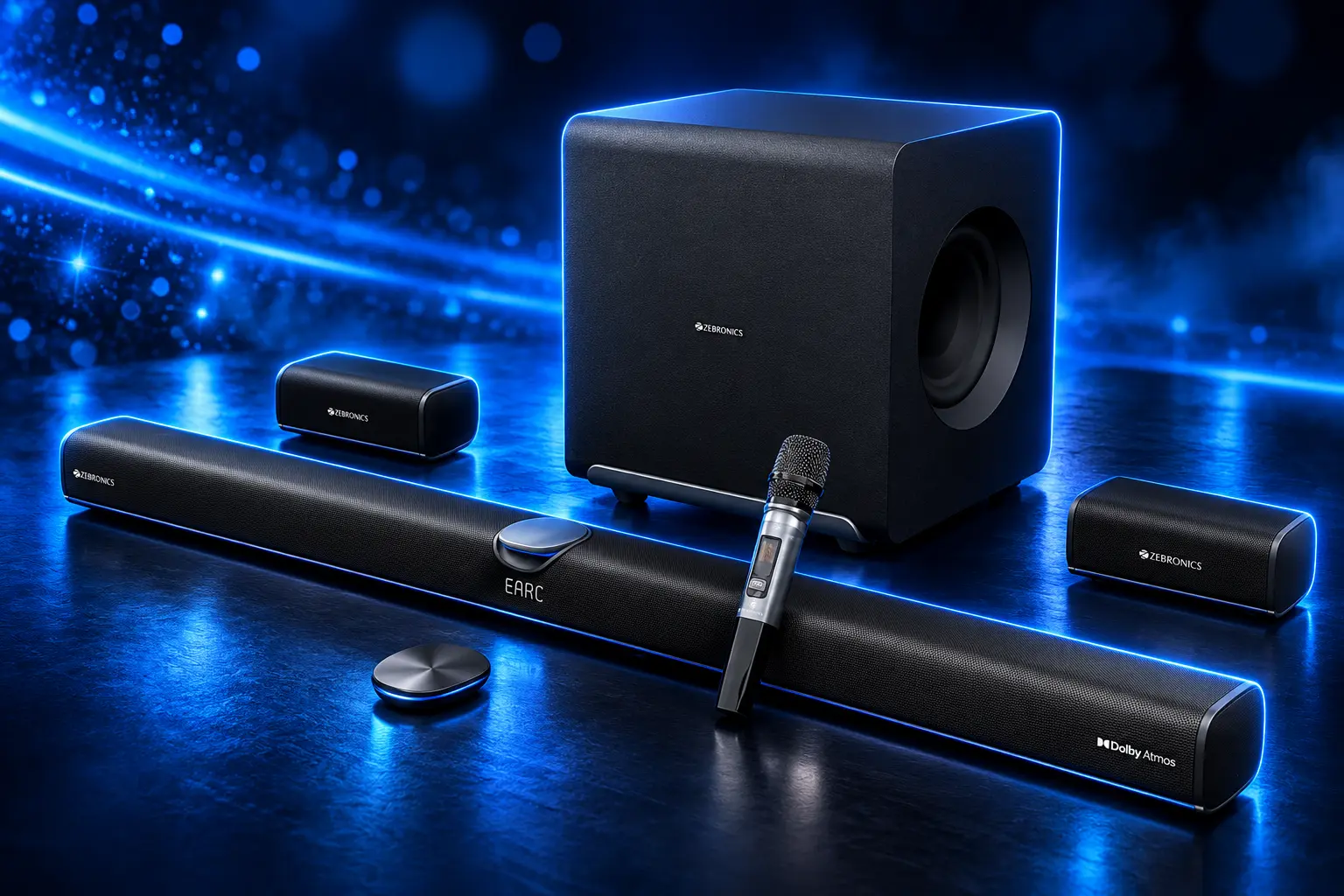
How the Juke Bar 11000 Compares With Samsung’s Q990H
The 11.x.4 fight in India is not empty. Samsung’s current flagship is the 11.1.4 Q-Series HW-Q990H with 23 speakers, a 756W system whose India store price is ₹1,07,990 against an MRP of ₹1,24,900. That carton includes a wireless subwoofer and wireless rear speakers, SpaceFit Sound Pro, Q-Symphony, Wi-Fi, two HDMI inputs, one HDMI output and 4K 120 Hz video pass.
Zebronics is asking ₹37,991 less and putting a second subwoofer channel in the model name. It is also claiming more than double the wattage. Wattage on an Indian spec sheet is a marketing number as often as it is a listening one, and Samsung’s 23-speaker count is the hardware fact the 11000 still has to beat in a room.
THE ₹70,000 NEIGHBOURHOOD
| Model | Channels | Claimed RMS | India price | Bass hardware |
|---|---|---|---|---|
| Zeb-Juke Bar 11000 | 11.2.4 | 1610W | ₹69,999 intro | Dual 20.32 cm subs |
| Samsung HW-Q990H | 11.1.4 | 756W | ₹1,07,990 store | One wireless sub, 23 speakers |
| Samsung HW-Q930H | 9.1.4 class, 580W | 580W | ₹73,990 store | Sub plus rears in the 2026 Q line |
| Zeb-Juke Bar 10000 | 7.2.4 | 1100W | ₹44,999 shop | Dual active drivers plus 20.32 cm passives |
| Zeb-Juke Bar 9900 | 5.2.4 | 725W | ₹29,999 shop | Dual 16.51 cm wireless subs |
At ₹73,990, the Q930H is the Samsung kit sitting on almost the same rupee as the 11000. Buyers who want the 11-channel Samsung stack still pay the Q990H’s ₹1,07,990. The 11000’s pitch is that two 20.32 cm (8-inch) subs and a higher channel label close that gap without another ₹38,000.
The launch note does not list extra HDMI inputs, Wi-Fi, app calibration or 4K 120 pass. Consoles are named as a use case, yet the published jacks stop at eARC, optical, USB, AUX and Bluetooth v5.3. That is a live hole if the buyer’s other habit is passing game video through the bar.
The Juke Bar Line Already Trains Buyers to Wait
Zebronics has been walking the same staircase for a year, adding channels and watts, then letting the shop price fall far below the printed MRP. The 11000’s ₹69,999 intro is new money for this brand. The discount habit around it is not.
THE JUKE BAR CLIMB
- September 7, 2015: First Juke Bar ships at 49W RMS with a 13 cm down-firing sub, sold as a compact home-cinema upgrade.
- May 5, 2026: Juke Bar 9890 launches at ₹29,999 with 1030W RMS, 5.1.2 surround, Dolby Atmos, DTS:X, a 20.32 cm wireless sub and true wireless rears.
- September 8, 2026: Juke Bar 11000 lists at ₹69,999 intro, ₹1,69,999 regular, claiming 11.2.4 channels and 1610W RMS.
Four months before this launch, a 1030W Atmos bar with wireless rears was already a ₹29,999 special. The 11000 asks 2.3 times that money for 1.56 times the claimed watts. Shoppers who know the family will also see the 7.2.4 Juke Bar 10000 at ₹44,999 against a ₹1,29,999 regular price, and the Juke Bar 9900 at ₹29,999 against ₹84,999. Both older kits already include Dolby Atmos, DTS:X and a UHF mic.
The 10000 is the cleaner read-through. It ships a 1100W 7.2.4 stack with 10 drivers in the bar, dual wireless rear satellites with top-firing drivers, a wireless sub that mixes 16.51 cm active drivers and 20.32 cm passives, and the same eARC-plus-Bluetooth jack pack. If that kit can be had for ₹44,999 on the brand’s own shop, the 11000 has to prove 11.2.4 is a different product, not a louder SKU waiting for the next sale.
A Wireless Mic Sony and Samsung Leave Out
The feature Sony and Samsung do not drop in the carton is the UHF wireless microphone. Zebronics has been bundling that mic down the Juke Bar line, and the 11000 keeps it. In an Indian living room that hosts birthday karaoke, festival singing and weekend cricket as often as a Dolby Atmos film, that accessory is the use the channel-count ads skip.
WHAT THE 11000 PUTS IN THE PITCH
- Two cinema codecs: Dolby Atmos and DTS:X are both listed, so height mixes from either camp can be decoded without a separate processor.
- Dual 20.32 cm subs: Low-frequency work is split across two 8-inch drivers rather than one wireless cabinet.
- UHF karaoke mic: A wireless microphone is bundled for parties, which the 9900 and 10000 already treated as a standard extra.
- True Wireless Home Audio: Extra compatible speakers can be added for a wider synced stage, which is also how the launch note handles expansion beyond the bar.
- Magnetic remote: The dockable remote adds ambient lighting and parks on the bar, a design touch aimed at the coffee table as much as the rack.
Zeb AcoustiMax is the in-house processing engine, described as tuning each channel in real time. On the 10000, the same badge is written as multi-dimensional DSP. There is no independent measurement yet of what that engine does to dialogue lift, bass leak into neighbouring flats, or Atmos objects in a 10-by-12 room.
What 11.2.4 Means in a Small Room
In the channel formula, 11.2.4 means 11 bed channels, two subwoofer channels and four height channels. Samsung’s rival is 11.1.4: the same bed and height math with one sub channel, built from 23 speakers including in-box wireless rears. Zebronics’ launch note says the 11000 uses 11 drivers and dual 20.32 cm subs, then points to True Wireless Home Audio for additional speakers. It does not, in that note, itemise wireless rear satellites in the carton the way the 10000 product page does.
That gap is the part of “India’s first 11.2.4” that still has to be opened on a table. Side-firing and up-firing drivers in a bar can support a high channel label. Discrete rears in the corners of a typical Indian apartment are a different layout, and they need floor space, power sockets and a partner who will tolerate two extra boxes. Dual 20.32 cm subs raise a second placement problem: two large cabinets in rooms that already fight for a TV unit.
WHAT WE KNOW
- The claim: Zebronics calls the 11000 India’s first 11.2.4 soundbar and rates it at 1610W RMS with Dolby Atmos and DTS:X.
- The ticket: Amazon and Flipkart carry it at ₹69,999 intro, and the shop regular is ₹1,69,999.
- The bass: Two 20.32 cm subwoofer drivers are specified, which is the hardware difference versus Samsung’s single-sub 11.1.4 flagship.
- The extras: A UHF wireless mic, magnetic remote, LED display and wall-mount kit language are in the launch copy.
WHAT IS UNCONFIRMED
- In-box rears: The launch note does not itemise wireless rear satellites in the carton, unlike the 10000 page.
- HDMI beyond eARC: Extra HDMI inputs, 4K 120 pass and an app room-correction pass are not in the published jack list.
- Measured output: No third-party SPL, distortion or Atmos object test has been published against the 1610W claim.
- This SKU’s origin mark: The 11000 carton has not been read in a spec table the way the 10000’s has.
If the 11.2.4 label is mostly drivers in the bar plus two subs, the system still needs a lot of wall and floor in a 2BHK. If discrete rears arrive in the box, the 11000 is a fuller stack than the press note showed. Until a packed carton is inventoried, the safer read is the list Zebronics actually printed.
The Last Flagship Carries a China Origin Mark
Zebronics was founded in 1997 in Chennai as a peripherals house and still sells the 11000 under “Always Ahead” and “Premium for Masses.” The about page cites 145+ Priority Zeb Cares centres, reach across 19,000+ pin codes, 25 offices, 1,300+ staff and more than 500 skilled workers tied to local production and Make in India. CRISIL’s November 18, 2025 note puts ₹1,448.66 crore of operating income in FY25, up from ₹1,292.89 crore in FY24, with reported profit after tax of ₹52.66 crore.
ZEBRONICS ON THE BOOKS
- The age: Private company since April 23, 1997, still run by the Doshi family from Royapettah, Chennai.
- The FY25 top line: ₹1,448.66 crore of operating income, with ₹52.66 crore of reported profit after tax.
- The service net: 145+ Priority Zeb Cares centres and 19,000+ pin codes, which is the after-sales argument against a one-year Amazon-only fling.
- The factory line: The about page puts 500+ skilled workers against a Make in India and Aatmanirbhar Bharat claim.
The previous 1100W flagship does not help that manufacturing story on the carton. The Juke Bar 10000 spec sheet marks country of origin as People’s Republic of China. Several other high-watt Juke Bars carry the same mark. The 11000’s own origin line has not been published in a matching table, so it is not assumed here. The pattern on the last big Atmos bar is still the one buyers can read.
So the ₹69,999 ticket has to do three jobs at once. It has to feel cheaper than Samsung’s ₹1,07,990 11.1.4 stack. It has to feel like a different product from the ₹44,999 7.2.4 kit already on the same shop. And it has to hold, because this brand has already taught India that a Juke Bar’s real price shows up months after the launch card.

Maharashtra Grants Nana Patekar a State Funeral at His Farm

Nifty Tests 22,600 as Banks Carry a Fragile Rebound

India’s 13.3 Crore Voter Cut Lands on the Election Commission

Reflection Bets $25 Billion on Beam’s Cheaper Open Weights

India Finishes Fourth Again, 21 Medals Short of Hangzhou

Tesla Raises Dual Motor Prices as Texas Builds Cybercabs

Generation Lab’s Secret Youth Shot Has a Copycat Problem

The Nantucket Friendship Basket Boom Meets a Maker Shortage

Bristol Myers Quits Cellares as Autoimmune Doses Proceed

Okta Stock Jumps 20% on McKinnon’s Identity Bet
-
 NEWS2 months ago
Generation Lab’s Secret Youth Shot Has a Copycat Problem
-
 AUTO2 months ago
Tesla Raises Dual Motor Prices as Texas Builds Cybercabs
-
 LIFESTYLE2 months ago
The Nantucket Friendship Basket Boom Meets a Maker Shortage
-
 NEWS2 months ago
Okta Stock Jumps 20% on McKinnon’s Identity Bet
-
 BUSINESS2 months ago
Bristol Myers Quits Cellares as Autoimmune Doses Proceed
-
 LIFESTYLE2 months ago
Labor Day Mattress Sales Repeat a Familiar Holiday Discount
-

 BUSINESS2 months ago
Poland Closes Visa-Free Work for Three Fast-Growing Nationalities
-

 NEWS2 months ago
Google Ends EU Spam Demotions but Keeps the Ranking Split