
NEWS
Roman’s First Image Repeats Hubble’s Famous Blur
Roman’s first test image shows green star rings, a planned blur like Hubble’s 1990 start, with fuel now for 22 years of science.

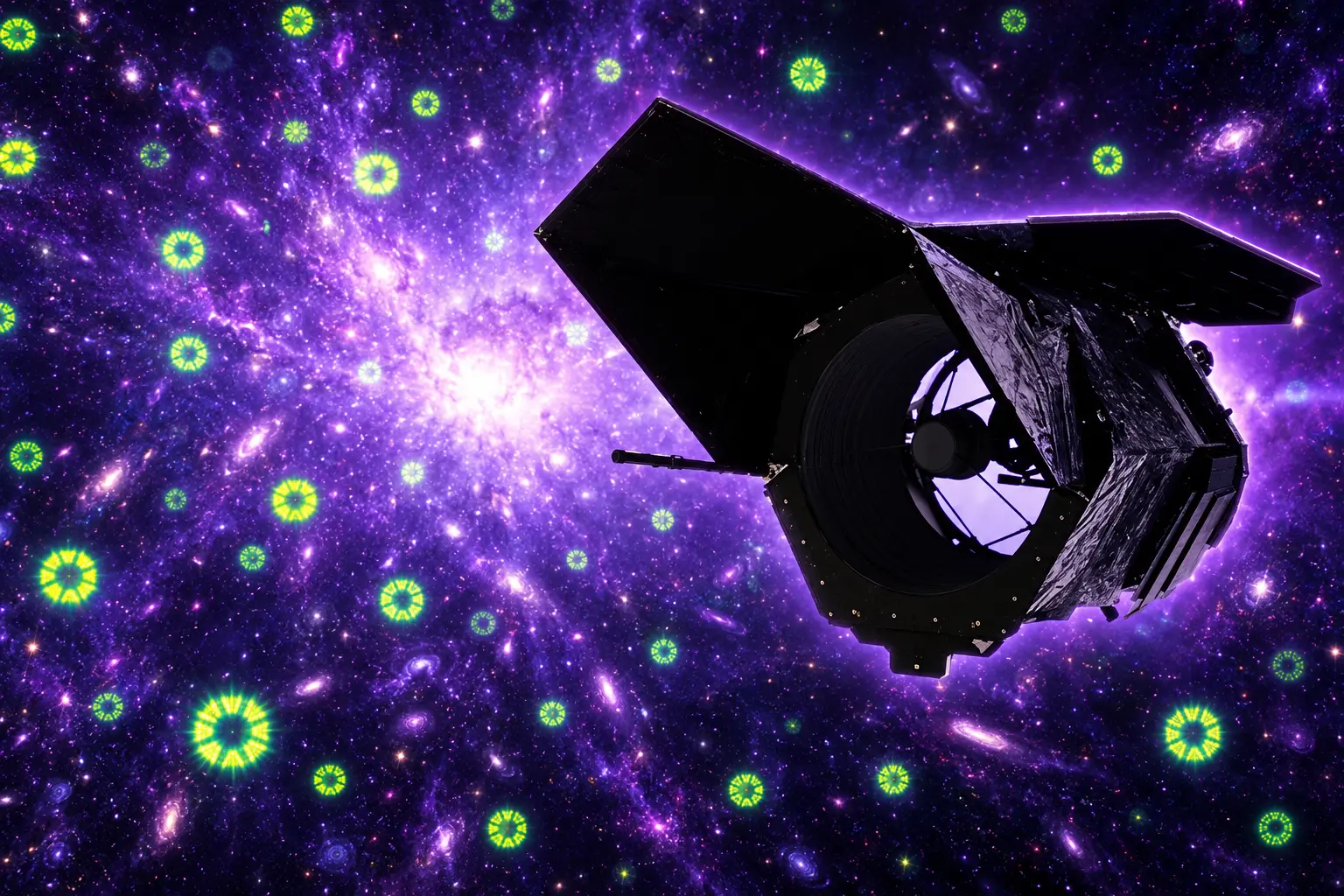
NASA’s Nancy Grace Roman Space Telescope returned its first starlight on a 300-megapixel camera still stowed far from focus, turning a sea of stars into lime-green rings. The agency posted that engineering frame on Sept. 15, 2026, three weeks after an Aug. 30 Falcon Heavy launch from Kennedy Space Center, while the observatory was still coasting toward Lagrange point L2.
The picture will look familiar to anyone who remembers 1990. Hubble’s first months produced blurry stars too. The causes are different, and this time the blur is the checkout NASA planned.
A Repeat of Hubble’s First Blurry Stars
Hubble left Earth on April 24, 1990, with a 2.4-meter primary mirror and a promise of the sharpest pictures yet from space. Two months later, on June 27, 1990, NASA said the telescope was flawed. Both of its imaging cameras showed the same smear, which meant the error sat in the optics, not in one instrument.
Investigators found that a test device called a null corrector had been set with a 1.3-millimeter spacing error, so the Hubble could not achieve sharp focus. The outer edge of the mirror was too flat, ten times outside the allowed tolerance, and light from different zones met at different points. NASA named that flaw spherical aberration. Shuttle astronauts installed corrective optics in December 1993, including a refrigerator-sized package called COSTAR. Hubble’s original life expectancy was 15 years. It has more than doubled that.
Roman uses a primary of the same 2.4-meter class. Its first public frame is another field of hollow star images. The rhyme stops at the physics.
HUBBLE 1990 AND ROMAN 2026, SIDE BY SIDE
| Item | Hubble | Roman |
|---|---|---|
| Launch | April 24, 1990 | August 30, 2026, 7:26 a.m. EDT |
| When the blur went public | June 27, 1990 | Sept. 15, 2026 |
| Cause | Primary mirror too flat from a 1.3 mm test error | Detector array still stowed, far from best focus |
| What fixed or will fix it | Shuttle servicing in December 1993 | On-orbit focus, with science frames due early 2027 |
| Fuel or design life | 15-year plan, already more than doubled | 10-year fuel plan, now 22 years of potential operations |
Round, even rings in a defocused frame are also a quiet optical report. A 2.4-meter mirror figured under Earth’s gravity has to hold that figure once the weight comes off. Clean rings mean the wavefront is still symmetric. Bright stars in later Roman frames will also carry six diffraction spikes from the six struts that hold the secondary, a different stamp from Hubble’s four-spike pattern.
The Detector Array Is Still Stowed for Launch
NASA’s Sept. 15 blog is blunt about what the picture is. It captures the first photons of starlight to reach the Wide Field Instrument, taken as a performance check with the detector array still stowed as it rode to space, far from best focus. Each star is spread over many thousands of pixels. The agency says those broad, donut-like features appear as expected in that configuration. The released frame paints them green.
Josh Schlieder, the Wide Field Instrument scientist at NASA’s Goddard Space Flight Center in Greenbelt, Maryland, put the result in workshop language rather than postcard language.
After years of effort to build and test the instrument on the ground, we now have confirmation that it is operational in space. This is a huge milestone for the team at Goddard, our industry teams at BAE Systems, Inc. and Teledyne, and our science centers. There is much to do, but we are on our way to groundbreaking science.
Josh Schlieder, Wide Field Instrument scientist, NASA Goddard
The mission account struck the same note when it posted the frame, saying sometimes your eyes need a minute to focus when you wake up.
Sometimes your eyes need a minute to focus when you wake up. Roman's Wide Field Instrument just woke up for the first time EVER, and scientists have started adjusting its "eyes" so they can focus on the bigger picture.
Check out its first test image below https://t.co/lkv3LFMyMR pic.twitter.com/AnI6XU1MAm
— Nancy Grace Roman Space Telescope (@NASARoman) September 15, 2026
Before anyone could even turn the camera on, the team let the Wide Field Instrument rest for 10 days so it could dry out, with the detectors held at a relatively warm minus 85 degrees Fahrenheit (minus 65 Celsius). On the morning of Sept. 11 they cut the instrument heater and let the hardware fall to minus 225 Fahrenheit (minus 143 Celsius), then brought up all 18 infrared detectors. Those chips share a sensing area about the size of a laptop screen. They kept cooling toward a final temperature of about minus 300 Fahrenheit (minus 183 Celsius) while other hardware got its first workout without gravity.
WHAT THE WFI TEAM RAN IN MID-SEPTEMBER
- Sept. 11 morning: Heaters off, detectors cooled, all 18 chips turned on.
- That night: The calibration system came up so test data could move through the camera.
- Next morning: Test data ran down to engineers on the ground.
- Saturday evening: The element wheel of filters, prisms, and other optics moved in microgravity for the first time.
- Sunday morning: The focus mechanism, which will sharpen hundreds of thousands of later frames, checked out.
NASA says every one of those tests matched the plan. The team will next turn on the fine-guidance system so Roman can lock onto targets, then pull each star down from a broad ring to a crisp point. First science images are still due by early 2027.
Eighteen Detectors and a Moon-Wide Frame
The wavy rows of squares in the test image are the camera. The Mosaic Plate Assembly holds 18 large-format detectors in an arch. Each chip has more than 16 million pixels that collect visible and infrared light; together they make a camera with more than 300 million pixels. Teledyne built the detectors. BAE Systems built the opto-mechanical assembly, including the element wheel that sits in front of the mosaic and rotates filters, a grism, and a prism into the beam.
One Roman exposure covers a patch of sky bigger than the apparent size of a full Moon, with the sharpness of a space telescope in Hubble’s class. Hubble’s infrared frames from Wide Field Camera 3 are about 200 times smaller. Even Hubble’s widest exposures, from the Advanced Camera for Surveys, are nearly 100 times smaller. Over the first five years of observations, NASA says Roman will image over 50 times as much sky as Hubble covered in its first 30 years, and survey the sky up to 1,000 times faster while keeping similar sensitivity and infrared resolution.
That is the job Hubble never had. Hubble stares. Roman tiles. The High-Latitude Wide-Area Survey is built to map galaxies by the billion and to measure how fast the universe’s expansion is speeding up, which is the dark-energy problem in survey form. The same wide field will watch the galactic bulge for brief brightenings that betray planets, black holes, and other compact masses through microlensing.
Why the First Burn Used 18 Kilograms
The picture is the public milestone. The fuel ledger is the one that changes the mission’s clock. Roman was designed for a five-year primary run plus a five-year extended run, a 10-year fuel budget in total. Propellant is the consumable that ends the work. NASA now says the observatory has fuel for at least 22 years of potential science operations.
The first mid-course correction went out on Aug. 31, a day after launch, and hit its target with more than 99 percent accuracy. It burned about 40 pounds (18 kilograms) of hydrazine, down from an allocation of 441 pounds (200 kilograms), which is less than 10 percent of the fuel set aside for that maneuver. NASA books that save as about four extra years.
Four more years were already in the tanks at liftoff. The team had budgeted propellant against a conservative maximum mass of 21,605 pounds (9,800 kilograms). Roman actually weighed 17,760 pounds (8,056 kilograms), some 3,845 pounds lighter, so the tanks could be filled to capacity instead of to the 10-year line. Technicians had loaded 290 gallons of hydrazine at Kennedy on July 25.
A spacecraft’s mass changes throughout the design and build process, so we base the propellant budget on a set maximum value so we won’t come up short. We track the propellant needed based on actual mass throughout integration and testing as well, to make sure we have wiggle room. Since Roman’s was lower than we budgeted for, we were able to fill the propellant tanks to their capacity rather than only filling them as much as we needed to for the 10-year requirement.
Alison Rao, Roman propulsion lead, NASA Goddard
Jamie Dunn, Goddard’s center director, tied the extra life to the trajectory team, the operations team, and a precise SpaceX launch. A second course correction, planned for later in September, is expected to be very small because the first burn was so accurate, and orbital insertion at L2 should also come in under budget. NASA treats those two remaining burns as about four more years, still expected rather than banked.
WHERE THE EXTRA YEARS COME FROM
| Source | Added potential life |
|---|---|
| Original fuel plan | 10 years (five primary, five extended) |
| First burn, 18 kg of 200 kg allocated | +4 years |
| Tanks filled at launch because the spacecraft was light | +4 years |
| Second correction and L2 insertion, still expected | +4 years |
| Total potential science operations | At least 22 years |
Once Roman is in its halo path around L2, station-keeping burns come roughly every 28 days. NASA’s observatory notes also list the spacecraft as able to be refueled in flight by a robot, a port kept in reserve if a later servicer ever flies. That is not a funded 22-year science program. It is hydrazine in the tanks, and hardware still has to last.
Caltech Flipped Every Switch on the Coronagraph
The same week the Wide Field Instrument saw starlight, Roman’s second instrument stretched what NASA called its digital, electronic, and mechanical limbs. The Coronagraph Instrument is a stack of optics, masks, self-flexing mirrors, and sensors built to block a star’s glare so a faint planet beside it can be photographed in reflected light. It is a technology demonstration, with a path toward a future Habitable Worlds Observatory, not the machine that will mint the huge planet catalog.
Operators at the Coronagraph Commanding Center at Caltech/IPAC in Pasadena, California, confirmed they could talk to the software, thermal control, mechanisms, cameras, and avionics. The movable mechanisms that hold the masks, color filters, lenses, and prisms all answered. The thermal system brought the hardware, aside from the detectors, to 72 degrees Fahrenheit (22 Celsius), near room temperature on purpose so the deformable mirrors sit in the material state they were tested in. The shaped-pupil masks are each about the size of a U.S. quarter.
Eric Cady, an optical engineer leading coronagraph commissioning at NASA’s Jet Propulsion Laboratory, said the instrument then went idle with its detectors warm so water and trace chemicals will leave the surfaces. That dry-out is set for 30 days, with occasional stops for other early calibration. If the coronagraph later performs as designed, it is built to pick out planets about 100 million times fainter than their stars, a hundred to a thousand times better than earlier space coronagraphs, including Jupiter-like worlds in Jupiter-like orbits.
The big planet numbers belong to the Wide Field Instrument. NASA expects Roman to reveal around 100,000 worlds by the transit method, watching stars dim as planets cross them, against a current tally of nearly 6,300 confirmed exoplanets. Microlensing, which is better at wider orbits and smaller planets, is expected to add more than 1,000 more. The coronagraph’s job is to photograph a few of those neighbors without the star washing them out.
1.4 Terabytes Will Land Every Day
A camera this wide is a downlink problem. NASA’s launch statement said Roman will send back 1.4 terabytes of data every day, the highest data rate of any NASA astrophysics mission so far. Machine learning, other software, and volunteer classifiers will have to flag the interesting frames, because no guest observer is going to pull this archive onto a laptop the way Hubble users once did.
The mission account has already put that firehose next to Hubble’s lifetime haul: Hubble gathered 172 terabytes of data in its first 30 years, while Roman will produce 1.4 terabytes every day. At that rate the newer telescope matches Hubble’s 30-year archive in about 123 days. Ground stations in New Mexico, Australia, and Japan are on the receiving list, with the Deep Space Network in the mix on the cruise.
THE DAILY HAUL AGAINST THE OLD FLAGS
- Roman: 1.4 terabytes of science data each day, once surveys are running.
- Hubble: 172 terabytes across its first 30 years, matched by Roman in about 123 days.
- Field of view: One Roman frame is larger than a full Moon, about 200 times the area of Hubble’s infrared camera.
- Planet census: Around 100,000 transiting worlds expected, plus more than 1,000 from microlensing, against nearly 6,300 known today.
The people who will live in that archive are the ones the 1990 Hubble crisis never had to invent. Survey science at this volume is a software project as much as a telescope project. Dark-energy measurements, weak-lensing maps, and a bulge microlensing campaign all assume the pipeline holds when the Ka-band link is busy.
L2 Insertion Is Set for Early December
Roman is still on a roughly 100-day cruise to Sun-Earth L2, about one million miles (1.6 million kilometers) from Earth, the same neighborhood where the James Webb Space Telescope flies. NASA expects the insertion maneuver around early December. Commissioning does not wait for parking. Deployments, thermal soaks, and instrument checkouts are already stacked on the transfer.
ROMAN’S ROAD TO FIRST SCIENCE
- August 30, 2026: Lifts off at 7:26 a.m. EDT on a SpaceX Falcon Heavy from Launch Complex 39A at Kennedy Space Center.
- August 31, 2026: First mid-course correction uses 18 kilograms of hydrazine and scores more than 99 percent accuracy.
- September 11, 2026: Eighteen Wide Field Instrument detectors turn on after a 10-day dry-out.
- September 15, 2026: NASA releases the first test image, a field of out-of-focus green rings, and confirms a first coronagraph checkout.
- Later September 2026: A second, smaller course correction is planned to set up the L2 arrival.
- Early December 2026: Halo-orbit insertion around L2, about 100 days after launch.
- Early 2027: First science images, if focus and guidance work stay on the present path.
Hubble needed a shuttle crew and three years to turn hollow stars into a working observatory. Roman’s hollow stars are a focus mechanism and a still-stowed array away from the same class of sharpness, spread across a field a Moon wide, with enough hydrazine on board, if the hardware holds, for a 22-year watch. NASA is still aiming at those first science frames in early 2027.

John Mayer Bets Sob Rock Can Be a Record Label

H1N1 Rises Early After Last Winter’s H3N2 Wave

Human Fires Drive Amazon Carbon Emissions Even Without Drought

Charli XCX Secretly Films a Cameo in Scorsese’s Horror

Santos’s 58-Yard Kick Decides the Williams-Maye Rematch

Generation Lab’s Secret Youth Shot Has a Copycat Problem

Tesla Raises Dual Motor Prices as Texas Builds Cybercabs

The Nantucket Friendship Basket Boom Meets a Maker Shortage

Bristol Myers Quits Cellares as Autoimmune Doses Proceed

Okta Stock Jumps 20% on McKinnon’s Identity Bet
-
 NEWS2 months ago
Generation Lab’s Secret Youth Shot Has a Copycat Problem
-
 AUTO2 months ago
Tesla Raises Dual Motor Prices as Texas Builds Cybercabs
-
 LIFESTYLE2 months ago
The Nantucket Friendship Basket Boom Meets a Maker Shortage
-
 BUSINESS2 months ago
Bristol Myers Quits Cellares as Autoimmune Doses Proceed
-
 NEWS2 months ago
Okta Stock Jumps 20% on McKinnon’s Identity Bet
-

 BUSINESS2 months ago
Poland Closes Visa-Free Work for Three Fast-Growing Nationalities
-

 NEWS2 months ago
Ox Alpha Was a Chinese Chip Stress Test All Along
-

 LIFESTYLE2 months ago
Labor Day Mattress Sales Repeat a Familiar Holiday Discount