
NEWS
The Alzheimer’s Blood Marker That Missed Memory on Day One
University of Miami researchers found p-tau181 tracked poorer memory six years later, with no independent same-day memory link in 1,170 adults.

Higher blood p-tau181 in 1,170 older U.S. adults tracked poorer memory six years later, with no independent link to memory on the day of the draw. Deirdre O’Shea, Ph.D., and James Galvin, M.D., M.P.H., at the University of Miami Miller School of Medicine reported the pattern in Alzheimer’s & Dementia: Diagnosis, Assessment & Disease Monitoring, using Health and Retirement Study Harmonized Cognitive Assessment Protocol waves from 2016 and 2022.
The kits now reaching U.S. labs are built for people who already have symptoms, and they return a same-day category. This cohort result is a timing mismatch: the marker that looked quiet at baseline was the one that moved with later memory.
The Blood Draw That Failed the Same-Day Check
O’Shea, an assistant professor of cognitive neurology, and Galvin, professor of neurology and founding director of the Comprehensive Center for Brain Health, started with 1,657 people who completed both HCAP waves. Complete blood data existed for 1,287 of them. After dropping cases with missing covariates, the analytic sample was 1,170.
THE HRS-HCAP ANALYTIC SAMPLE
- Final sample: 1,170 adults with a 2016 blood draw and cognitive testing in both 2016 and 2022.
- Starting status: 931 were cognitively normal, 206 had mild cognitive impairment, and 33 had dementia.
- Who they were: Mean age 73.4 years (SD 6.0), 13.2 years of schooling (SD 3.0); 58.9% were women.
- Genetics: 23.6% carried at least one APOE ε4 allele.
The sample was 72.6% non-Hispanic White, 14.0% non-Hispanic Black, 11.5% Hispanic, and 1.9% other non-Hispanic. Certified phlebotomists drew the blood in people’s homes and shipped it overnight to the University of Minnesota Advanced Research and Diagnostic Laboratory. Prior checks of that shipping protocol found 92% of samples arrived within 24 hours and 99% within 48 hours.
Plasma amyloid-beta 42/40, glial fibrillary acidic protein (GFAP), and neurofilament light (NfL) were run on a Simoa HD-X with Quanterix’s Neurology 4-Plex E kit. Serum p-tau181 used the Simoa pTau-181 V2 kit. Values were log-transformed and converted to z-scores. Those measures sit inside the Health and Retirement Study’s 2016 venous blood neurodegeneration assays, which cover about 4,500 participants, including HCAP volunteers with stored venous blood.
At that first visit, p-tau181 did not differ across the normal, mild-impairment, and dementia groups (p =.497). Lower amyloid-beta 42/40 and higher GFAP and NfL did. If a clinic had used the 2016 p-tau181 reading as a same-day memory test, it would have looked like a miss.
p-tau181 Tracked Memory Six Years Later
The 2022 wave told a different story. In models that treated each marker on its own, 2016 p-tau181 showed the strongest later link to memory (beta -0.088, 95% CI -0.119 to -0.057) and to a global composite (beta -0.078). The executive-function link was smaller (beta -0.028). All of those models already accounted for age, sex, education, race and ethnicity, APOE ε4, and the matching 2016 score, so the 2022 result is performance after the baseline score is held constant.
When all four markers went into the same model, p-tau181 still moved with memory (beta -0.080) and global cognition (beta -0.066). NfL and amyloid-beta 42/40 did not keep an independent link to any domain. The full domain-by-domain results are in the May 5, 2026 preprint that matches the journal report.
People in the highest p-tau181 tertile scored lower six years later on memory (beta -0.237, 95% CI -0.314 to -0.160), global cognition (beta -0.213), language (beta -0.097), and executive function (beta -0.098). A stacked model found a tertile-by-domain interaction (chi-square 18.50 on 2 degrees of freedom). The high-versus-low gap was larger for memory than for executive function, with a planned contrast of -0.163 (SE 0.039).
p-tau181 was not associated with memory at the initial assessment, but it was associated with memory performance six years later. That suggests these blood markers may provide information about future cognitive vulnerability that is not apparent from cognition measured at the same point in time.
Deirdre O’Shea, Ph.D., assistant professor of cognitive neurology, University of Miami Miller School of Medicine
The same prospective pattern held when the authors limited the file to the 931 people who were cognitively normal in 2016, and again in the 1,137 who did not have dementia at the start. Attrition from the 1,287 people with blood data down to 1,170 did not shift demographics, APOE ε4, or marker levels (all p >.40).
Which Protein Maps Onto Which Skill?
O’Shea and Galvin refused the usual shortcut of one “Alzheimer’s positive” flag and one global score. They kept each marker on its measured range and scored memory, executive function, language, visuospatial skill, and global cognition as separate composites. Memory used delayed and recognition tasks from CERAD word lists and constructional praxis, MMSE three-word recall, the East Boston Memory Test, and Wechsler Logical Memory. Executive function used Trails A and B, backward counting, Raven’s matrices, and the HRS Number Series.
BIOMARKER PATTERN BY DOMAIN
| Marker | Same-day pattern in 2016 | 2022, all four markers together |
|---|---|---|
| p-tau181 | Modest, then gone after FDR and mutual adjustment | Independent link to memory and global cognition |
| GFAP | Memory, executive function, and global cognition | Still linked to memory, executive function, and global cognition |
| NfL | Memory, executive function, and global cognition | No independent link |
| Amyloid-beta 42/40 | Executive function, global cognition, and language | No independent link |
A first principal component loaded on NfL (0.86), GFAP (0.80), and p-tau181 (0.62), with almost no amyloid-beta 42/40 (-0.06). That composite tracked later memory, executive function, global cognition, and language, but not visuospatial skill. Fit statistics then split by domain: AIC preferred the four-marker panel for memory, while BIC preferred p-tau181 alone; both criteria preferred the composite for executive function.
Blood biomarkers are often discussed as positive or negative tests, but biology exists on a continuum. By examining biomarker levels across their full range and looking separately at memory, executive functioning and other cognitive abilities, we could see patterns that would be lost by reducing either the biomarker or cognition to a single category.
Deirdre O’Shea, Ph.D., University of Miami Miller School of Medicine
On the Day of the Draw, Injury Markers Led
Cross-sectional models, the ones a clinic would run if it only had today’s blood and today’s test scores, were led by NfL and GFAP. Both showed negative links with memory, executive function, and global cognition at q <.001 in single-marker models, and those effects survived when the four markers were entered together. p-tau181's same-day links were modest and largely dropped after FDR correction, then vanished in the mutual model.
Coefficient-difference tests made the swap explicit. For p-tau181, the memory and global coefficients were stronger in the six-year models than in the same-day models. For amyloid-beta 42/40 and NfL, the global coefficients were stronger on the day of the draw. GFAP did not show that memory-versus-executive tilt (interaction chi-square 1.66). High NfL tertiles moved memory, executive function, and global scores in parallel, without a memory preference.
That split matches a simple reading of what each protein indexes. NfL tracks axonal injury and GFAP tracks astrocyte activation, both of which can disturb several skills at once. p-tau181 indexes Alzheimer’s-related tau chemistry, which in typical amnestic disease hits episodic memory first. The 2016 p-tau181 reading was not a snapshot of the score in the room. It was a slow signal that showed up in 2022.
Marker levels also differed by race and ethnicity for p-tau181, NfL, and amyloid-beta 42/40 (all p <.001), though not for GFAP. Hispanic participants had the lowest p-tau181. Non-Hispanic Black participants had lower NfL and amyloid-beta 42/40 than non-Hispanic White participants, and the highest APOE ε4 share (34.8%, versus 21.9% and 19.4%). Those gradients are a warning against lifting one cutoff from a specialty clinic and dropping it onto a national sample.
Four Cleared Tests, All Built for Symptoms
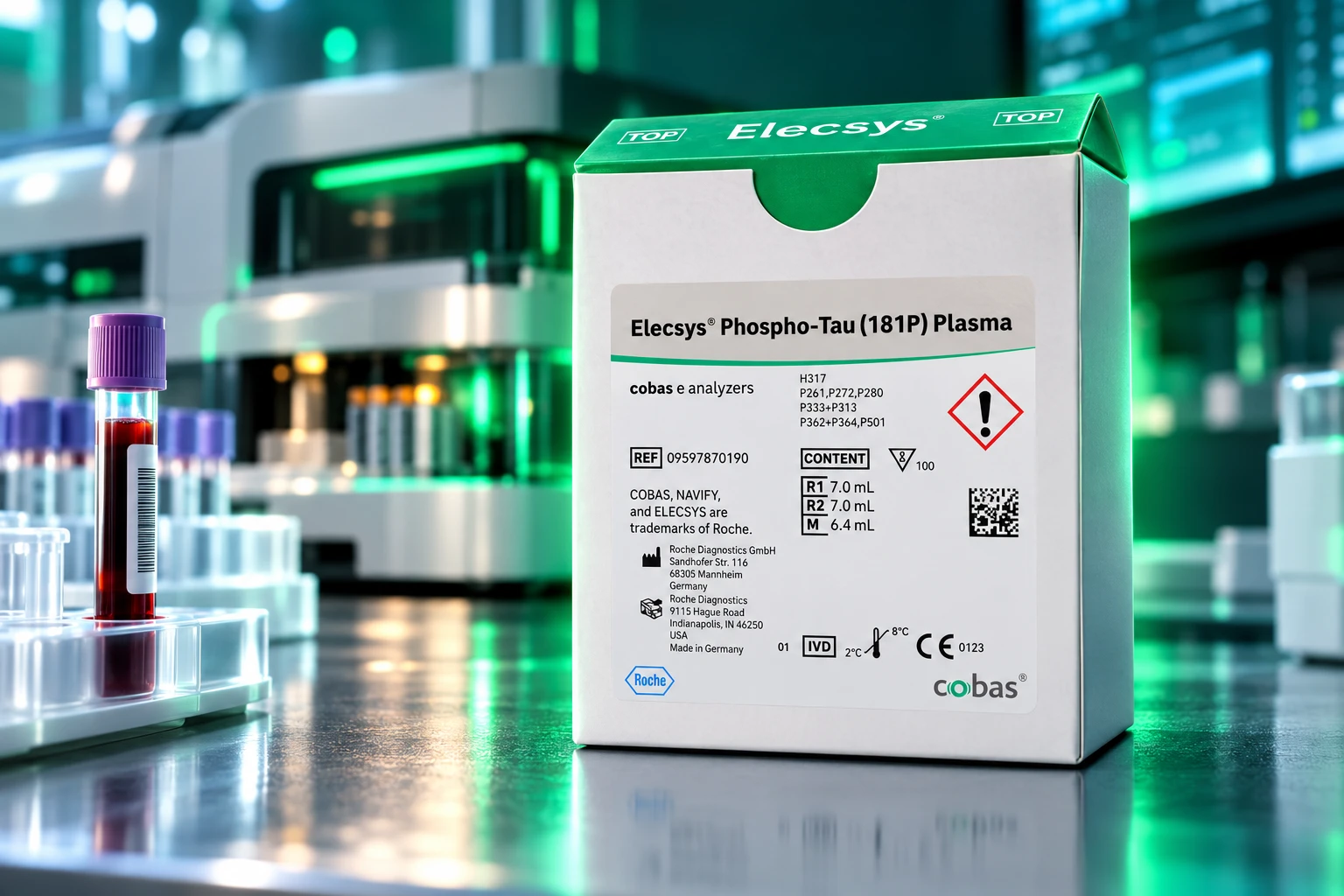
While this paper was moving from preprint to journal, the commercial market went the other way: binary, same-day, and aimed at people who already have complaints. Roche’s Elecsys pTau181, cleared on October 13, 2025 for adults 55 and older with signs or complaints of decline, is a primary-care rule-out. In a 312-person study built to look like that setting, Roche said the assay could 97.9% negative predictive value for amyloid pathology. A negative result, at or below 0.722 pg/mL on that platform, is treated as consistent with a negative amyloid PET scan. A positive result is not treated as proof of a positive scan.
On August 24, 2026, the FDA cleared Roche and Eli Lilly’s Elecsys pTau217, a single-marker assay that uses the same validated cutoffs across primary care and specialty care to sort results as positive, intermediate, or negative. Roche said it can run on more than 4,500 cobas instruments already in U.S. labs. Three days earlier, C2N Diagnostics said the FDA had cleared PrecivityAD2, a mass-spectrometry panel of amyloid-beta 42/40 and p-tau217 ratios for symptomatic adults as young as 40. In 1,142 people, C2N reported a 97.6% positive predictive value and a 93.1% negative predictive value against PET or spinal-fluid testing. Fujirebio’s Lumipulse pTau217/beta-amyloid 1-42 plasma ratio was the first of these blood tests, cleared in May 2025. The Alzheimer’s Association counted Elecsys pTau217 as the fourth cleared blood test, the second in a week.
THE PATH FROM DRAW TO CLINIC
- 2016: HRS HCAP wave 1 and the venous blood study collect cognition and the four markers in the home.
- 2022: HCAP wave 2 repeats the battery; the 2022 public file later lists 3,138 respondent and informant records.
- May 2025: Fujirebio Lumipulse becomes the first FDA-cleared Alzheimer’s blood test for symptomatic adults 55 and older.
- October 13, 2025: Elecsys pTau181 is cleared as a primary-care rule-out, 18 minutes on a cobas e analyzer.
- May 5, 2026: O’Shea and Galvin post the domain-specific HRS analysis as a preprint.
- August 21 and 24, 2026: PrecivityAD2 and Elecsys pTau217 join the cleared list, both built around p-tau217 in people who already have symptoms.
Every one of those kits is labeled for adults who already have cognitive complaints. None is labeled as a forecast of who will develop dementia. Roche’s own pTau217 notice says safety and effectiveness have not been shown for predicting dementia or for tracking drugs. The Elecsys pTau181 decision summary says the same in plainer words: performance has not been established for predicting dementia or for monitoring therapy, and the plasma test is not recommended once a patient has already been sent to a specialist.
So the marker in the Miami paper is the older, weaker cousin of the protein the market is now selling. Head-to-head work has generally found p-tau217 better than p-tau181 at spotting amyloid on PET. The HRS analysis never measured p-tau217. It asked a different question in a different population: in a national sample that still looks mostly normal, does a continuous 2016 p-tau181 reading carry any later memory signal that today’s score does not?
Biomarkers Added at Most 1.6 Percentage Points of Variance
Baseline cognition already explained a lot. Base models, with age, sex, education, race and ethnicity, APOE ε4, and the 2016 domain score, produced R2 values from 28.0% to 75.5% for the 2022 outcomes. Adding the blood markers raised that by a Delta-R2 of.000 to.016, which is 0 to 1.6 percentage points. Nested F-tests still beat the covariate-only model for memory, executive function, global cognition, and language. Visuospatial skill barely moved.
O’Shea has been direct about what that increment is not. The study was not built to say whether a given person will develop Alzheimer’s disease, mild cognitive impairment, or dementia. The associations sat on top of risk factors and the person’s own 2016 score, and they remained small. The design used one blood draw, not a series, and follow-up stopped at the second HCAP wave.
WHAT THIS ANALYSIS DOES NOT DO
- Individual risk: A single p-tau181 value from 2016 does not classify a person as destined for Alzheimer’s or as safe from it.
- Same-day screening: The marker that later tracked memory was the one that failed as a same-day memory correlate and did not differ by 2016 dementia status.
- Assay swap: HRS used Quanterix Simoa kits, including serum pTau-181 V2. Roche’s 0.722 pg/mL plasma cutoff is a different method and cannot be read onto these z-scores.
- p-tau217: The paper has no p-tau217 data, so it cannot rank 181 against the protein now in the newest cleared kits.
- Repeated blood: There is no second draw to show whether a rising slope would have carried more signal than one 2016 number.
The useful object here is a research window, not a product. A protein that did not sort memory in the room still sorted memory six years later, and it did so more for recall than for planning. Clinics buying yes-or-no kits this fall are buying a different tool, for a different patient, on a different day. Anyone who treats that kit as a six-year forecast is asking it to do work its label, and this cohort, both refuse.
Frequently Asked Questions
How Was p-tau181 Measured in the HRS Samples?
Serum p-tau181 was quantified with the Simoa pTau-181 V2 kit on a Quanterix HD-X at the University of Minnesota lab that received the overnight home draws; amyloid-beta 42/40, GFAP, and NfL were run on the separate Neurology 4-Plex E plasma kit, then all four markers were log-transformed and converted to z-scores before the models ran.
Did p-tau181 Differ by Dementia Status at the 2016 Visit?
No. Mean p-tau181 did not differ across the cognitively normal, mild cognitive impairment, and dementia groups in 2016 (p =.497), even though lower amyloid-beta 42/40 and higher GFAP and NfL did show the expected gradient (p ≤.002).
What Is the Harmonized Cognitive Assessment Protocol?
HCAP is an HRS substudy funded by the National Institute on Aging to measure dementia risk with a roughly one-hour in-home respondent battery plus a 20-minute informant interview; the 2016 wave was the first, and the 2022 respondent-and-informant public file contains 3,138 records, of which this paper used the overlap with complete 2016 blood and covariates.
Can These Simoa Z-Scores Be Read Against the Roche 0.722 pg/mL Cutoff?
No. The HRS values come from Quanterix Simoa kits, including a serum p-tau181 assay, while 0.722 pg/mL is the negative cutoff on Roche’s Elecsys Phospho-Tau (181P) Plasma electrochemiluminescence test; the two methods are not interchangeable, and the Elecsys cutoff applies only to that cleared plasma assay in symptomatic adults 55 and older.
Disclaimer: This article is news reporting on a published research analysis and on FDA-cleared laboratory tests. It is informational only and is not medical advice, a diagnosis, or a recommendation to seek or skip any blood test, brain scan, spinal-fluid test, or Alzheimer’s treatment. People who have memory concerns, or who have been offered a biomarker test, should talk with a qualified physician, preferably a neurologist or geriatrician, before acting on any result. Figures, assay cutoffs, and clearance statuses reflect the cited papers, FDA summaries, and company notices as of the dates those documents carry, and they can change.

John Mayer Bets Sob Rock Can Be a Record Label

H1N1 Rises Early After Last Winter’s H3N2 Wave

Human Fires Drive Amazon Carbon Emissions Even Without Drought

Charli XCX Secretly Films a Cameo in Scorsese’s Horror

Santos’s 58-Yard Kick Decides the Williams-Maye Rematch

Generation Lab’s Secret Youth Shot Has a Copycat Problem

Tesla Raises Dual Motor Prices as Texas Builds Cybercabs

The Nantucket Friendship Basket Boom Meets a Maker Shortage

Bristol Myers Quits Cellares as Autoimmune Doses Proceed

Okta Stock Jumps 20% on McKinnon’s Identity Bet
-
 NEWS2 months ago
Generation Lab’s Secret Youth Shot Has a Copycat Problem
-
 AUTO2 months ago
Tesla Raises Dual Motor Prices as Texas Builds Cybercabs
-
 LIFESTYLE2 months ago
The Nantucket Friendship Basket Boom Meets a Maker Shortage
-
 NEWS2 months ago
Okta Stock Jumps 20% on McKinnon’s Identity Bet
-
 BUSINESS2 months ago
Bristol Myers Quits Cellares as Autoimmune Doses Proceed
-

 BUSINESS2 months ago
Poland Closes Visa-Free Work for Three Fast-Growing Nationalities
-

 LIFESTYLE2 months ago
Labor Day Mattress Sales Repeat a Familiar Holiday Discount
-

 NEWS2 months ago
Ox Alpha Was a Chinese Chip Stress Test All Along