
ENTERTAINMENT
Maharashtra Grants Nana Patekar a State Funeral at His Farm
Nana Patekar will receive a Maharashtra state funeral at his Pune farm, a farewell aimed as much at his drought work as at his films.

Veteran actor Nana Patekar died at 75 after a cardiac arrest at his Goa home on October 8, and Maharashtra will give him a state funeral. His last rites will be held at his farmhouse in Donje, on the edge of Pune, after the body arrives from Goa around 5 pm.
Cultural Affairs Minister Ashish Shelar said the honour follows Patekar’s work in Marathi theatre and in Marathi and Hindi cinema. The venue, and the first memories offered by the state’s leaders, sit with the drought villages he spent a decade trying to keep wet.
He Messaged a Friend at 2.30 am
Patekar was at the family house in Dona Paula, near Panaji, with a caretaker and friends. His family was not in Goa. Around 2.30 am he messaged a friend that he was unwell and uncomfortable, with pain on the left side of his chest.
The friend saw the note late and reached the house around 4 am. Dr Shekhar Salkar, chief of oncology at Manipal Hospital, said the actor was then sweating and gasping. The caretaker fetched an ambulance from the nearby hospital. When the emergency team arrived, Patekar was unresponsive, and they started cardiac massage in the house.
THE LAST HOURS IN DONA PAULA
- 2.30 am, October 8, 2026: Patekar messages a friend that he is unwell and in discomfort.
- Around 4 am: The friend finds him sweating and gasping; the caretaker brings an ambulance.
- Around 4.20 am: He is brought to Manipal Hospital; Salkar said he arrived dead to the ward.
- 5.20 am: He is declared dead after what Salkar described as 45 minutes of continuous CPR.
Salkar said the hospital did not know whether Patekar had a history of heart trouble or was on tablets. “It is a case of cardiac arrest, but the cause we dont know,” he told reporters. Because Patekar was not a registered patient and was brought dead, staff opened a medico-legal case. Police moved the body to Goa Medical College for a post-mortem, after which it was to be handed to the family.
His son, Malhar Patekar, confirmed the death from Pune and said he was leaving for Goa. He later reached the hospital. Malhar said his father had died of natural causes and that the funeral would be in Pune.
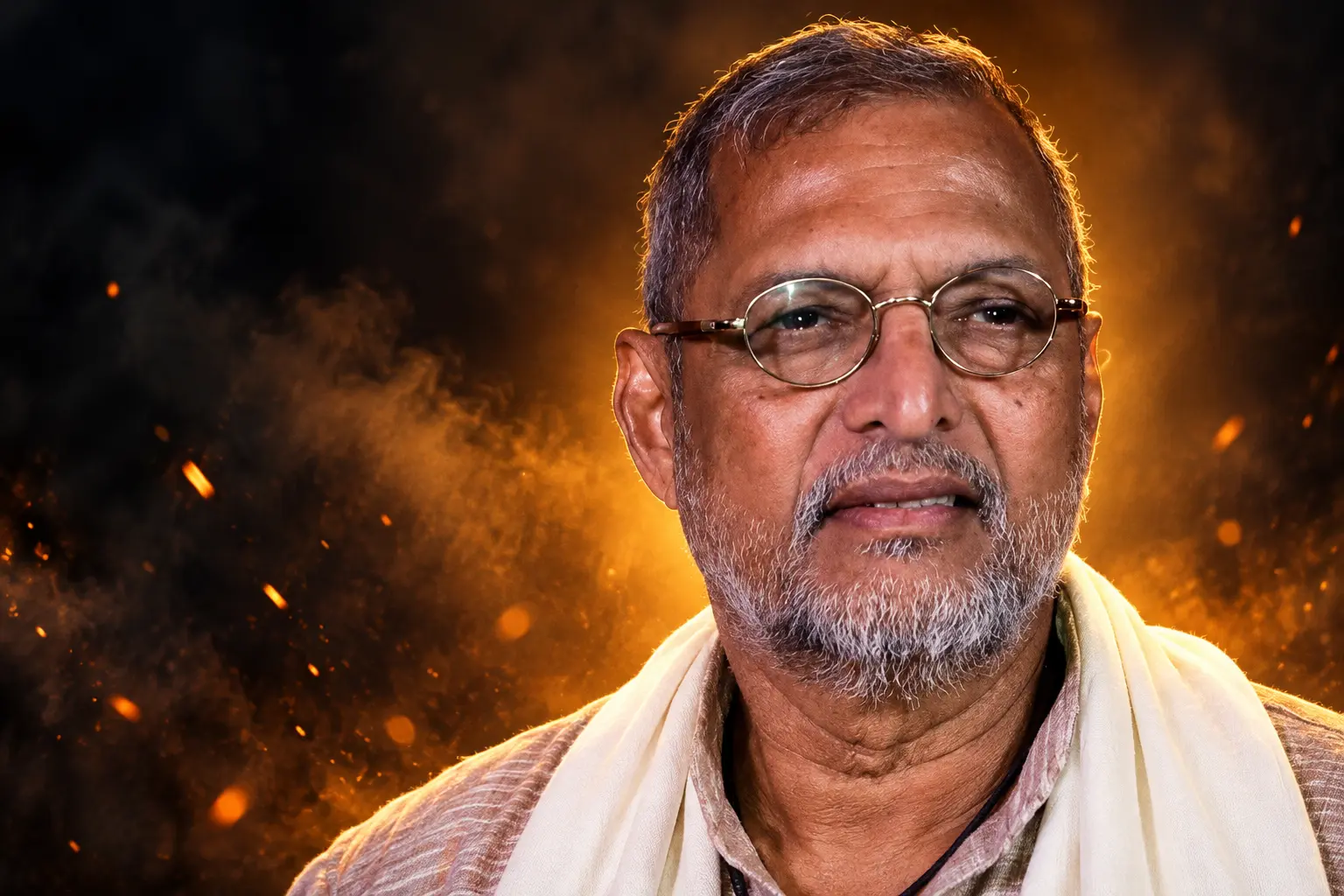
The Funeral Goes to a Pune Farm, Not Mumbai
Ganesh Thorat, chief executive of Naam Foundation, the organisation Patekar co-founded, said the remains would reach Pune around 5 pm, be kept for last darshan, and then be consigned on the farmhouse grounds, with state honours. Shelar had earlier said the family would choose Pune or Mumbai; the choice, once it came, was the farm.
That is a geographic fact, not a sentiment. Mumbai is where the film industry would have staged a public cortege. Donje is where Patekar asked to be taken, a last wish his son and the foundation both repeated through the morning. Four days earlier, on October 4, he had spoken at an event in Dona Paula and told the room, “We all have to go someday,” then, “I don’t know whether I will be here tomorrow or not.”
Shelar announced the state’s decision in Nagpur, then again on his official account, tying the gun salute to theatre and cinema. The post is the order as the government wrote it.
अभिनेते नाना पाटेकर यांचे मराठी नाटकासह मराठी, हिंदी सिनेमातील अतुलनीय योगदान पाहता त्यांचे अंत्यसंस्कार "शासकीय इतमामात" करण्याचा निर्णय आम्ही केला आहे.
— Adv. Ashish Shelar – ॲड. आशिष शेलार (@ShelarAshish) October 8, 2026
Deputy Chief Minister Eknath Shinde, speaking separately, went straight to farmers. He said Patekar’s work for their uplift would not be forgotten, and he named Naam Foundation’s record in drought-prone Maharashtra. The honour on paper is an artist’s honour. The men arranging the pyre are the NGO’s staff.
Naam Foundation’s Own Count Runs Past 77 Lakh Farmers
In September 2015 Patekar and Marathi actor Makarand Anaspure registered Naam Foundation in Pune, after a season of farmer suicides in Vidarbha and Marathwada. Patekar later said he had set aside about ₹1.5 crore for a luxury car, watched a television report on a bereaved farm family, and called Anaspure. They began by sending cheques of ₹15,000 to households that had lost a farmer.
The work moved from cash to water. River beds, nalas, percolation tanks and farm ponds were dug and desilted so rain would stay in the ground. The foundation adopted Dhondalgaon in Vaijapur taluka of Chhatrapati Sambhajinagar district and Aamala in Wardha, aiming to make both tanker-free. It also ran sewing clusters, seed programmes and widow support.
THE NAAM FOUNDATION TALLY
| Measure | Figure on Naam’s site |
|---|---|
| Farmers listed as benefitted | 77.17 lakh |
| Disaster-relief families | 50,908 |
| Aid listed for Army martyrs’ kin | ₹102.5 lakh |
| Widows listed as supported | 4,957 |
| Villages listed on water work | 2,187 |
| People listed as benefitted by water projects | 1,27,23,126 |
| Silt listed as removed | 7,03,97,436 cubic m |
Those numbers are the organisation’s own, published on its homepage as 77.17 lakh farmers on its public tally, not an audited state census. They are still the scale Patekar’s partners now have to defend without him.
THE WATER WORK IN MAHARASHTRA
- Rivers: 198 waterways through 2,187 villages listed as rejuvenated.
- Farm ponds: 385 ponds built in 77 villages.
- Tanks: 939 percolation tanks desilted.
- Dams: five dams desilted.
- Canals: repair or construction listed in 141 villages.
On the same site, Sheela Suryavanshi of Latur district describes the part of this work that never makes a tribute reel. After her husband died by suicide over a loan, Naam bought her a sewing machine. She added machines, trained other women, and now earns about ₹25,000 to ₹30,000 a month, with both children in higher studies. That is the constituency the farmhouse funeral is actually for.
In May 2026, at the Jal Kranti Parishad in Nagpur, Patekar told distressed farmers to call him if they felt suicidal, and he said visits to places such as Beed, and the young widows there, had changed him. Chief Minister Devendra Fadnavis, who called Patekar a close friend, said the actor had walked into villages for farmers and for drought relief, including work tied to the state’s Jalyukt Shivar campaign.
What Full State Honours Mean in Maharashtra
Full state honours are automatic for a sitting governor, chief minister and the chief justice of the Bombay High Court. For anyone else they are a cabinet choice, used for people the government wants to mark as having given the state something large in art, social work or public life. Lata Mangeshkar received them in 2022, Ratan Tata in 2024, Asha Bhosle in April 2026. Patekar now joins that list as a Padma Shri actor whose other life was an NGO.
The ceremony is a police ritual, not a military one. Under the state’s published sequence, 21 police personnel fire three rounds of blanks together, a rifle salute rather than an Army gun.
THE HONOUR SEQUENCE
- Wreath laying: Officials and family place wreaths on the flagged bier.
- Volley: The police contingent fires the three blank rounds.
- The Last Post: The bugle call for a dead serviceman, used here as state theatre.
- Silence: Two minutes, then the Rouse.
- The flag: Folded and handed to the family.
On a farm outside Pune, that sequence will look different from Shivaji Park. There will be less room for a film-industry crowd and more room for the people who already knew the place. The state still gets the image of the tricolour on an artist. The family gets the ground he chose.
Three National Awards and a Padma Shri
Born Vishwanath Patekar in Murud-Janjira, in Raigad district, he studied at Mumbai’s Sir J.J. Institute of Applied Art and took his first stage roles under Vijaya Mehta. He reached films with Gaman in 1978 and spent a decade in small Marathi and Hindi parts, including Mira Nair’s Salaam Bombay! in 1988, before Vidhu Vinod Chopra’s Parinda made him national.
THE NATIONAL FILM AWARDS
| Film | Category |
|---|---|
| Parinda (1989) | Best Supporting Actor |
| Krantiveer (1994) | Best Actor |
| Agni Sakshi (1996) | Best Supporting Actor |
He took Filmfare’s best villain prize twice, for Angaar (1992) and Apaharan (2005), and, with Irrfan Khan, is one of the few actors to win Filmfare trophies as lead, supporting player and villain. He directed, wrote and starred in Prahaar: The Final Attack (1991) after army training for the officer’s role. In Marathi cinema, Natsamrat (2016), as an ageing stage actor, became the part Fadnavis reached for first. The Padma Shri came in 2013. Later credits included Welcome’s comic gangster Uday Shetty, Ab Tak Chhappan, Raajneeti, Kaala, and, in 2026, the series Sankalp and the film O’Romeo.
His later years also carried a public fight he never shook. Actor Tanushree Dutta accused him of harassing her on the 2008 set of Horn Ok Pleassss and repeated the charge in 2018, a complaint that helped open the Hindi industry’s MeToo wave. Mumbai police registered a case and filed a closure report in June 2019. Patekar denied the allegations throughout.
Leaders Named the Drought Work Before the Roles
Fadnavis, in his first written tribute, called the death a massive shock to the heart and said Patekar was as grand on screen as he was in spirit. “Nana was as great-hearted as he was great on screen. He gave Marathi and Hindi cinema an entire era. From Krantiveer to Natsamrat, there is no parallel to the powerful and accomplished range of his acting. His death is a great loss to the film industry,” he said, then turned to Naam Foundation and to the villages.
President Droupadi Murmu put the same two lives in one note, films first, then the poor.
Deeply saddened by the passing of veteran actor Shri Nana Patekar. Through his powerful and deeply evocative performances, he brought to life a wide range of human experiences. He portrayed characters that left a lasting imprint on the hearts and minds of people. His commitment to social service reflected his concern for the underprivileged. His passing is a great loss to Indian cinema.
Droupadi Murmu, President of India, on X
That commitment to social service is what the farm funeral makes visible. Prime Minister Narendra Modi, posting in Marathi, praised the force of Patekar’s screen presence and the frank and unwavering views he refused to soften. Shelar, speaking in Nagpur, lingered on the same bluntness, and on farmers, addiction and water, before he offered the government’s salute.
Riteish Deshmukh, a fellow Maharashtrian star, wrote that the news felt like a truck had hit him, then added that Patekar was a hero off screen who worked through charity for people in trouble. The line that keeps returning, from official accounts and from viewers who never bought a ticket for Parinda, is the soil, not the clapboard.
The NGO Still Has a CEO and a Calendar
Naam Foundation did not die at 5.20 am. Thorat is already the man telling Pune when the body will arrive. Anaspure is still co-founder. The site still lists seed banks, desilting crews, CSR partners and a widow in Latur who bills ₹25,000 a month from a sewing floor that started with one machine. In June 2026 the same organisation was still sending soybean seed to women farmers in Parbhani and planning a seed festival for thousands of households in Dharashiv and across Marathwada.
That calendar is now the test. Celebrity NGOs often shrink when the face that raised the money is gone, because donors were giving to a voice they recognised from Krantiveer, not to a silt-removal invoice in Yavatmal. If the 2,187 villages stay on the books, Patekar’s second career will have outlasted the first. If they do not, the state funeral will have been a better show than a succession plan.
Malhar still owed the detailed family statement he promised from the road to Goa. The post-mortem at Goa Medical College still has to put a certified cause under the cardiac arrest Salkar described. Until both arrive, the facts that will not move are the time of death, the farm in Donje, and a government that wrapped a drought worker in the flag while naming his films.

Maharashtra Grants Nana Patekar a State Funeral at His Farm

Nifty Tests 22,600 as Banks Carry a Fragile Rebound

India’s 13.3 Crore Voter Cut Lands on the Election Commission

Reflection Bets $25 Billion on Beam’s Cheaper Open Weights

Denza Comes to India After Mercedes Walked Away

Tesla Raises Dual Motor Prices as Texas Builds Cybercabs

Generation Lab’s Secret Youth Shot Has a Copycat Problem

The Nantucket Friendship Basket Boom Meets a Maker Shortage

Bristol Myers Quits Cellares as Autoimmune Doses Proceed

Okta Stock Jumps 20% on McKinnon’s Identity Bet
-
 NEWS1 month ago
Generation Lab’s Secret Youth Shot Has a Copycat Problem
-
 AUTO1 month ago
Tesla Raises Dual Motor Prices as Texas Builds Cybercabs
-
 LIFESTYLE2 months ago
The Nantucket Friendship Basket Boom Meets a Maker Shortage
-
 BUSINESS1 month ago
Bristol Myers Quits Cellares as Autoimmune Doses Proceed
-
 NEWS1 month ago
Okta Stock Jumps 20% on McKinnon’s Identity Bet
-

 LIFESTYLE1 month ago
Labor Day Mattress Sales Repeat a Familiar Holiday Discount
-

 NEWS1 month ago
Google Ends EU Spam Demotions but Keeps the Ranking Split
-

 NEWS1 month ago
Ox Alpha Was a Chinese Chip Stress Test All Along