
BUSINESS
Maple Leaf Bets Plant Protein on One Indianapolis Factory
Maple Leaf Foods will close Seattle and Turners Falls plants by late 2027, betting one Indianapolis tempeh factory can make Lightlife and Field Roast pay.

Maple Leaf Foods will close plant-protein factories in Seattle and Turners Falls and run U.S. output from Indianapolis by late 2027. The Mississauga company is betting one plant can carry Lightlife, Field Roast, and Yves Veggie Cuisine after volumes left three factories too empty to keep.
Curtis Frank, president and CEO, tied the move to idle capacity, not to a sale of the brands. The bill, he said, already sits inside Maple Leaf’s 2030 earnings plan.
Maple Leaf Bets Plant Protein on One Indianapolis Plant
On September 22, 2026, Maple Leaf Foods said it will fold U.S. plant-protein production into a single Plant Protein Centre of Excellence at its Indianapolis, Indiana plant. Production at Seattle, Washington, and Turners Falls, Massachusetts, will wind down in phases over about 12 to 18 months, with targeted completion in Q4 2027.
The decision sits inside Fuel for Growth, the company’s plan to simplify plants, cut idle cost, and lift profit. Both closing sites will keep running during the transfer so customers still get product while lines move.
Over the past several years, we have taken significant action to improve the performance of our Plant Protein business, and we have made meaningful progress. But the category has changed significantly, and declining volumes have left our manufacturing network substantially underutilized. Maintaining three facilities at these utilization levels creates structural costs that are not sustainable over the long term.
Curtis Frank, President and CEO, Maple Leaf Foods, September 22, 2026 statement
Frank said Indianapolis will improve the economics of the network and help build “a structurally stronger and sustainably profitable Plant Protein business.” He also said the closures do not change the company’s commitment to the category, and that the recent Yves Veggie Cuisine relaunch adds a brand and extra volume to the plant that will remain.
Maple Leaf did not say how many jobs will go in Seattle or Turners Falls. It said it will support affected staff and look at openings at other plants where that is feasible. It also did not publish the Indianapolis investment or the savings it expects, only that those figures are already in the 2030 outlook.
WHAT WE KNOW
- The footprint: Two U.S. plants wind down; Indianapolis becomes the only U.S. plant-protein factory.
- The clock: The transfer runs about 12 to 18 months and is aimed at Q4 2027.
- The brands: Lightlife, Field Roast, and Yves Veggie Cuisine stay; Yves is cited as extra volume for the remaining plant.
- The books: Expected costs, benefits, and capital needs are included in the previously disclosed 2030 outlook.
WHAT IS UNCONFIRMED
- Headcount: Maple Leaf has not published how many people work in Seattle or Turners Falls, or how many Indianapolis jobs it will add.
- The check: No dollar figure was given for new Indianapolis spending or for savings from the two closures.
- The SKU test: The company has not said how a tempeh-first plant will take on grain sausages, vegan cheese, and the Yves Canadian set.
Empty plants, not a sudden dislike of the labels, are what broke the three-site map. Maple Leaf is still refusing to put Lightlife or Field Roast on the block. That is the wager: keep the brands, kill the extra bricks.
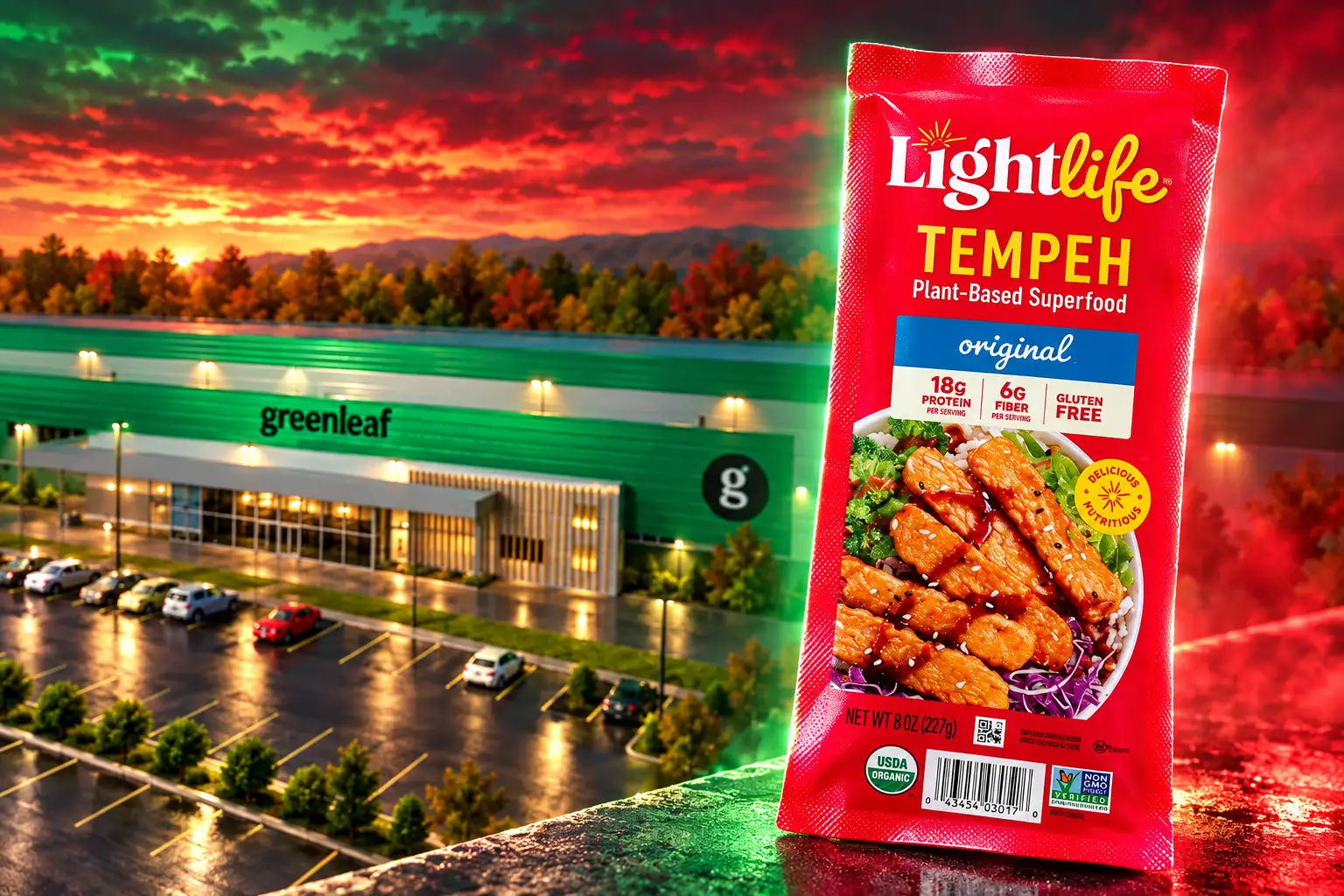
The Tempeh Factory Built for a Boom That Thinned Out
The plant that now has to do everyone’s job sits at 8735 E 33rd St. on Indianapolis’s east side. Maple Leaf bought the 118,000 square foot building in 2021 through Greenleaf Foods, its plant-protein unit, and started production in January 2022. The company still calls it the largest tempeh manufacturing site in the world.
On January 11, 2021, Maple Leaf announced an about US$100 million tempeh expansion at that site. Phase 1 was the purchase plus equipment with initial capacity of about 4.5 million kilograms of tempeh. When fully running, the project was expected to employ about 115 people. If demand held, a second phase could double capacity.
Michael McCain, then president and CEO, said high demand for Lightlife tempeh made Indianapolis a faster way to add capacity. A larger plant-protein factory planned for Shelbyville, Indiana, had already slipped, in part because of Covid-19. Indianapolis was the near-term fix. It is now the whole U.S. plan.
Maple Leaf’s Indianapolis page lists 54 team members. That is 61 below the 115 jobs the 2021 project sketched for full operations, and about 47% of that planned headcount. The page is the company’s own figure, not a new count released with the closures. Even so, the gap is the point: a boom-era tempeh plant never filled out, and it is now being asked to absorb two other factories.
THE THREE U.S. PLANTS
| Plant | How Maple Leaf got it | What it makes | Stated staff | What happens |
|---|---|---|---|---|
| Indianapolis, Indiana | Bought 2021; production January 2022 | Lightlife tempeh | 54 on the company page | Becomes the Centre of Excellence; more staff planned |
| Seattle, Washington | Came with Field Roast in 2018 | Grain meats and Chao vegan cheese | About 200 at the 2017 deal; current figure not given | Wind down by Q4 2027 |
| Turners Falls, Massachusetts | Came with Lightlife in 2017 | Lightlife plant-protein products | Not disclosed | Wind down by Q4 2027 |
Frank said Maple Leaf expects to invest in Indianapolis and add team members as the plant takes on a wider mix. He did not say how much money, or how many people. A factory built to ferment soy cakes will have to learn sausage, deli slices, and whatever Yves volume actually arrives.
Field Roast’s Seattle Plant and Lightlife’s Massachusetts Home
The three-plant map was assembled when plant protein still looked like a second growth engine beside meat. Maple Leaf bought Lightlife in 2017, picking up the Turners Falls plant with it. Lightlife had been making tempeh in Massachusetts for decades before that sale.
The Field Roast deal closed at USD$120 million on January 29, 2018. When Maple Leaf signed the agreement in November 2017, Field Roast had about USD$38 million in sales, about 200 people, and 75,000 square feet of leased plant in Seattle, where the brand started in 1997. Its lineup was grain-based roasts, sausages, frankfurters, burgers, deli slices, and Chao vegan cheese.
Greenleaf Foods was stood up in 2018 to hold both brands. Then came the Indianapolis tempeh bet in 2021, and a Shelbyville factory that never became the North American flagship Maple Leaf once described. By the time Frank spoke on September 22, 2026, the company had already spent years trying to make plant protein earn its keep. The last move is to stop paying for three roofs.
THE ROAD TO ONE FACTORY
- 2017: Maple Leaf buys Lightlife and takes on the Turners Falls, Massachusetts plant.
- January 29, 2018: The Field Roast purchase closes at USD$120 million, adding the Seattle plant.
- January 11, 2021: Maple Leaf announces the US$100 million Indianapolis tempeh project, with about 4.5 million kilograms of initial capacity and about 115 jobs at full run.
- January 2022: Indianapolis starts production and is later described as the world’s largest tempeh plant.
- 2026: Maple Leaf brings Yves Veggie Cuisine back to Canadian grocery shelves with six products.
- August 12, 2026: Second-quarter results show Prepared Foods sales down and poultry sales up.
- September 22, 2026: The company says Seattle and Turners Falls will wind down, with Q4 2027 the target for one U.S. plant.
Seattle is not a random node on a map. It is where Field Roast was founded. Turners Falls is where Lightlife’s tempeh habit lived. Indianapolis is the newest building, and the only one Maple Leaf chose to erect for a boom it no longer forecasts at three-plant scale.
A 2% Drop in Prepared Foods, a 7.1% Jump in Poultry
The factory decision landed six weeks after Maple Leaf reported second-quarter 2026 results on August 12. Sales for the quarter ended June 30 were C$1,020.1 million, up 1.6% from C$1,004.2 million a year earlier. Adjusted EBITDA was C$137.1 million, up 4.8% from C$130.8 million, and the margin rose 40 basis points to 13.4% from 13.0%.
Frank called it the seventh straight quarter of year-over-year revenue growth. Earnings from continuing operations were C$40.8 million. The company reaffirmed full-year 2026 guidance for mid-single-digit revenue growth and adjusted EBITDA of C$520 million to C$540 million.
The split under those totals is the reason Indianapolis can be asked to wait for volume. Prepared Foods sales decreased by 2.0%, on lower volumes and more trade promotion spending, partly offset by pricing, related-party revenue, and mix. Poultry sales rose 7.1%, on higher volumes, a better channel mix, and pricing, even with heavier trade spend. Prepared Foods is about 60% of sales and includes plant protein. Poultry is about 40%.
Q2 2026 AT MAPLE LEAF
- Sales: C$1,020.1 million, up 1.6% from C$1,004.2 million.
- Adjusted EBITDA: C$137.1 million, up 4.8%, margin 13.4%.
- The split: Prepared Foods sales -2.0%; poultry sales +7.1%.
- 2026 guide: Mid-single-digit revenue growth; adjusted EBITDA C$520 million to C$540 million.
Year-to-date sales were C$1,983.0 million, up 3.8% from C$1,910.9 million. Poultry sales were up 9.3% in the first half. Prepared Foods sales were flat, as pricing and mix offset lower volumes. Plant protein does not get its own line in those figures, so the 2.0% Prepared Foods drop is not a pure plant-protein read. It is still the bucket that has to fund idle plant-protein lines until Indianapolis is full.
On the March 2026 investor day, Frank described plant protein as a business in the stages of returning to profitable growth. One of the 2030 goals he laid out was portfolio-average margins in plant protein, beside double-digit growth in meat. The long-range targets attached to that plan are about C$5 billion in revenue and about C$750 million in adjusted EBITDA. Closing two plants is how Fuel for Growth tries to make the margin half of that math less theoretical.
Yves Veggie Cuisine Is the Volume the New Plant Needs
Frank went out of his way to put Yves in the same sentence as the closures. Maple Leaf brought the brand back to grocery stores across Canada with six products after taking it on when Hain Celestial had stopped it. In the September 22 statement, he called that relaunch complementary, “bringing a leading brand and additional volume into our portfolio and helping us create greater scale and improve the economics of our consolidated manufacturing footprint.”
That is a specific claim. Yves is not a nostalgia side project in this telling. It is tonnes that Indianapolis is supposed to run so the remaining plant is less empty than the three-plant net was. If Canadian shoppers do not pick those six products up at enough scale, the “centre of excellence” still has a utilization problem, only with one address instead of three.
The brands Maple Leaf is stacking onto that address are not interchangeable. Lightlife’s Indianapolis output today is tempeh, a fermented soy cake sold to retail and foodservice. Field Roast’s Seattle heritage is grain meat and Chao cheese. Yves is a Canadian grocery set being restarted. One plant can run all of that only if changeovers, recipes, and customers tolerate the squeeze. Frank’s own forward-looking list names SKU transfer and customer service as things that have to go right.
Shoppers who already walked away from plant-protein analogues will not refill a tempeh plant by themselves. The company is acting as if a tighter factory, plus Yves, plus whatever is left of Lightlife and Field Roast, can earn the same kind of margin as the rest of the portfolio. That is a narrower, harder bet than the one McCain described when tempeh demand still justified US$100 million of new kit.
What Has to Hold Until Late 2027
The transfer is not a weekend shutdown. Maple Leaf said production will continue in Seattle and Turners Falls while work moves, so retailers keep stocked and the Indianapolis plant can be rebuilt in stages. The company’s caution list is blunt: the wind-downs have to finish, the lines have to commission on time, SKUs have to move without wrecking service, and the savings have to show up. Volumes, labour, and the plant-protein category itself can still knock the plan off course.
Q4 2027 is the date on the door. From September 22, 2026, that target sits inside the 12 to 18 month window the company also gave. Until then, Maple Leaf will be paying for plants it has already scheduled to close, which is the expensive middle of this kind of bet.
WHAT THE INDIANAPOLIS BET NEEDS
- A full SKU move: Grain sausages, tempeh, vegan cheese, and Yves lines have to run in one 118,000 square foot plant without losing customers.
- Real Yves tonnes: The Canadian relaunch has to deliver the extra volume Frank said would improve the remaining plant’s economics.
- Staff who stay, then staff who arrive: Seattle and Turners Falls teams keep the old lines alive through the transfer; Indianapolis has to add people as the mix widens.
- Category volumes that stop falling: A single plant still fails if demand keeps shrinking under the capacity Maple Leaf chose to keep.
- The 2030 margin test: Plant protein has to move toward portfolio-average margins if the C$750 million earnings target is going to have that unit in it.
Frank told Seattle and Turners Falls staff the decision was not a judgment on their work. “Our colleagues in Seattle and Turners Falls have made important contributions to our business and have consistently demonstrated tremendous commitment to our customers, consumers and brands,” he said. “This decision is not a reflection of their performance or the quality of their work.” Support, he said, would come “with respect, fairness and transparency.”
The remaining factory is a 118,000 square foot tempeh plant on the east side of Indianapolis, with 54 people on the company roster and a second phase that was designed to double tempeh output if demand ever returned. Seattle and Turners Falls are due to keep shipping until those lines actually move. Maple Leaf has not said how many people that leaves without a plant, or how much it will spend to make one building do the work of three.

John Mayer Bets Sob Rock Can Be a Record Label

H1N1 Rises Early After Last Winter’s H3N2 Wave

Human Fires Drive Amazon Carbon Emissions Even Without Drought

Charli XCX Secretly Films a Cameo in Scorsese’s Horror

Santos’s 58-Yard Kick Decides the Williams-Maye Rematch

Tesla Raises Dual Motor Prices as Texas Builds Cybercabs

Generation Lab’s Secret Youth Shot Has a Copycat Problem

The Nantucket Friendship Basket Boom Meets a Maker Shortage

Bristol Myers Quits Cellares as Autoimmune Doses Proceed

Okta Stock Jumps 20% on McKinnon’s Identity Bet
-
 NEWS2 months ago
Generation Lab’s Secret Youth Shot Has a Copycat Problem
-
 AUTO2 months ago
Tesla Raises Dual Motor Prices as Texas Builds Cybercabs
-
 LIFESTYLE2 months ago
The Nantucket Friendship Basket Boom Meets a Maker Shortage
-
 BUSINESS2 months ago
Bristol Myers Quits Cellares as Autoimmune Doses Proceed
-
 NEWS2 months ago
Okta Stock Jumps 20% on McKinnon’s Identity Bet
-

 BUSINESS2 months ago
Poland Closes Visa-Free Work for Three Fast-Growing Nationalities
-

 LIFESTYLE2 months ago
Labor Day Mattress Sales Repeat a Familiar Holiday Discount
-

 NEWS2 months ago
Ox Alpha Was a Chinese Chip Stress Test All Along