
NEWS
Heatwaves Now Arrive Before Bodies and Crops Are Ready
A 1979 to 2023 land study finds heatwave seasons about 39 days longer, with first events arriving earlier and peaking faster, before health plans and crops are set.

A global land study covering 1979 to 2023 finds the heatwave season has lengthened by about 39 days, with the first event arriving about two weeks earlier. The last heatwave now falls about 24 days later in the year. That stretch is large enough to move heat into weeks when bodies, crops and summer alert plans are still set for a shorter season.
Wenfang Xu of the South China Botanical Garden, Chinese Academy of Sciences, led the work with colleagues in China, France and Australia. Their paper on earlier and faster heatwave onset was published on 23 September 2026. They tracked when heatwaves start and end, how long the season runs, and how fast the first event of each season reaches its peak.
A 39-Day Stretch in the Global Heatwave Season
The team used the Copernicus ERA5 record, which blends weather observations into hourly fields for the whole planet, and checked the pattern against Berkeley Earth daily land temperatures and Japan’s JRA-3Q reanalysis. A heatwave was three or more days in a row when the day’s high sat in the top 10% for that calendar date. They then found the first and last event inside each hemisphere’s warm season, May through September in the north and November through March in the south.
Because the threshold is unusual heat for the date, an early event is not always as hot as a midsummer one. The method still shows the season itself moving. Direction held across most land. Statistical significance was narrower, as expected for noisy local series, and was strongest for season length.
GLOBAL HEATWAVE TIMING, 1979 TO 2023
| Metric | Trend per decade | Change over 45 years | Share of land with the trend | Share with a statistically significant trend |
|---|---|---|---|---|
| Onset of first heatwave | 3.29 ± 0.12 days earlier | About two weeks earlier | 72.0% | 13.4% |
| End of last heatwave | 5.41 ± 0.12 days later | About 24 days later | 79.6% | 20.3% |
| Heatwave season length | 8.71 ± 0.17 days longer | About 39 days longer | 92.1% | 34.4% |
Xu, the first author and a corresponding author, said the field has spent years on frequency, strength and duration. Timing and onset speed, she said, have been changing too, and that can shrink the window to prepare.
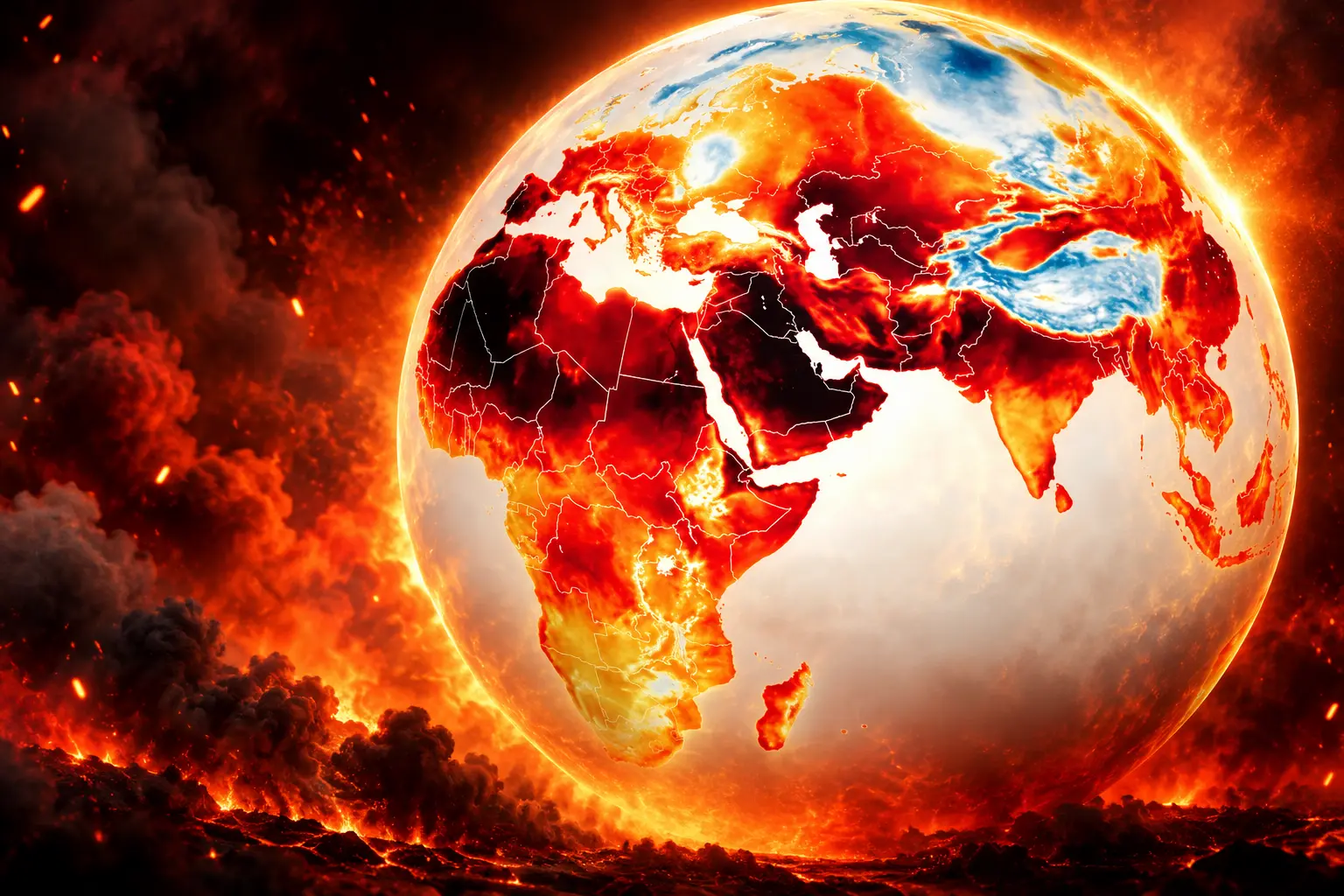
The Season’s End Shifted Faster Than Its Start
The back of the season moved more than the front. The last heatwave retreated later by 5.41 days per decade, while the first advanced by 3.29 days per decade. Extra days in late summer and early autumn now make up most of the 39-day stretch.
That split is easy to misread as a story about August and September alone. Late heat still matters for power demand, wildfire weather and late-season crops. The health and farming records the authors point to, though, put a heavier cost on heat that arrives before people have had a hot spell to adapt to, and before flowering is over.
The study measured when events happened, not why. Xu’s group points to general warming, stubborn high-pressure systems and soils that dry out early as plausible drivers, and it did not assign a share to each. Other groups have already shown midlatitude summers getting longer. This paper isolates the heatwave calendar rather than the whole warm season.
Why the First Heatwave of Summer Still Kills More People
In 43 U.S. cities from 1987 to 2005, G. Brooke Anderson and Michelle L. Bell found that mortality rose more on the first heatwave of summer than on later ones, compared with non-heatwave days. The paper cites that work because timing, not only peak temperature, changes the death toll. People have had less time to acclimatize, and behavior such as turning on cooling or changing outdoor work often lags the first blast.
FIRST HEATWAVE DEATH TOLL IN 43 U.S. CITIES
- All heatwaves: Deaths rose 3.74% on heatwave days (95% interval 2.29% to 5.22%).
- First of the summer: Deaths rose 5.04% (3.06% to 7.06%) versus non-heatwave days.
- Later events: Deaths rose 2.65% (1.14% to 4.18%) versus non-heatwave days.
Anderson and Bell also found larger effects for more intense and longer events, and a sharper pattern in the Northeast and Midwest than in the South. Xu’s global timing trends do not rerun that death study. They do show the first event of the season moving earlier on most land, which is the window those U.S. cities already showed as deadlier.
The new analysis used daytime highs only. It left out hot nights and humid heat, which often drive hospital admissions. The human cost of an earlier, faster first peak could be larger than a map of daytime extremes implies, and WHO guidance on extreme heat still treats much of that harm as preventable if warnings and cooling reach the people who need them.
Arid Ground Took the Sharpest Timing Shift
Deserts and dry grasslands moved faster than humid regions. In arid places the first heatwave arrived about 6 days earlier per decade, about 2.4 times the pace in humid ones. In the driest places the last heatwave ended more than 8 days later per decade, about one and a half times the global rate.
Dry soils store less water that could otherwise blunt a hot spell, so once rain fails, temperature can jump with less lag. That is a physical reason the calendar shift is larger where the ground is already dry, and it matches the paper’s finding that drylands outran humid belts on both onset and ending.
WHERE THE SEASON MOVED MOST
- Late-season push: Northern Europe, western and central Europe, the Caribbean and southern Central America saw the last heatwave move more than 10 days later per decade.
- Both ends: Eastern Europe, the Mediterranean, northwestern North America and northern Africa gained heat at the start and the finish.
- Mostly the finish: In South Asia, most of the shift came at the end of the season.
- Mostly the start: Western North America and South Africa gained heat mainly at the opening of the season.
Those regional splits mean a single global “summer protocol” will miss the places where heat now arrives in spring, and the places where it lingers into what used to be the shoulder of autumn.
Flowering Crops Met Heat Even When Onset Held Still
Farmland was the one land-cover type where heatwaves did not arrive significantly earlier. That sounds like a reprieve until the season length is put against crop calendars. From 2001 to 2023, the share of crop area hit during critical reproductive stages such as flowering and silking rose by 1.6% to 13.3% for several major crops, compared with 1979 to 2000. Heat also reached fields more often in early growth and near harvest.
Silking is the maize stage when kernels are set. A few hot days then can cut seed set even if the rest of the year looks ordinary. The authors point to Europe in 2018, when heat and drought overlapped wheat and barley flowering. Damien Beillouin and colleagues, using more than 82,000 regional yield records, found that nearly 40% of the crop area in Northern and Eastern Europe recorded winter wheat and barley yields below the 10th percentile of the historical series.
Southern Europe had a better spring that year and nearly offset the northern loss in the continental total. The local failures still show what a longer heatwave season does when it lands on a sensitive week. A later end of the season can hit grain filling. An earlier start can hit flowering even if the first heatwave on farmland did not trend earlier in a statistically clean way.
Rapid First Heatwaves Gained Share After 2001
Xu’s group sorted each year’s first heatwave by how fast it built, using the relative time from the start of the event to its hottest day. Over the full 45 years the mix of fast, medium and slow first heatwaves stayed roughly steady. From 2001 to 2023, the share of rapid first heatwaves inside heatwave-affected land rose, by about half a percentage point per decade. The authors call that a recent shift, not a long-term one.
HOW FAST THE FIRST HEATWAVE BUILT
- Rapid onset: The hottest day arrives at the start of the event, leaving little time for a warning to land or for a body to adjust.
- Moderate onset: The peak sits in the middle of the spell.
- Slow onset: Temperature builds toward a peak near the end.
Rapid first heatwaves also tended to arrive earlier in the season than slower ones. A small rise in their share still changes the first event people feel, which is already the deadlier one in the U.S. city record. The public argument around heat still treats a long, baking July as the main threat. A date-specific 90th percentile already asks whether a day is hot for that date, so the extra weeks are not a trick of a hotter midsummer. They are extra dates when unusual heat now qualifies as a heatwave.
Heat Alerts Still Count Degrees, Not Dates
Most heat plans still open on intensity and duration: how hot, how many days, when to open cooling centers. Xu’s group argues that monitors should also track when the season opens and closes, and how fast the first peak arrives. Philippe Ciais of France’s Laboratoire des Sciences du Climat et de l’Environnement and Ying-Ping Wang of Monash University are among the co-authors who frame that as a risk-assessment gap, not a curiosity.
In the past, we have mostly focused on whether heatwaves are becoming more frequent, stronger, and longer. Our study further shows that their timing and onset speed are also changing. If heatwaves arrive earlier and develop more rapidly, the time available for societies and ecosystems to prepare and adapt could become even shorter.
Wenfang Xu, first author, South China Botanical Garden, Chinese Academy of Sciences
Grids already feel the calendar. During the late June to early July 2025 European heatwave, Ember found daily power demand by up to 14% in Spain as cooling load jumped, with France up 9% and Germany up 6% against a Tuesday a week earlier. Average daily power prices rose two to three times in several countries once thermal plants also tripped or cut output. An earlier first peak moves that stress into weeks when some plants are still in spring maintenance and when cooling demand has not yet been treated as a summer fixture.
Coverage of warnings is still uneven. The United Nations Early Warnings for All plan aims to put everyone under early warning systems by 2027, and the disaster office still counts about one-third of the world’s people as uncovered. Twenty-four hours of warning can cut ensuing damage by 30%, that office says. A warning that is issued on the old summer start date arrives after a faster first peak has already hit.
The 45-year record does not say the next decade will add another 39 days at the same pace, and the rapid-onset rise is still a short, modest trend. What it does show is a season that already starts about two weeks earlier and ends about 24 days later, with drylands out in front and the first event of the year more often jumping to its hottest day at the outset. Heat monitors that only count how hot it got are scoring the wrong exam.
Frequently Asked Questions
Did This Study Include Hot Nights and Humid Heat?
No. The analysis used daytime high temperatures only, so it does not capture tropical nights or “feels like” humidity that often drive hospital admissions. The authors note that the risk to people may therefore look different from their daytime map, especially in humid cities where nights no longer cool off.
Which Other Temperature Records Showed the Same Timing Shift?
Besides ERA5, the team repeated the timing trends with the Berkeley Earth gridded land record and with the JRA-3Q reanalysis from Japan’s meteorological services. Both independent products showed the same direction of earlier onset, later ending and a longer heatwave season, which is why the authors treat the pattern as a land-wide result rather than an ERA5 quirk.
How Much Extra Mortality Did U.S. Heatwaves Show Overall?
In the 43-city study that Xu’s paper cites, deaths on all heatwave days, not only the first event, were 3.74% higher than on non-heatwave days from 1987 to 2005. That overall lift sits between the 5.04% rise on the first heatwave of summer and the 2.65% rise on later ones, and it is the baseline against which the extra first-event penalty was measured.
How Much Can One Day of Early Warning Cut Disaster Damage?
The United Nations Office for Disaster Risk Reduction says 24 hours of early warning can cut the damage that follows by 30%. That figure covers multi-hazard systems, not heat alone, and it is why the authors argue that a first heatwave which peaks on day one needs a warning clock that starts before the old summer season, not after the temperature has already spiked.

John Mayer Bets Sob Rock Can Be a Record Label

H1N1 Rises Early After Last Winter’s H3N2 Wave

Human Fires Drive Amazon Carbon Emissions Even Without Drought

Charli XCX Secretly Films a Cameo in Scorsese’s Horror

Santos’s 58-Yard Kick Decides the Williams-Maye Rematch

Generation Lab’s Secret Youth Shot Has a Copycat Problem

Tesla Raises Dual Motor Prices as Texas Builds Cybercabs

The Nantucket Friendship Basket Boom Meets a Maker Shortage

Bristol Myers Quits Cellares as Autoimmune Doses Proceed

Okta Stock Jumps 20% on McKinnon’s Identity Bet
-
 NEWS2 months ago
Generation Lab’s Secret Youth Shot Has a Copycat Problem
-
 AUTO2 months ago
Tesla Raises Dual Motor Prices as Texas Builds Cybercabs
-
 LIFESTYLE2 months ago
The Nantucket Friendship Basket Boom Meets a Maker Shortage
-
 BUSINESS2 months ago
Bristol Myers Quits Cellares as Autoimmune Doses Proceed
-
 NEWS2 months ago
Okta Stock Jumps 20% on McKinnon’s Identity Bet
-

 BUSINESS2 months ago
Poland Closes Visa-Free Work for Three Fast-Growing Nationalities
-

 NEWS2 months ago
Ox Alpha Was a Chinese Chip Stress Test All Along
-

 LIFESTYLE2 months ago
Labor Day Mattress Sales Repeat a Familiar Holiday Discount