
NEWS
France’s Riot Cycle Hits Six Months Before the Vote
Saturday’s 2,400 arrests fit France’s old riot cycle, this time six months before a vote Macron cannot run in.

French police arrested nearly 2,400 people on Saturday after cost-of-living marches across the country slid into arson, looting and street fights. The interior ministry said almost 1,000 police and gendarmes were hurt, seven of them seriously.
President Emmanuel Macron, who cannot run again, told the country on Sunday it should feel “anger and shame,” six months before a presidential election already led in the polls by Marine Le Pen.
Saturday’s Marches Left Nearly 2,400 People in Custody
About 550,000 people marched in 110 cities, the interior ministry said, including 110,000 in Paris. The CGT union put the crowd at 800,000. Most of that day was a classic French demo over fuel, prices and public services. The edge of it was not.
Hooded groups hit public buildings, then looters moved on shops. Prime Minister Sébastien Lecornu blamed “ultra-left” militants and criminals, and said some people were using the day as a “warm-up” for the presidential race. “We will not let ourselves be intimidated,” he wrote. “No one will impose their political agenda through violence.”
THE WEEKEND COUNT
- Arrests: Nearly 2,400 people on Saturday, the interior ministry said, with 855 of them in Paris, a record for the capital.
- Still held: 557 people remained in custody in Paris, about a third of them minors.
- Police hurt: Almost 1,000 officers and gendarmes injured, seven seriously.
- Sunday: 108 more arrests in Paris after an undeclared gathering, with at least five stores looted around Place de la République.
Interior Minister Laurent Nuñez said a 22-year-old officer died in Nantes after being struck by a vehicle. Paris police said a protester died after a cardiac arrest. Nuñez described “several thousand far-left individuals” going after public buildings, then “delinquents who looted and ransacked numerous businesses in several cities.”
Macron posted while the fires were still going. “No room for violence in our Republic,” he wrote, and promised prosecutions for people who had smashed prefectures, shops and town halls.
Aucune place pour la violence dans notre République.
Ceux qui ont cassé, attaqué les préfectures comme les commerces, pillé jusqu’à nos mairies, seront poursuivis et punis.
Aux forces de l’ordre, garantes du droit à manifester, je dis le soutien de la Nation.
Nous ferons tous…
— Emmanuel Macron (@EmmanuelMacron) October 17, 2026
US President Donald Trump offered a different cause, blaming immigration and saying “France is burning.” That is not the account the interior ministry gave. Nuñez named ultra-left groups and looters. The marches themselves had been called over prices, fuel and schools.
A Créteil School Blockade Became a National Crowd
The first blockade went up on September 17 at Lycée Saint-Exupéry in Créteil, a working-class suburb east of Paris. Students there were short a nurse and a deputy head, and they were sitting in rooms that leaked, clogged and overheated. Videos of rats in other lycées spread. The blockades then moved through Bordeaux, Rennes, Nantes, Lyon, Lille and Marseille.
They wanted smaller classes, enough teachers, buildings that did not fall apart, and school days that did not run them into the ground. They also wanted a fairer path through Parcoursup, the post-school admissions platform. Education Minister Édouard Geffray promised 3,000 extra supply teachers on October 8 and opened a consultation that Macron later said had drawn more than 100,000 contributions.
FROM THE FIRST BLOCKADE TO SATURDAY
- September 17: Students shut Lycée Saint-Exupéry in Créteil over staff shortages and broken buildings.
- October 8: Geffray promises 3,000 extra supply teachers after weeks of blockades.
- October 16: A Paris police order cites 1,474 actions around schools and 1,322 arrests around Paris schools, with 112 security staff and 17 education workers already hurt.
- October 17: Students, unions and Yellow Vest groups march together; the day ends in fires and mass arrests.
- October 18: Macron speaks at 8 p.m.; Le Pen posts a video hours earlier; new clashes hit Paris.
Emile Chabal, a professor of contemporary history at the University of Edinburgh, called Saturday “the logical outcome of a series of protests” that run back to the Yellow Vests. Pulling students, unions and that older cost-of-living anger into one crowd was, he said, “the worst possible outcome for the French government.”
The government is also trying to pass a 54 billion euro (about $60.8 billion) package of cuts and tax measures for the 2027 budget, including a fourth straight freeze of the civil service pay scale. Fuel costs, Macron said, are being driven by a conflict in the Persian Gulf that France has stayed out of.
Macron Speaks of Anger, Shame and a Vote in Six Months
He used a Sunday night address to France to split peaceful marchers from people he called ultra-left agitators and looters. He named the Limoges town hall, the Lyon tourist office, the Marseille town hall and the prefect’s residence in Bordeaux. He did not declare a state of emergency or a curfew.
Nothing justifies it, nothing explains it, nothing excuses it. We all feel anger and shame tonight. Those who destroyed must pay. Those who looted must reimburse. Those who sought to bring down the Republic will be held accountable.
Emmanuel Macron, President of France, Élysée address, October 18, 2026
He asked Nuñez for “clear answers” on intelligence and planning after police were caught off guard, and he promised “full transparency” on the force used. Local officials, he said, could now ban some gatherings to protect cities, public buildings and shops. He also said Sébastien Lecornu would chair a crisis cell the next morning to get money to damaged businesses, and that he himself would fly to Gulf countries to lock in fuel and gas.
Then he put the date on the table. “We are six months from our presidential election,” he said. Anyone sending people into the street to create disorder, he argued, wanted to “damage the Republic and steal the debate.” France, he said, “deserves a fine presidential election in six months.”
Left and right had already called for Nuñez to go. Macron left him in the job and told him to explain how the state missed the scale of the violence.
One Saturday Outran the Yellow Vests’ Worst Day
France has a method for this. A grievance hits the street, a fringe fights the police, the state mass-arrests, and the political argument shifts to order. The method is old. The calendar is not.
HOW THE ARREST TALLIES COMPARE
| Episode | Dates | Arrests | Spark |
|---|---|---|---|
| Banlieue unrest | October-November 2005 | About 4,728 over three-plus weeks | Deaths of two teenagers hiding from police |
| Yellow Vests peak day | December 8, 2018 | 1,723 in one day | Fuel tax and living costs |
| Nahel unrest | June 27-July 4, 2023 | 1,311 in one night; 3,354 in 10 days | Police shooting of a 17-year-old |
| Saturday marches | October 17, 2026 | Nearly 2,400 in one day | Prices, fuel, schools, public services |
Saturday’s haul passed the worst Yellow Vest day and the worst Nahel night. It did not pass 2005’s multi-week total, and it was not the same crowd as 2005 or 2023. Those earlier shocks began in the banlieues after deaths involving police. Saturday began as a national march and then broke.
The Yellow Vests in 2018 also began with fuel and prices, and they also produced smashed shopfronts in central Paris. What they did not produce was a presidential first round 6 months later with the incumbent already barred from the ballot. Nicolas Sarkozy could still run after 2005. Macron cannot.
Thomas Piketty, the left-wing economist, called the moment “the twilight of Macronism.” That line will travel. The arrest ledger is colder. France has cleared streets like this before. It has not had to do it on the doorstep of a race the sitting president is not in.
A Town Hall Burned and a 17-Year-Old Lost a Hand
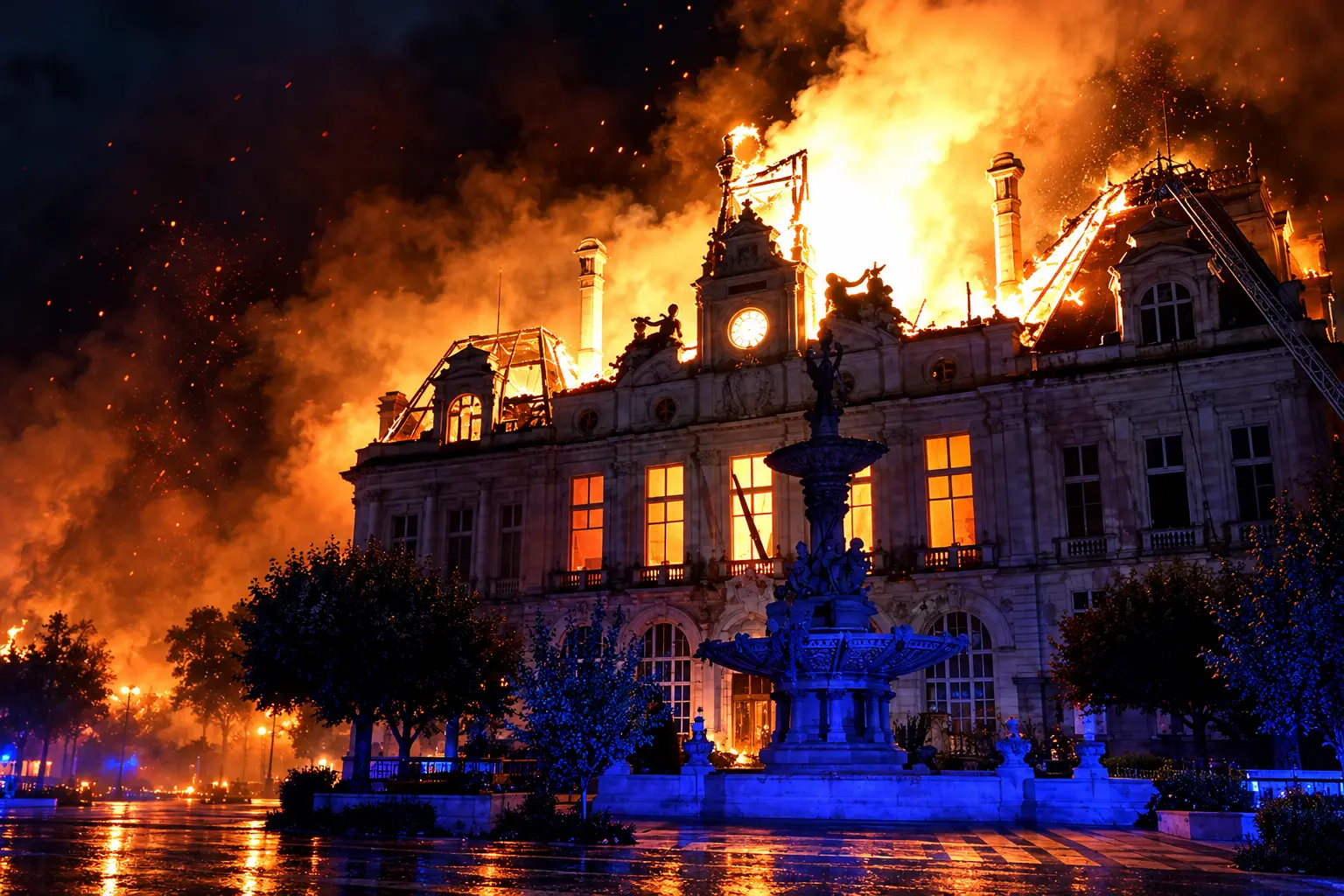
Limoges lost its 19th-century town hall to a fire that local prefect Maurice Barate said was set by “a wild horde.” In Lyon, a tourist office in the centre burned. In Marseille, protesters got into the town hall. In Bordeaux, they went at the prefect’s residence. Grenoble’s city hall was damaged. In Paris, tear gas and water cannon were used near the Champs-Élysées and the Arc de Triomphe, and luxury shops were looted.
BUILDINGS AND BODIES
- Limoges: The 19th-century town hall burned, and part of the roof came down.
- Lyon: A city-centre tourist office was set on fire.
- Saint-Étienne: A 17-year-old boy lost his right hand to a crowd-control grenade.
- Mulhouse: A 17-year-old girl lost an eye, prosecutors said.
The police watchdog is looking at at least two dozen claims of police violence. Stun grenades had been pulled from the student demos, then cleared for Saturday. Mehmet Ozeden, 78, standing among burnt barricades in central Paris, told an interviewer, “It’s like we had a war.”
Shopkeepers are the other bill. Macron said some of them had stood in their own doorways against looters, and he promised they would not be left alone. Lecornu’s crisis cell is supposed to move aid fast. That is the part of these cycles that lasts after the vans leave: boarded glass, insurance fights, and a mayor staring at a blackened civic roof.
Le Pen Called the Government Exhausted Before He Did
Le Pen went up on Sunday afternoon, hours before the Élysée, sitting at a desk with a French flag. Ifop-Fiducial, in a mid-October survey of 1,390 people, had already put her at 34.2% for the first round, 18 points ahead of Jean-Luc Mélenchon on 16.2%, with Raphaël Glucksmann on 13.8% and former prime minister Édouard Philippe on 11.2%. The first round is on April 18, 2027. The runoff is May 2.
On Saturday she had already written that rioters had wrecked a purchasing-power march and that the demands taken hostage by the far left were those of people squeezed between austerity and tax. Hold on a few months, she told them. A National Rally government, she said, would get rid of “toxic” Macron-era policy and protect the country from far-left violence.
We are living through a profound crisis of trust and authority that poses a threat to democracy. Our country is caught in a vice, or even taken hostage, between violence and powerlessness. We have a Macronist power that is out of breath, exhausted, disoriented.
Marine Le Pen, National Rally leader, video address, October 18, 2026
A Paris appeal court ruling in July left her free to stand despite a conviction over European Parliament funds. Mélenchon, who is also running, warned that the country could be heading toward “events that will eventually become uncontrollable.” Traders on Monday were already treating a National Rally win as the base case, which is how a riot weekend becomes a campaign fact before anyone has counted the ballots.
WHERE EXPERTS DISAGREE
- Paul Smith: The Nottingham historian sees “only one beneficiary and that’s Le Pen,” and thinks the violence may also hurt Mélenchon.
- Emile Chabal: He warned against assuming an automatic far-right gain, noting that fear of disorder in France has often helped conservative or centrist candidates, including after 1968.
Le Pen did not dismiss the marchers’ grievances. She called them legitimate, then accused the far left of holding them hostage. That is the move this cycle always offers the hard right: keep the anger about prices, attach it to disorder, and wait for the runoff.
Prefects Can Now Ban the Next Gathering if They Choose
Macron’s practical change is the ban power. Prefects, working with mayors, can now block some rallies to protect streets, halls and shops. He also wants parties, unions and business groups to condemn the violence in public, and he wants students, teachers and local officials around a table this week on schools.
None of that settles why a lycée protest that began over toilets, rotas and missing teachers ended with a 19th-century town hall in flames. The state has the arrest numbers. It has a minister still in post who has been told to explain the intelligence failure. It has a first round on April 18.
France has run this sequence before. This time the man in the Élysée is already on his way out, and the candidate leading the next race spoke before he did.

John Mayer Bets Sob Rock Can Be a Record Label

H1N1 Rises Early After Last Winter’s H3N2 Wave

Human Fires Drive Amazon Carbon Emissions Even Without Drought

Charli XCX Secretly Films a Cameo in Scorsese’s Horror

Santos’s 58-Yard Kick Decides the Williams-Maye Rematch

Generation Lab’s Secret Youth Shot Has a Copycat Problem

Tesla Raises Dual Motor Prices as Texas Builds Cybercabs

The Nantucket Friendship Basket Boom Meets a Maker Shortage

Bristol Myers Quits Cellares as Autoimmune Doses Proceed

Okta Stock Jumps 20% on McKinnon’s Identity Bet
-
 NEWS2 months ago
Generation Lab’s Secret Youth Shot Has a Copycat Problem
-
 AUTO2 months ago
Tesla Raises Dual Motor Prices as Texas Builds Cybercabs
-
 LIFESTYLE2 months ago
The Nantucket Friendship Basket Boom Meets a Maker Shortage
-
 NEWS2 months ago
Okta Stock Jumps 20% on McKinnon’s Identity Bet
-
 BUSINESS2 months ago
Bristol Myers Quits Cellares as Autoimmune Doses Proceed
-

 BUSINESS2 months ago
Poland Closes Visa-Free Work for Three Fast-Growing Nationalities
-

 LIFESTYLE2 months ago
Labor Day Mattress Sales Repeat a Familiar Holiday Discount
-

 NEWS2 months ago
Ox Alpha Was a Chinese Chip Stress Test All Along