
NEWS
Shingrix Heart Finding Points to the AS01 Adjuvant
An Oxford natural experiment links Shingrix to a 9% lower heart burden than Zostavax, and the authors put the effect on the AS01 adjuvant more than on fewer.

Adults who received Shingrix after the 2017 U.S. switch had a 9% lower heart-disease burden over seven years than matched peers who got Zostavax. The comparison, published Aug. 26 in Nature Medicine, used a calendar cutoff rather than vaccinated versus unvaccinated people.
Oxford researchers say the likelier driver is immune reprogramming from the AS01 adjuvant, not simply fewer shingles flares. A Danish randomized trial is already testing whether that reading holds.
A Natural Experiment Across an October Switch
Maxime Taquet, an associate professor of psychiatry at the University of Oxford who led the study, and colleagues used the U.S. flip from Merck’s live shot Zostavax to GSK’s protein-and-adjuvant shot Shingrix. After October 2017, clinics almost stopped giving the live vaccine, so people who came in for a shingles shot a few months apart received different products for reasons that had little to do with their health.
The team pulled electronic records from TriNetX, a U.S. network of about 60 health systems covering more than 100 million patients. They matched 36,460 adults aged 60 and older vaccinated from April 1 to Sept. 30, 2017 (98.6% live vaccine) to 36,460 people vaccinated in the same months of 2018 (93.5% recombinant). Propensity scores balanced age, sex, and medical history. The network does not include people on public health insurance, so the file is thinner on Medicare patients than a national claims study would be.
Paul Harrison, professor of psychiatry at Oxford who co-led the work, said the design was meant to blunt the usual problem that people who show up for shots are already healthier. In the year before vaccination, the two groups did not differ in preventive care or in recorded heart events. A tetanus-diphtheria-pertussis comparison across the same two summers showed no similar shift in heart diagnoses, which argues against a change in how hospitals coded disease.
THE SWITCH FROM LIVE TO RECOMBINANT
- 2006: Zostavax, a live attenuated shingles vaccine, enters wide use in older adults.
- October 2017: Shingrix is approved in the United States and rapidly displaces the live shot.
- April to September 2018: 93.5% of shots in the Oxford 2018 cohort are recombinant.
- 2020: Zostavax is withdrawn in the United States after weaker efficacy and faster waning.
- August 26, 2026: Nature Medicine publishes the seven-year cardiovascular comparison.
Taquet has received consultancy fees from GSK. John Todd, a co-author, is a GSK consultant and co-director of the Oxford-GSK Institute for Molecular and Computational Medicine. The analyses were funded by the NIHR Oxford Health Biomedical Research Centre.
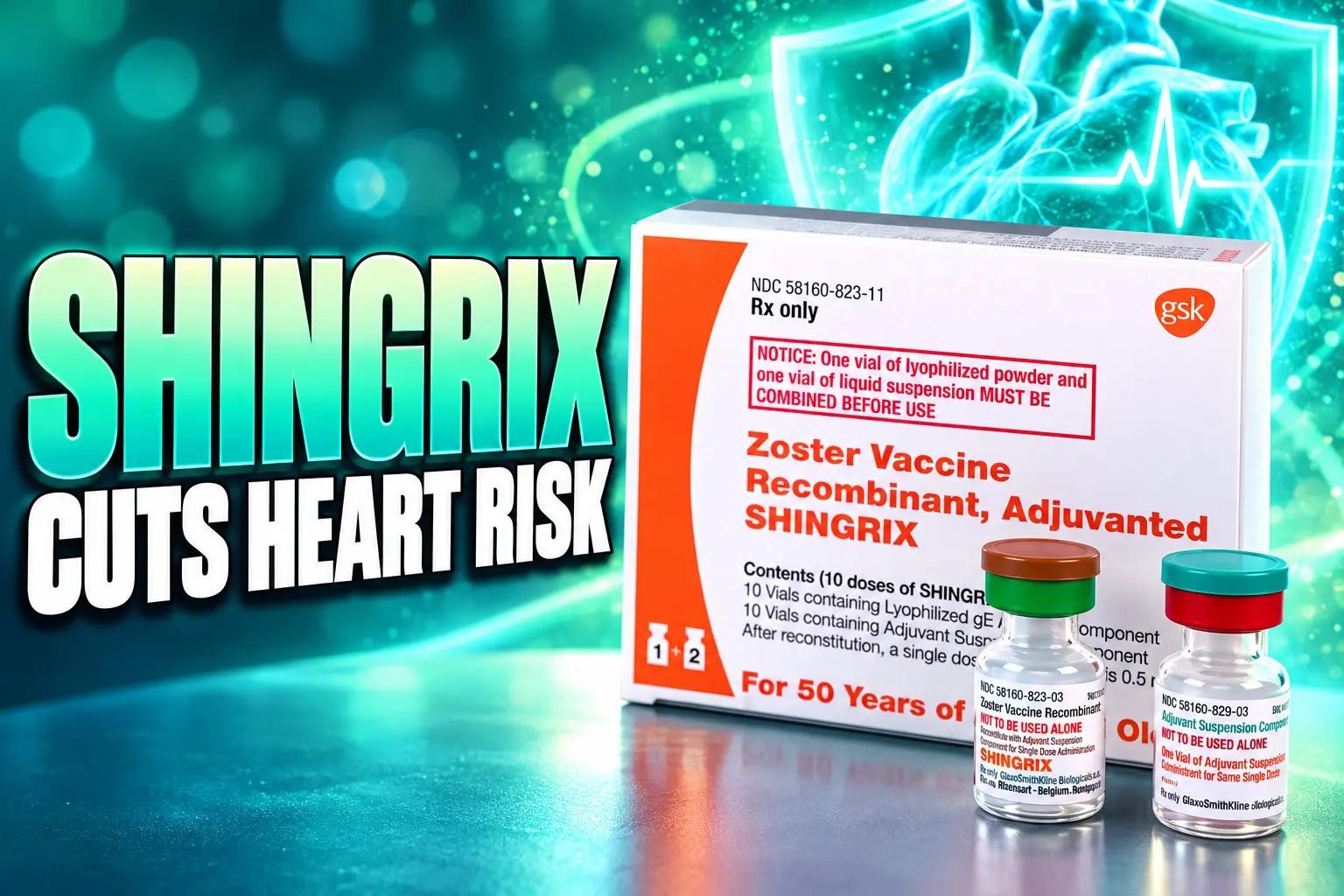
Heart Events Fell 9% Over Seven Years
The primary endpoint was a composite of ischemic heart disease, heart failure, or ischemic stroke. Over seven years the recombinant group showed a restricted mean time lost ratio of 0.91 (95% CI 0.88 to 0.95), which the authors describe as a 9% decrease in cardiovascular burden, or 9% more time lived without one of those diagnoses. The E-value was 1.42, meaning a hidden factor would have to be 1.42 times more common in the 2017 group and raise heart risk by the same factor, after matching, to wipe the finding out.
CARDIOVASCULAR OUTCOMES OVER 7 YEARS
| Outcome | RMTL ratio (95% CI) | Burden change |
|---|---|---|
| Composite (IHD, heart failure, ischemic stroke) | 0.91 (0.88 to 0.95) | 9% lower |
| Ischemic heart disease | 0.90 (0.87 to 0.94) | 10% lower |
| Heart failure | 0.88 (0.83 to 0.93) | 12% lower |
| Ischemic stroke in men | 0.88 (0.78 to 0.98) | 12% lower |
| Atrial fibrillation | 0.93 (0.88 to 0.98) | 7% lower |
Stroke was not clearly lower in women. There was no association with myocarditis, peripheral arterial disease, hemorrhagic stroke, or transient ischemic attack. ST-elevation heart attack moved in the same direction as ischemic heart disease but did not reach statistical significance. Non-cardiovascular death did not differ, and results held when follow-up stopped before COVID-19.
If causal, the authors wrote, a 0.8% absolute difference in cumulative ischemic heart disease and heart failure among adults over 60 would mean hundreds of thousands of cases avoided in the United States. That is about one extra diagnosis avoided per 125 people over seven years, a population number that is easy to advertise and a personal number that is easy to overstate. Mark Russell, a clinical senior lecturer and consultant rheumatologist at King’s College London, said the benefits are relatively small on an individual basis, though millions of shots could still move national counts.
Why Stopping Shingles Does Not Explain It
Shingles itself raises short-term heart and stroke risk, and Shingrix prevents shingles far more often than Zostavax did, so a simple viral story is the first one most readers reach for. The paper says that account looks weak. The absolute gap in shingles between the two shots was under 0.5% at mid-follow-up, against a 1.5% drop in ischemic heart disease, and the heart curves split early rather than tracking the slow pile-up of shingles cases.
THREE REASONS THE AUTHORS DOUBT A SHINGLES-ONLY STORY
- Case counts: The shingles gap between vaccines stayed under 0.5% at mid-follow-up, smaller than the 1.5% ischemic heart disease gap.
- Timing: A pure infection effect should grow as untreated shingles accumulate; the heart difference appeared early, then flattened.
- The live shot: A separate natural experiment of Zostavax versus no vaccine did not cut heart disease or stroke.
The heart association was present in the first 3.5 years, then weakened. Hazard ratios that sat below 1 in the first half of follow-up were no longer significant in the second half, and the gap in cumulative incidence stopped widening. That fade is awkward for a lifelong antiviral story and friendlier to a time-limited immune change, including the idea of later booster doses that no health system currently gives for heart protection.
AS01 Retrains Innate Cells for Years
Shingrix pairs varicella-zoster glycoprotein E with AS01B, a liposome adjuvant that holds 50 µg of monophosphoryl lipid A and 50 µg of QS-21. Zostavax had neither. Fabiana Corsi-Zuelli, a research fellow in psychiatry at Oxford who led the analyses, has said the recombinant vaccine may induce trained immunity, meaning lasting changes in innate immune cells. Betty Raman, associate professor of cardiovascular medicine at Oxford, tied those changes to cytokines that act on the lining of blood vessels and to fat deposited in artery walls.
A key question is, how does the vaccine produce its apparent benefit in protecting the heart? One possibility is that infection with the Herpes zoster virus might increase the risk of heart and vascular diseases, and therefore by inhibiting the virus the vaccine could reduce this risk. Alternatively, the vaccine also contains chemicals which might have separate beneficial effects on the heart.
Paul Harrison, Professor of Psychiatry, University of Oxford news release
Taquet has put more weight on the adjuvant for heart disease than for dementia, because live-vaccine studies have not shown cardiovascular protection. The Nature Medicine paper points to AS01’s epigenetic reprogramming of monocytes, including weaker interleukin-6 responses to Toll-like receptor activation. IL-6 blockade is already known, from other drug trials, to lower cardiovascular risk.
Reduced IL-6 Is the Working Guess
Ian Jones, a virologist at the University of Reading, said the antibodies are specific to the virus but the shot also includes chemicals that kick-start the immune system, and that jolt might clear low-level persistent inflammation that would otherwise feed later neuronal and cardiovascular disease. Kaleen Hayes, associate director of pharmacoepidemiology at Brown University School of Public Health, who was not on the paper, said it remains open whether AS01 is doing special work or whether any strong shingles shot that keys up immunity would look similar.
Colorado Work Shows the Training Lasts
A December 2025 PLOS Pathogens study from Michael J. Johnson, Adriana Weinberg, and colleagues at the University of Colorado compared innate responses after Shingrix and Zostavax. The recombinant shot increased NK, monocyte, and dendritic-cell activity against glycoprotein E for up to five years. The live shot raised only dendritic-cell responses, and only for about 90 days. In monocyte and NK cocultures, recombinant recipients also responded more strongly to cytomegalovirus and herpes simplex antigens. ATAC-seq showed reduced accessibility at TGFβ1, and the team concluded the shot generated trained immunity in monocytes for years through genomic repression of that regulatory cytokine.
That is still lab immunology, not a heart trial. It does show the two products do different things to innate cells long after the deltoid ache fades, which is the gap the Oxford design was built to isolate.
Most Adults Over 50 Still Lack Both Doses
CDC’s adult schedule already calls for two recombinant doses at age 50 and older, and at 19 and older for people with weakened immune systems. Uptake has risen, and it has not caught the people who would matter most if a heart effect is real. National Health Interview Survey data for 2024 put any shingles shot at 43.6% of adults 50 and older and 51.1% of adults 60 and older. Completed recombinant series lagged further.
CDC COVERAGE, 2024
- Two doses at 50+: Recombinant series completion was 28.7%, up from 1.1% in 2018, when the shot was first recommended.
- Two doses at 60+: Completion reached 33.4%, up from 27.5% in 2023, still leaving about two in three without a full course.
- Two doses at 65+: Completion was 35.0%; ages 50 to 59 sat at 19.4%.
- Race gap: Among adults with an indication, any shingles dose was 44.8% in White adults, 31.6% in Black adults, 30.5% in Hispanic adults, and 50.3% in Asian adults.
Those two-dose coverage among adults 50 and older figures are the practical limit on any population heart claim. The Oxford file, drawn from health systems that exclude public insurance, also cannot say what the shot does in the Medicare-heavy group that carries most U.S. heart failure. In the days after publication, pharmacy voices in Britain used the paper to argue for a faster adult rollout. The records still describe people who already reached a clinic.
The Dementia Papers Got There First
The same Oxford group used the 2017 switch in 2024 to compare dementia after the two shingles shots. Receiving the recombinant vaccine was associated with a 17% increase in diagnosis-free time over six years, or 164 extra days without a dementia diagnosis among those who later received one (RMTL ratio 0.83, 95% CI 0.80 to 0.87). A later Oxford analysis of AS01-adjuvanted RSV and shingles vaccination found similar short-term dementia associations for both products, a pattern that fits the adjuvant better than any single virus protein.
Other groups have since reported lower dementia incidence after two Shingrix doses in Medicare data, with smaller effects when recombinant recipients were compared with people who got a tetanus-containing shot instead of with the unvaccinated. The heart paper is the next chapter of that argument, not a separate miracle. Hayes called cardioprotection the question everyone was already asking after the dementia work, and said prior heart studies had been conflicting in part because they compared people who chose a shot with people who did not.
A 162,000-Person Danish Trial Is Already Running
Taquet told a briefing the present study remains observational even as a natural experiment, and that a randomized trial is underway. DAN-ZOSTER, sponsored by Tor Biering-Sørensen at Herlev and Gentofte Hospital, is a nationwide open-label trial in Denmark. Adults 65 and older are assigned 1:1 to two intramuscular Shingrix doses two to six months apart, or to no study vaccine, with follow-up through national registries. Dual primary endpoints are major adverse cardiovascular events (nonfatal heart attack, nonfatal stroke, or cardiovascular death) and new dementia. GSK donated the doses. The registry lists about 162,000 adults aged 65 or older, an actual start of April 28, 2026, and estimated primary completion in April 2029. Taquet has said first results could come in 2027.
WHAT WE KNOW
- Published comparison: Matched recombinant versus live vaccination in U.S. records is associated with lower ischemic heart disease and heart failure burden over seven years.
- Adjuvant biology: AS01 reprograms monocytes; a 2025 Colorado study found heterologous innate responses lasting up to five years after Shingrix and not after Zostavax.
- Uptake: Only about one in three U.S. adults 60 and older had completed two recombinant doses in 2024.
WHAT IS UNCONFIRMED
- Cause: No randomized trial has yet shown that Shingrix prevents heart attack, heart failure, or stroke.
- Who benefits: Stroke moved only in men; public-insurance patients were absent from TriNetX.
- How long: The association weakened after 3.5 years, so any heart use would need a dosing schedule no label currently provides.
Corsi-Zuelli said a randomized trial is still required to confirm that the vaccine truly protects the heart. Raman has called for more work on who should be offered a shot if a heart effect is real, including people younger than today’s shingles schedule. Until Denmark reports, the honest clinical sentence is the one Taquet already offered for uptake: people should get Shingrix for shingles first. ZOE-50 found 97.2% efficacy against shingles in adults 50 and older, and later follow-up has kept protection above 70% at 10 years, which is a firmer reason to finish both doses than a 0.8% heart gap that still needs a trial.
Taquet has said that if the heart and dementia findings nudge more people into clinic, that is welcome, and that confirmed effects could be large for patients and health services. He has also said the first reason to roll up a sleeve remains the rash, the nerve pain, and the hospital stays the shot was licensed to stop.
Disclaimer: This article is news reporting and analysis of a published observational study and related trials. It is informational only and is not medical advice, a vaccination recommendation, or a guide to diagnosing or treating heart disease, stroke, shingles, or dementia. Readers should talk with a qualified physician, cardiologist, or other licensed clinician before changing vaccines, medicines, or heart-risk care. Figures, trial timelines, and coverage rates reflect the papers, CDC survey, and registry entries available as of Sept. 2, 2026, and may change as DAN-ZOSTER and other studies report.

India’s 13.3 Crore Voter Cut Lands on the Election Commission

Reflection Bets $25 Billion on Beam’s Cheaper Open Weights

Denza Comes to India After Mercedes Walked Away

CJP Sets an October 10 March Over Voter-Roll Cuts

Amazon Drops Data Center NDAs but Leaves Older Deals Intact

Tesla Raises Dual Motor Prices as Texas Builds Cybercabs

Generation Lab’s Secret Youth Shot Has a Copycat Problem

The Nantucket Friendship Basket Boom Meets a Maker Shortage

Okta Stock Jumps 20% on McKinnon’s Identity Bet

Bristol Myers Quits Cellares as Autoimmune Doses Proceed
-
 AUTO1 month ago
Tesla Raises Dual Motor Prices as Texas Builds Cybercabs
-
 NEWS1 month ago
Generation Lab’s Secret Youth Shot Has a Copycat Problem
-
 LIFESTYLE2 months ago
The Nantucket Friendship Basket Boom Meets a Maker Shortage
-
 NEWS1 month ago
Okta Stock Jumps 20% on McKinnon’s Identity Bet
-

 LIFESTYLE1 month ago
Labor Day Mattress Sales Repeat a Familiar Holiday Discount
-
 BUSINESS1 month ago
Bristol Myers Quits Cellares as Autoimmune Doses Proceed
-

 NEWS1 month ago
Google Ends EU Spam Demotions but Keeps the Ranking Split
-

 BUSINESS2 months ago
Poland Closes Visa-Free Work for Three Fast-Growing Nationalities