
BUSINESS
FSSAI Unsafe Tag on Nestle Whitener Hits One Delhi Hotel
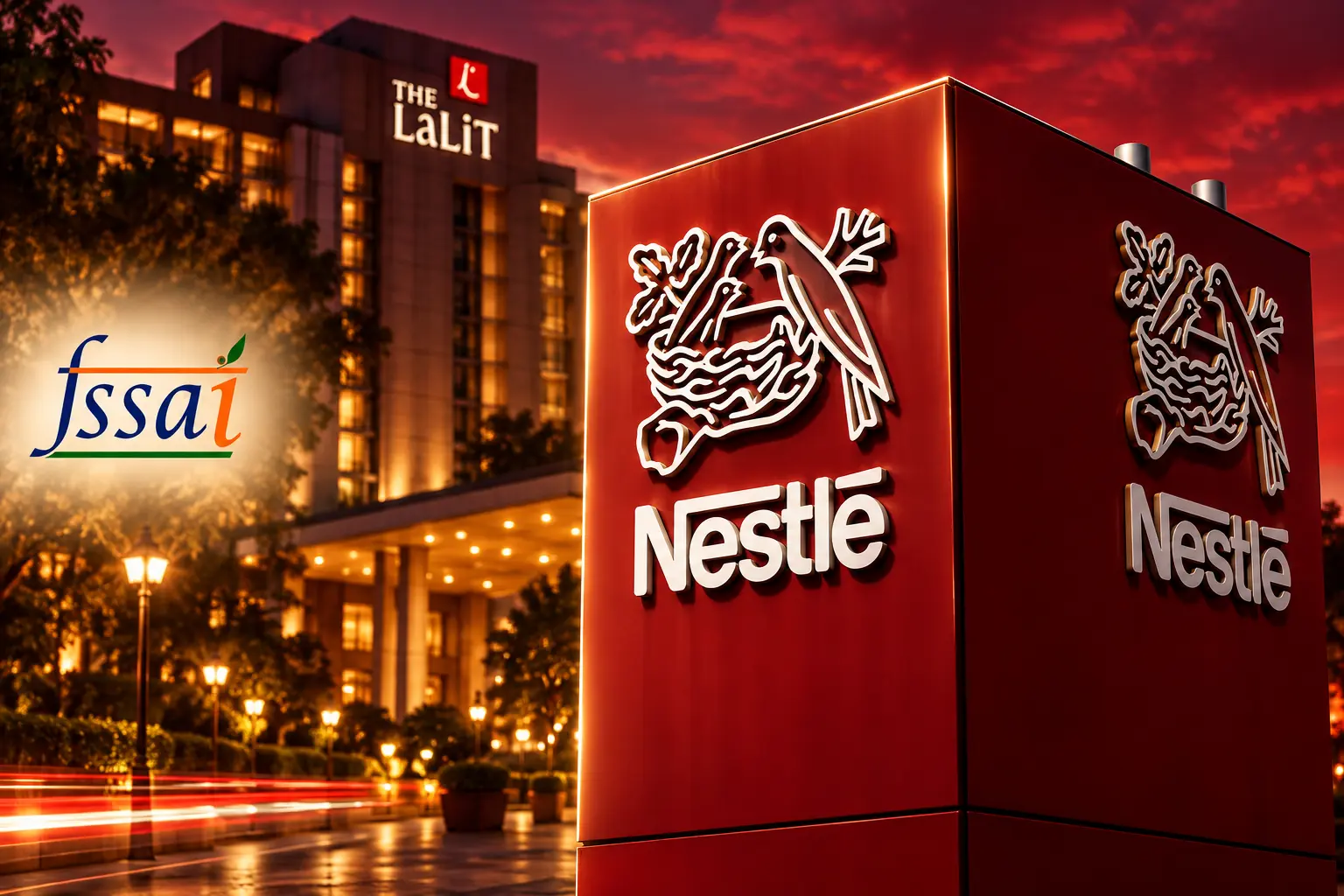
FSSAI tagged a Nestle Low Fat Dairy Whitener sample at The Lalit unsafe, while Nestle says labs counted natural phosphorus against the additive cap.

FSSAI declared a Nestle Low Fat Dairy Whitener sample unsafe and substandard after a test at The Lalit in New Delhi. The FSSAI notice posted on October 3 names M/s Bharat Hotels Ltd., which runs the Connaught Place hotel, as the food business operator told to stop selling the identified stock.
The regulator has not published the lab numbers, the failed parameter, or a batch list a shopper could check. Nestlé India says the product is safe and that the count at issue is phosphorus measured the wrong way.
Bharat Hotels Must Stop Selling the Identified Packs
The Food Safety and Standards Authority of India wrote that a Food Analyst report under the Food Safety and Standards Act, 2006, found the sample non-compliant. A copy of that report went to the hotel company. A notice followed. The operator was told it could appeal, and was told in the same breath to halt sale of the identified product at once.
That is a stop-sale order tied to stock drawn from one premises, not an order that names Nestlé’s factories or every bag on every shelf. Several headlines still called it a ban. The named licensee in the public notice is the hotel group that held the powder, not the manufacturer’s plant.
A sample of Nestlé "Low Fat Dairy Whitener" collected from M/s Bharat Hotels Ltd. (The Lalit), New Delhi, has been declared UNSAFE & SUBSTANDARD by Food Analyst reports under the FSS Act 2006.
Directives have been issued to immediately prohibit the sale of product#FSSAINotice pic.twitter.com/4aVEOV7gx9
— FSSAI (@fssaiindia) October 3, 2026
Bharat Hotels has not issued a public technical reply in the hours after the post. Under the Act, the food business operator is the person carrying on the food business who must keep the food compliant. A hotel kitchen that bought sealed packs still sits in that seat when an inspector draws a sample on site.
WHAT WE KNOW
- The sample: Nestlé Low Fat Dairy Whitener drawn at Bharat Hotels Ltd. (The Lalit), Connaught Place, New Delhi.
- The labels: The Food Analyst report called the same sample both unsafe and substandard under the 2006 Act.
- The order: The hotel operator was directed to prohibit sale of the identified product at once, with a right of appeal.
- The gap: FSSAI has not released the lab values, the batch codes, or the test method in public.
WHAT IS UNCONFIRMED
- The failed test: Nestlé is answering on phosphorus; the public notice does not name the parameter.
- The spread: No recall list, factory order, or nationwide withdrawal has been posted.
- The hotel’s defence: Whether Bharat Hotels will argue it sold the article as purchased, on a licensed supplier invoice, is not yet on the record.
Until those three points move, a supermarket bag and a hotel pantry are not in the same legal place. The identified packs at The Lalit are the ones the notice actually reaches.
Nestle’s Defence Turns on Added Versus Total Phosphorus
A Nestlé India spokesperson said the Low Fat Dairy Whitener is safe to consume and complies with all applicable rules. The company says phosphorus occurs naturally in milk, so it is present in every milk-based powder, and that FSSAI lab reports put total phosphorus against the additive limit.
Nestlé Low Fat Dairy Whitener is safe to consume and complies with all applicable regulatory requirements. Phosphorus is a nutrient that occurs naturally in milk and is therefore present in all milk-based products. FSSAI lab reports reflect total phosphorus against the additive limit, without accounting for the substantial natural phosphorus contribution from milk-based ingredients. Our product is in full compliance for added phosphorus as per prescribed limits under FSSR, including for as consumed basis. We have been in continuous engagement with the authorities as per due process established under law and have shared data across other same/similar milk-based products in the category to reflect presence of naturally occurring phosphorous.
Nestlé India spokesperson, company statement, October 3, 2026
That is a fight about the denominator. If a lab measures every milligram of phosphorus in the dry powder, milk minerals and permitted phosphate salts sit in the same pile. Nestlé wants the cap applied to added phosphates, and it wants that cap read on an as-consumed basis after the powder is mixed into tea or coffee, not only as a neat gram of dust.
FSSAI’s public post does not confirm that phosphorus was the failed line. The company is answering the finding it believes it received. The regulator has not put the certificate in public, so a reader cannot yet check the milligram figure against the additives table.
The first public reflex, including in replies under the wire copy, is already a court stay. Maggi trained that muscle. Nestlé is not in court on this sample yet. It is in the statutory reply window, sharing category data and arguing the method.
What Unsafe and Substandard Mean in Indian Food Law
Unsafe and substandard are two different charges, and this sample was given both. Sub-standard food under Section 51 of the 2006 Act can draw a civil penalty of up to ₹5 lakh. Unsafe food under Section 59 is a criminal route, with jail terms graded by harm and starting from six months, plus a fine. Putting both labels on one hotel sample raises the stakes of a fight that still has no public numbers.
The first move after a failed Food Analyst report is not a press conference. The person from whom the sample was taken, and in some cases the manufacturer named on the pack, may file an appeal against a Food Analyst report before the Designated Officer, in Form VIII, within 30 days of receiving it. If that officer sends a retained part of the sample to a referral lab, that second report is final for the analysis.
Only then does the file split. A Designated Officer who sees a fine-only offence sends it to an Adjudicating Officer. A finding that the food was unsafe can move toward prosecution. The penalty ladder under the 2006 Act also gives a trader a narrow shield: if the article was sold exactly as purchased, against a proper invoice from a licensed supplier, that warranty is a statutory defence. A five-star kitchen that kept sealed Nestlé bags may try to stand on that shield. The manufacturer still has to live with the chemistry argument.
That is not a nationwide manufacturing halt. It is a sample file, a stop-sale on identified stock, and a clock.
Three Infant-Nutrition Cases Were Opened on 18 September
The whitener notice did not arrive in a quiet month. On September 18, 2026, 15 days earlier, FSSAI said it had filed three separate adjudication cases against Nestlé India over infant nutrition products. Nestlé said those products were fully compliant and that the labels had been approved by an FSSAI expert committee.
THE THREE SEPTEMBER CASES
- NAN Excella Pro Stage 1: The regulator flagged claims on “5 HMOs” and “Whey Protein” in material it reviewed, including e-commerce listings.
- Lactogen Pro 1: The file takes aim at a claim that whey protein is easy to digest, which FSSAI tied to promotion rules for infant foods.
- Follow-up formula: A sample was found sub-standard for biotin, and a referral lab also found it non-conforming with the 2020 infant-nutrition rules.
FSSAI said the claim cases sit under Regulation 4(2) of the Food Safety and Standards (Foods for Infant Nutrition) Regulations, 2020, and under Section 3 of the Infant Milk Substitutes, Feeding Bottles and Infant Foods (Regulation of Production, Supply and Distribution) Act, 1992, which restricts advertising of those products. Nestlé said the label statements are factual and backed by scientific literature, and that it had sent a detailed reply.
That September file is about claims and a vitamin line in baby food. Saturday’s file is a hotel pantry powder. The common thread is a regulator that is sampling Nestlé in India again, and a company that answers each notice by saying the product already meets the rule as written.
Maggi’s 2015 Court Fight Is the Template
Anyone who bought noodles in India in 2015 knows the next chapter people are waiting for. On June 5, 2015, FSSAI ordered Nestlé India to recall all nine Maggi noodle variants, halt sale and production, and drop the “No Added MSG” claim. The trigger was lead and MSG findings that began with a Uttar Pradesh sample and then spread through state labs.
One widely cited certificate put lead at 17.2 ppm against a limit of 2.5 ppm. Nestlé said its own accredited tests, covering hundreds of millions of packs, found lead within limits. The company went to the Bombay High Court.
THE NESTLE-FSSAI TIMELINE
- June 5, 2015: FSSAI orders a nationwide Maggi recall and a halt on commercial activity for the noodles.
- August 13, 2015: The Bombay High Court overturned the Maggi ban, calling the move arbitrary and holding that natural justice was not followed, then requiring fresh tests in accredited labs.
- September 18, 2026: FSSAI files three adjudication cases on Nestlé infant-nutrition claims and a biotin finding.
- October 3, 2026: A Low Fat Dairy Whitener sample from The Lalit is declared unsafe and substandard, with a stop-sale on the identified product.
Maggi returned after those court-ordered tests. The 2015 fight was a national product off the shelf. Saturday’s notice is a hotel sample with an unpublished certificate. Treating them as the same event is how a stop-sale becomes a ban in a headline.
The Powder Must Meet a Published Composition Table
Low Fat Dairy Whitener is not a marketing nickname. It is a named class in FSSAI’s dairy-product rules, sitting between skimmed-milk whitener and the medium-fat and high-fat grades. The powder is allowed added sugar. It is built for tea and coffee, not as a straight stand-in for milk powder.
The current compositional table for dairy whitener sets the same protein, moisture, ash and sugar lines across all four fat grades, then splits them on milk fat. Additives, including phosphate salts used as stabilisers, are controlled in a separate appendix, which is the table Nestlé is pointing at when it talks about added phosphorus and an as-consumed reading.
FSSAI LIMITS FOR LOW FAT DAIRY WHITENER
| Parameter | Limit |
|---|---|
| Moisture, maximum | 4.0% (m/m) |
| Milk fat | More than 1.5% and less than 10.0% (m/m) |
| Milk protein in solids-not-fat, minimum | 34.0% (m/m) |
| Insolubility index, maximum | 1.5 ml |
| Total ash, maximum (moisture, added sugar and fat free) | 9.3% (m/m) |
| Acid-insoluble ash, maximum | 0.1% (m/m) |
| Added sugar as sucrose, maximum | 18.0% (m/m) |
| Titratable acidity, maximum (as lactic acid) | 1.5% |
A public certificate would show which of those lines, or which additive cap, the Lalit sample missed. Without it, the unsafe tag is a legal conclusion with no visible arithmetic. Nestlé’s phosphorus reply only makes sense if the failed line sits in the additives appendix rather than in the fat-protein-sugar grid above.
Shoppers Still Have No Batch List to Check
Consumers have been told to follow official updates and to verify product information before using affected batches. That advice is hard to use. No batch codes, no pack sizes, and no manufacturing-unit numbers have been posted with the notice. A guest who drank tea at The Lalit last week cannot match a receipt to a lot. A household that bought a Nestlé whitener in another city has no list to hold against the bag on the counter.
Hotel procurement is the quiet party with money on the table. Institutional kitchens buy dairy whitener in bulk for tea service. A stop-sale inside one five-star store room is a compliance event for that licence. If referral testing later pins the failure on the sealed manufacturer pack, the file can move up the chain. If storage, scooping, or an open tin in a pantry is ever raised, the hotel’s handling becomes the fact in dispute. Nobody has put that claim on the record either.
The identified packs at The Lalit are off sale under the October 3 direction. Nestlé has put a phosphorus method fight on paper. The numbers that would let anyone else check a bag are still inside a lab report the regulator has not released.
Disclaimer: This article is news reporting on an FSSAI sample finding and company statements. It is for information only and is not food-safety, medical, or legal advice. It does not tell anyone to buy, discard, eat, or avoid a specific pack, and it does not advise a hotel, retailer, or manufacturer on how to answer a notice. Readers who have a health concern, a product complaint, or a live enforcement file should speak with a qualified doctor or a food-safety lawyer before acting. Figures, case status, and batch information reflect the public notices and statements available on October 3, 2026, and may change as the appeal and any referral test proceed.

Maharashtra Grants Nana Patekar a State Funeral at His Farm

Nifty Tests 22,600 as Banks Carry a Fragile Rebound

India’s 13.3 Crore Voter Cut Lands on the Election Commission

Reflection Bets $25 Billion on Beam’s Cheaper Open Weights

India Finishes Fourth Again, 21 Medals Short of Hangzhou

Generation Lab’s Secret Youth Shot Has a Copycat Problem

Tesla Raises Dual Motor Prices as Texas Builds Cybercabs

The Nantucket Friendship Basket Boom Meets a Maker Shortage

Bristol Myers Quits Cellares as Autoimmune Doses Proceed

Okta Stock Jumps 20% on McKinnon’s Identity Bet
-
 NEWS2 months ago
Generation Lab’s Secret Youth Shot Has a Copycat Problem
-
 AUTO2 months ago
Tesla Raises Dual Motor Prices as Texas Builds Cybercabs
-
 LIFESTYLE2 months ago
The Nantucket Friendship Basket Boom Meets a Maker Shortage
-
 NEWS2 months ago
Okta Stock Jumps 20% on McKinnon’s Identity Bet
-
 BUSINESS2 months ago
Bristol Myers Quits Cellares as Autoimmune Doses Proceed
-

 BUSINESS2 months ago
Poland Closes Visa-Free Work for Three Fast-Growing Nationalities
-

 LIFESTYLE2 months ago
Labor Day Mattress Sales Repeat a Familiar Holiday Discount
-

 NEWS2 months ago
Google Ends EU Spam Demotions but Keeps the Ranking Split