
NEWS
TSMC Flags 2027 Caution After a Sixth Record Profit
TSMC lifted 2026 sales growth to 44% yet called 2027 prudent, even as Arizona’s next fab starts that year.

TSMC posted a sixth straight record quarterly profit on Oct. 15, then told investors it is being prudent about 2027. Net income for the quarter ended Sept. 30 rose 68.7% to NT$763.06 billion, and the foundry lifted 2026 dollar revenue growth to about 44%.
Chairman and chief executive C.C. Wei tied that caution to consumer and price-sensitive markets being hit by rising component prices and a shaky macro backdrop. The same call said Arizona’s second plant will start volume output in the third quarter of 2027, a little early, and that annual 2-nanometer capacity is set to more than double that year.
A Record Quarter That Could Not Close the Gap
TSMC’s third-quarter results issued Oct. 15 showed consolidated revenue of NT$1,494.24 billion, up 50.9% from a year earlier and 17.6% from the second quarter. In dollars, sales were $46.72 billion, up 41.2% year on year and 16.2% from the prior quarter, above the high end of the company’s own July range of $44.6 billion to $45.8 billion.
Diluted earnings were NT$29.43 a share, or $4.60 per ADR. Gross margin was 66.4%, operating margin 58.7%, and net margin 51.1%. The profit figure beat an LSEG SmartEstimate of NT$746.3 billion compiled from 16 analysts.
THE QUARTER IN FOUR LINES
- Sales: $46.72 billion, $0.92 billion above the top of TSMC’s July guide.
- Profit: NT$763.06 billion, up 68.7% from NT$452.30 billion a year earlier.
- Q4 sales plan: $52.3 billion to $54.3 billion, about 14% up at the midpoint and 58% above a year earlier.
- 2026 dollar growth: about 44%, raised from a view of more than 40% given last quarter.
Chief financial officer Wendell Huang said the fourth quarter will be carried by leading-edge demand, including a steep ramp of 2-nanometer technology. He put fourth-quarter gross margin at 65% to 67% and operating margin at 56.5% to 58.5%, using an exchange-rate assumption of NT$31.8 per dollar.
Wafer shipments were 4,476 thousand 12-inch equivalents, only 3.2% higher than the second quarter, which is a reminder that price and mix, not a flood of extra wafers, did most of the sales work. Inventory days fell to 82 from 87 as those wafers moved. Cash and marketable securities ended at about $126 billion.
Wei told the call that demand for leading-edge technologies continues to be extremely robust, and that the gap between demand and supply is still quite big. He also said the company did not see any sign of a slowdown in the trend it calls the AI mega cycle. That is the backdrop for a 2027 warning that is easy to misread as an AI pause.
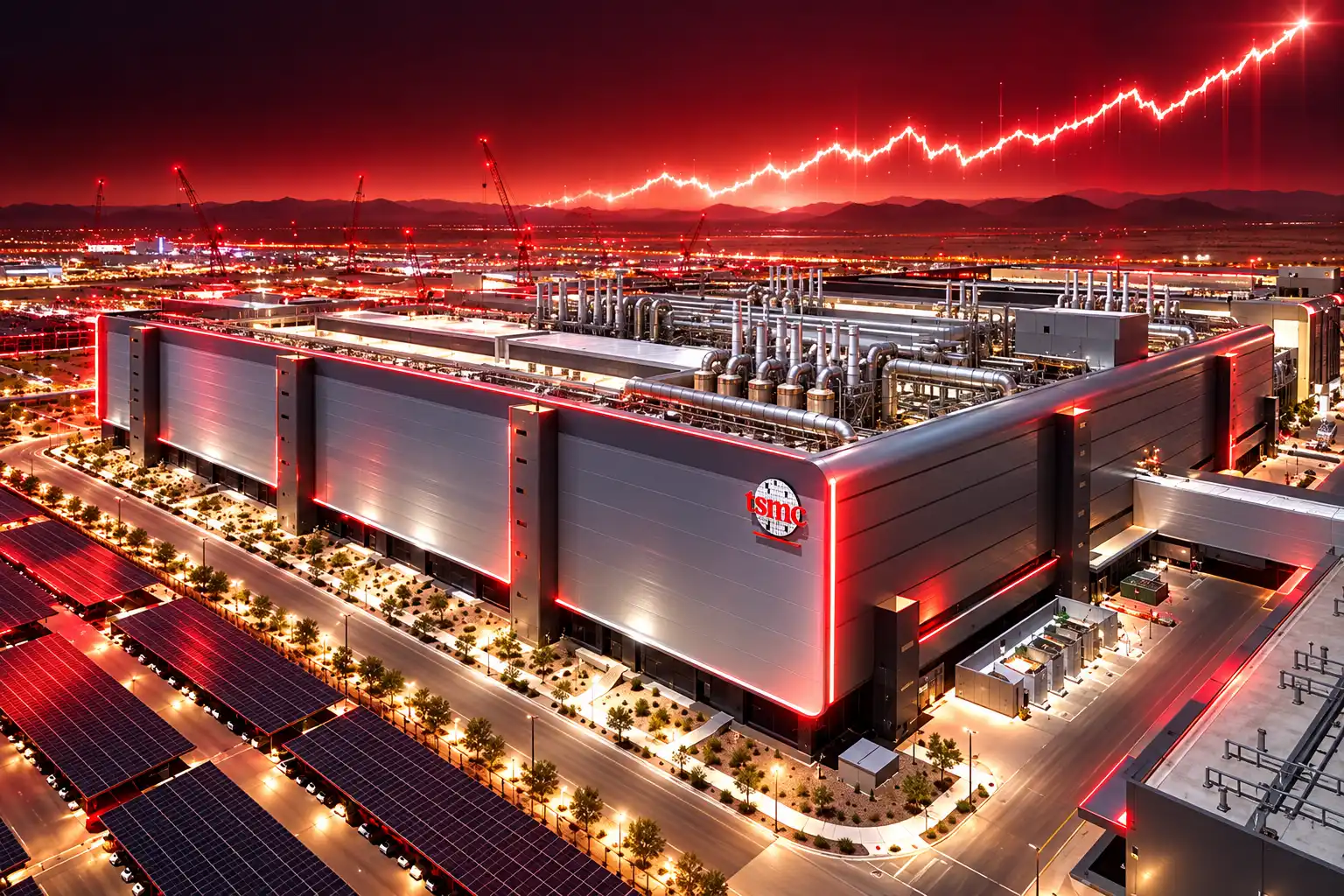
High-Performance Computing Took 68% of Third-Quarter Sales
The mix now explains both the record and the caution. High-performance computing, TSMC’s bucket for AI accelerators, server chips, and networking silicon, rose 22% from the second quarter and supplied 68% of sales, up from 57% a year earlier. Smartphones rose 10% sequentially and were 21% of sales, down from 30% in the third quarter of 2025.
WHERE THE MONEY CAME FROM
| Platform | Share of 3Q26 sales | Change vs 2Q26 | Share in 3Q25 |
|---|---|---|---|
| High-performance computing | 68% | +22% | 57% |
| Smartphone | 21% | +10% | 30% |
| Internet of Things | 4% | +5% | 5% |
| Automotive | 4% | +23% | 5% |
| Digital consumer electronics | 1% | -12% | 1% |
| Others | 2% | -10% | 2% |
The high-performance computing share of sales is the figure that turns a strong quarter into a concentrated one. Automotive was the fastest sequential gainer at 23%, still only 4% of the book. Digital consumer electronics, already 1% of sales, fell 12% from the second quarter. Customers based in North America accounted for 79% of revenue, with Asia Pacific at 10%, China at 5%, and Japan and EMEA at 3% each.
A year ago, phones were still a third of the company. They are now a side business next to the AI and server book. That is why a soft consumer tape-out plan for 2027 cannot be dismissed as mix noise. There is less ballast left if the expensive, price-sensitive devices that use mature and mid-range nodes keep getting squeezed.
Why TSMC Is Being Prudent About 2027
Wei’s 2027 line was not a cut to the 2026 plan. It sat next to a raise. He still described leading-edge demand as extremely robust, with agentic AI processors and networking chips adding to accelerator work. The prudence was aimed at a different shelf of the market.
Looking ahead, we continue to observe consumer and price-sensitive end market segment are being challenged due to the impact of rising component prices and macroeconomic uncertainties. As such, we are being prudent in our business planning going into 2027 while focusing on the fundamentals of our business to further strengthen our competitive position.
C.C. Wei, chairman and chief executive, TSMC third-quarter 2026 earnings call
Those rising component prices are not an outside weather system. In July, people familiar with customer talks said wafer prices would rise by as much as 10% from 2027, covering advanced nodes and mature lines such as 12-nanometer, 16-nanometer, and 28-nanometer. TSMC does not comment on pricing. A company spokesperson said only that its approach is strategic, not opportunistic.
If those talks hold, the same year TSMC is being prudent about consumer demand is the year more of its own wafer bill lands on the devices that Wei just flagged as stretched. Memory prices have already been the harsher story for PC and phone makers. A foundry increase on the logic side would stack on top.
WHAT TSMC HAS ALREADY SCHEDULED FOR 2027
- 2-nanometer output: Annual N2-family capacity is set to more than double, after high-volume manufacturing began in the fourth quarter of 2025 at Hsinchu and Kaohsiung.
- Arizona Fab 2: Volume production of 3-nanometer chips is due in the third quarter, slightly ahead of the prior timetable, with tools now moving in.
- Reported wafer pricing: Customer talks described increases of as much as 10% from the start of 2027, which TSMC has not confirmed.
Gary Tan, a portfolio manager at Allspring Global Investments, which holds TSMC shares, said the tone matches caution heard across recent chip calls and investor days. He framed the risk as TSMC’s wording feeding earnings cuts along a chain used to upward revisions, while calling the message sensible expectation management rather than a break in long-term demand.
That reading fits the numbers TSMC actually moved. 2026 sales growth went up, not down. The 2026 capital budget stayed at $60 billion to $64 billion. Huang said spending from 2026 through 2028 will be even more significantly higher than in the prior three years. Prudence, in this shop, is a planning word, not a capex cut.
Arizona’s Second Fab Moves In Ahead of Plan
The U.S. build is the other half of the 2027 collision. In July the White House and the Commerce Department announced an extra $100 billion from TSMC, taking the company’s $265 billion U.S. manufacturing plan across 12 plants. Wei said then that the company appreciated support from the administration and from leading U.S. customers.
Phoenix now lists 12 facilities planned in Arizona, and says that once the announced fabs are finished, about 30% of TSMC’s 2-nanometer and more advanced capacity will sit there. TSMC Arizona employs more than 3,500 people in the state. The first Phoenix fab has been in volume production of N4 chips since late 2024, with yields the city describes as comparable to Taiwan.
THE ARIZONA BUILD
- Late 2024: The first Phoenix fab begins volume production on N4.
- July 16, 2026: TSMC adds $100 billion, taking the U.S. total to $265 billion and 12 facilities.
- Oct. 15, 2026: Wei says Fab 2 construction is complete, tools are moving in, and volume production will begin in the third quarter of 2027, slightly ahead of plan.
Fab 2 is a 3-nanometer plant. Wei told the Oct. 15 call that construction is finished and that the company is in tool move-in and installation. Bringing that factory in early is a win for U.S. customers who have asked for more local wafers. It is also more expensive output arriving in the year TSMC just labelled as one for careful planning, with Huang already warning that overseas-fab dilution of gross margin will widen to 3% to 4% over the next few years as more U.S. lines ramp, from about 2% now.
The geography of the book already leans that way. North America is 79% of sales. The new Arizona wafers are being built for that customer set, not for the price-sensitive consumer names Wei put on the 2027 watch list.
Order Interest Out to 2029 and 2030
A day before TSMC’s call, ASML, the Dutch maker of the extreme-ultraviolet tools that print TSMC’s most advanced layers, reported €11.7 billion of third-quarter sales and €4.96 billion of net income. Gross margin was 57.5%. It guided fourth-quarter sales to €14.2 billion to €15.2 billion and full-year 2026 sales to €44 billion to €45 billion.
In light of their demand visibility, some customers are expressing an interest in placing orders with us for 2029 and even 2030.
Christophe Fouquet, chief executive, ASML third-quarter 2026 results
Fouquet said customers keep raising their short- and medium-term equipment forecasts, driven by how large and how long they think AI investment will be. ASML now expects planned supply for 2027 and 2028 will not fully meet demand, even after a 30% capacity increase planned for 2027, and it is looking at going beyond a further 30% rise in 2028. The same release recorded orders for 2029 and even 2030 as interest, not as a booked total.
That is a longer clock than TSMC’s 2027 planning note, and it is why the two prints landed as a split screen. ASML is telling the tool market that 2027 and 2028 are still short of machines. TSMC is telling the wafer market that the consumer end of 2027 needs a conservative plan. Both can be true at once if AI and high-performance computing keep soaking leading-edge capacity while phones, PCs, and other price-sensitive boxes struggle with the bill.
A Fast 2-Nanometer Start and a Thinner Gross Margin
The newest node is already large enough to move the profit ratio. 2-nanometer wafers were 8% of wafer revenue in the third quarter, up from 3% in the second quarter and from nothing a year earlier. 3-nanometer was the biggest slice at 33%. Nodes at 7-nanometer and below were 79% of wafer sales.
WAFER SALES BY NODE
| Node | 3Q26 share | 2Q26 share | 3Q25 share |
|---|---|---|---|
| 2-nanometer | 8% | 3% | 0% |
| 3-nanometer | 33% | 30% | 23% |
| 5-nanometer | 28% | 33% | 37% |
| 7-nanometer | 10% | 11% | 14% |
| 7-nanometer and below | 79% | – | – |
Gross margin fell 1.3 points from 67.7% because of the early N2 ramp, the management report said, and still landed inside the 65% to 67% band set in July. Operating margin at 58.7% cleared the 56% to 58% range. Huang guided the fourth-quarter gross-margin midpoint down about 40 basis points to 66%, again on the 2-nanometer ramp and on overseas plants, partly offset by cost work.
Third-quarter capital spending was $13.84 billion, bringing the first nine months to $40.64 billion against the full-year band of $60 billion to $64 billion. Huang’s point on the call was the usual TSMC one: a higher capex year is a claim on growth in the years after it. The 2026 budget was held, not cut, in the same hour Wei asked for prudence in 2027 plans.
N2 is also the node TSMC says will sell into both smartphones and HPC AI applications as capacity more than doubles next year. That dual use is the bet inside the caution. If flagship phones keep taking 2-nanometer wafers, the consumer warning is about cheaper devices and older nodes. If those flagship programs slip because the whole bill of materials is up, some of that doubled N2 capacity has to be absorbed by the same HPC customers who already cannot get enough CoWoS-class packaging and leading-edge wafers.
Texas Teams and Who Would Run Terafab
Wei said major U.S. customers have asked TSMC to add manufacturing outside Arizona, and that the U.S. government has been supportive. Texas is on that list. “Texas is one,” he said. “We send the teams to Texas to do all the evaluation.” No site, dollar figure, or process node was named, and no decision was announced.
The same Q-and-A covered Elon Musk’s Terafab idea, a planned chip complex tied to Musk’s companies. Musk had said those companies would build and run it, with TSMC possibly subleasing space. Wei said TSMC has held talks and drew a hard line: any fab collaboration would have to be operated by TSMC.
WHAT WE KNOW
- The Texas work: Evaluation teams are in the state, at the request of large U.S. customers, with no investment announced.
- The operating rule: Wei said a fab in any such tie-up has to be run by TSMC, not subleased as a customer-operated line.
- The Arizona clock: Fab 2 is already in tool install, with volume due in the third quarter of 2027.
WHAT IS UNCONFIRMED
- A Texas site: No location, capital figure, or technology node has been disclosed.
- A Terafab deal: Talks are open; nothing is signed, and the two sides have described different operating models.
- The 2027 price list: Customer-talk reports of increases up to 10% have not been confirmed by TSMC.
That unfinished U.S. map is the live edge of the 2027 file. TSMC is early on Arizona’s second plant, open to a second American state, and unwilling to let someone else run the cleanroom. It is also the foundry telling a consumer-heavy slice of its book that prices and the macro picture argue for a careful plan in the same year those new tools are meant to start earning their keep.
Wei did not cut the 2026 growth number to make that point. He raised it to about 44%, kept a $60 billion to $64 billion capex band, and still asked the room to treat 2027 as a year that needs prudence, because the parts of the market that do not live on AI accelerators are already paying more for the chips inside them.
Disclaimer: This article is news reporting and analysis of TSMC’s public results, guidance, and expansion plans, and it is for information only. It is not investment advice, a recommendation to buy or sell TSMC or any other security, and it is not a forecast of 2027 earnings. Readers should consult a qualified financial adviser or licensed investment professional before making any investment decision. Figures, schedules, and statuses reflect company statements and cited primary documents as of the dates given in the piece and can change with later results, capex revisions, or customer orders.

John Mayer Bets Sob Rock Can Be a Record Label

H1N1 Rises Early After Last Winter’s H3N2 Wave

Human Fires Drive Amazon Carbon Emissions Even Without Drought

Charli XCX Secretly Films a Cameo in Scorsese’s Horror

Santos’s 58-Yard Kick Decides the Williams-Maye Rematch

Generation Lab’s Secret Youth Shot Has a Copycat Problem

Tesla Raises Dual Motor Prices as Texas Builds Cybercabs

The Nantucket Friendship Basket Boom Meets a Maker Shortage

Bristol Myers Quits Cellares as Autoimmune Doses Proceed

Okta Stock Jumps 20% on McKinnon’s Identity Bet
-
 NEWS2 months ago
Generation Lab’s Secret Youth Shot Has a Copycat Problem
-
 AUTO2 months ago
Tesla Raises Dual Motor Prices as Texas Builds Cybercabs
-
 LIFESTYLE2 months ago
The Nantucket Friendship Basket Boom Meets a Maker Shortage
-
 NEWS2 months ago
Okta Stock Jumps 20% on McKinnon’s Identity Bet
-
 BUSINESS2 months ago
Bristol Myers Quits Cellares as Autoimmune Doses Proceed
-

 BUSINESS2 months ago
Poland Closes Visa-Free Work for Three Fast-Growing Nationalities
-

 LIFESTYLE2 months ago
Labor Day Mattress Sales Repeat a Familiar Holiday Discount
-

 NEWS2 months ago
Ox Alpha Was a Chinese Chip Stress Test All Along