
NEWS
Roman Space Telescope Begins a Million-Mile Survey Run
NASA’s Roman Space Telescope is cruising to L2 after an Aug. 30 Falcon Heavy launch, set to pour public survey data into a dark energy fight.

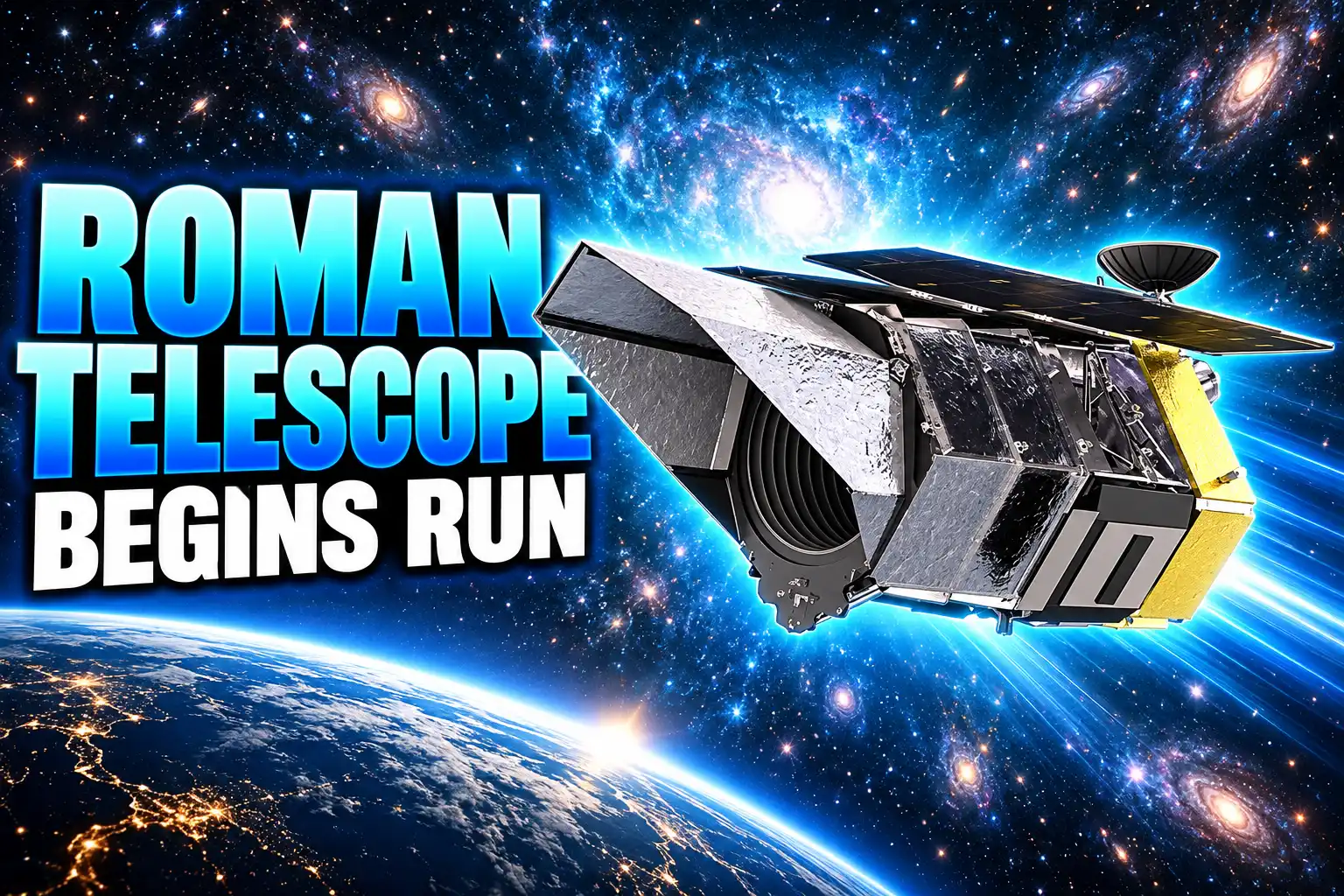
NASA’s Nancy Grace Roman Space Telescope left Kennedy Space Center at 7:26 a.m. EDT on Sunday, Aug. 30, riding a SpaceX Falcon Heavy off Launch Complex 39A. Controllers at Goddard Space Flight Center locked onto the spacecraft seven minutes later, and the observatory is now on a three-month, million-mile run toward the Sun-Earth L2 point.
The pad story is finished. What flies next is a survey engine that will dump public infrared maps into a cosmology fight that already looks shaky from the ground.
Roman Left Florida at Sunrise
Falcon Heavy’s 27 Merlin engines lifted a Hubble-class 2.4-meter telescope that NASA managed at Goddard with BAE Systems, L3Harris, Teledyne, and partners at ESA, JAXA, CNES, and Germany’s Max Planck Institute for Astronomy. NASA Administrator Jared Isaacman called the flight the kind of success story he wants across the agency, saying the mission was delivered ahead of schedule and on budget.
The Nancy Grace Roman Space Telescope has officially launched and is heading to its forever home at L2!
Over the next three months, the observatory will perform final checks and power its instruments before revealing its first images by early 2027.https://t.co/IdabpolHmh pic.twitter.com/tuDHAEzgKh
— Nancy Grace Roman Space Telescope (@NASARoman) August 30, 2026
THE LAUNCH CLOCK
- 7:26 a.m. EDT, Aug. 30: Falcon Heavy lifts off from pad 39A at Kennedy.
- 7:33 a.m.: Goddard begins receiving telemetry through NASA’s Tracking and Data Relay satellites.
- 7:57 a.m.: The observatory separates from the upper stage about 31 minutes after launch.
- T+1 hour 23 minutes: Solar panels and the lower instrument sun shade deploy.
- T+70 minutes: The Deep Space Network takes over through Canberra, then Madrid and Goldstone.
SpaceX planned side boosters landing at LZ-2 and LZ-40 at Cape Canaveral Space Force Station, cores that had previously flown GOES-U and Viasat-3 F3. NASA said the boosters returned safely for refurbishment. This was the agency’s fourth primary Falcon Heavy science flight, moved up after the Launch Services Program worked with SpaceX to match the telescope’s early finish.
The Telescope Will Dump 1.4 Terabytes a Day
Roman’s Wide Field Instrument is a 300-megapixel infrared camera built around 18 saltine-size 4K detectors. Each pointing covers a patch bigger than the full Moon. Hubble’s Wide Field Camera 3 frames are about 200 times smaller; even the Advanced Camera for Surveys is nearly 100 times smaller.
User docs at the Space Telescope Science Institute put the active sky area at 0.281 square degrees, a field of view 200 times larger than Hubble’s WFC3/IR. NASA says the rigid optical bench lets Roman scan up to 1,000 times faster than Hubble at similar infrared sharpness, covering more than 50 times as much sky in five years as Hubble did in 30.
THE DOWNLINK
- Daily haul: NASA says the spacecraft will send back 1.4 terabytes every day, the highest data rate of any NASA astrophysics mission so far.
- Five-year pile: Mission briefing papers put processed holdings at 20,000 terabytes, or 20 petabytes, across the primary mission.
- Open tap: There is no exclusive-access window for the core surveys.
- Human filter: NASA expects machine learning and citizen scientists to flag events for follow-up.
Nicky Fox, associate administrator for the Science Mission Directorate, called Roman a discovery machine with fast survey speeds. Julie McEnery, senior project scientist at Goddard, put the same point in plainer words.
We’ve never been able to view the universe with eyes like Roman’s before. There’s no telling what more we’ll know and have seen by this time next year.
Julie McEnery, Roman senior project scientist, NASA Goddard
The practical shift is who gets to publish. Hubble and JWST time still goes through oversubscribed proposals. Roman’s core maps land in public archives as soon as they are processed, so the scarce resource becomes computing, not nights on the telescope.
The DESI Maps Shifted Roman’s Job
Roman was sold for years as the space mission that would pin down dark energy, the poorly named push that makes cosmic expansion speed up. That job got sharper after the Dark Energy Spectroscopic Instrument released three years of baryon acoustic oscillation measurements from more than 14 million galaxies and quasars.
DESI’s own DR2 cosmology paper says those BAO data are still well described by a flat ΛCDM model, yet the preferred parameters sit in 2.3-sigma tension with the cosmic microwave background. When the same maps are combined with CMB data and supernova catalogs, the 2.8 to 4.2 sigma with supernova catalogs is the range DESI quotes for a dynamical dark energy model over ΛCDM, depending on which supernova sample is used.
WHERE EXPERTS DISAGREE
- BAO alone: DESI finds a mild mismatch with CMB parameters, not a standalone discovery of changing dark energy.
- BAO plus CMB plus supernovae: The same team says a time-evolving equation of state fits better, still short of the 5-sigma line astronomy treats as a detection.
Roman cannot settle that argument from cruise. It can, once science operations start, add two space-based checks the ground survey does not own: weak lensing and galaxy clustering across more than a billion galaxies, plus a supernova sample NASA has described as tens of thousands of distant explosions against fewer than 2,000 used in many current Hubble diagrams. Rebekah Hounsell of the University of Maryland, Baltimore County, a supernova-survey co-leader, called that jump huge. The point of flying a Hubble-sharp camera so wide is to make those two tests in the same dataset, not to wait for another decade of mixed catalogs.
Most Observing Time Is Already Spoken For
Unlike Hubble and JWST, where most orbits are awarded proposal by proposal, Roman’s first five years were carved up before launch. The Roman Observations Time Allocation Committee, co-chaired by Gail Zasowski of the University of Utah and Saurabh Jha of Rutgers University, delivered its advice in April 2025. Core community surveys take the majority of the clock. General astrophysics keeps 389 days, 25.5% of science time, including an early Galactic Plane Survey.
WHERE FIVE YEARS GO
| Program | Time on the clock | What it is built to measure |
|---|---|---|
| High-Latitude Wide-Area Survey | About 17 months | Imaging plus grism spectroscopy of more than a billion galaxies; a medium tier of 2,400 square degrees and a wide H-band tier that pushes the total above 5,000 |
| High-Latitude Time-Domain Survey | About 6 months | Type Ia supernovae and other transients, with a short pilot of templates as early as possible |
| Galactic Bulge Time-Domain Survey | About 15 months | Microlensing planets on a 12.1-minute cadence across six seasons, three early and three late |
| General astrophysics | 389 days | Competitively picked programs, including the Galactic Plane Survey of nearly 700 square degrees |
All Roman data will be publicly available immediately, NASA’s survey pages state, with no proprietary lock. The High-Latitude Wide-Area work is spread through the five-year mission, with at least half the deep tier early and most of the wide tier late. That schedule is how a single observatory can feed both the dark-energy tests and a later, shallower map that overlaps Rubin optical photometry.
How Many New Planets Can Microlensing Find?
NASA’s bulge survey is written to find more than a thousand wide-orbit planets in the habitable zone and beyond, plus more than 100,000 transiting worlds, by staring at the crowded heart of the Milky Way. Microlensing has so far tagged just over 200 exoplanets, against more than 4,000 found by transits in a confirmed list that now exceeds 6,000. Roman is supposed to multiply the microlensing haul more than fivefold.
THE BULGE YIELD SHEET
- Cadence: Hundreds of millions of stars, revisited about every 12 minutes during high-cadence seasons.
- Bound planets: A 2019 simulation series led by Matthew Penny predicted about 1,400 bound microlensing planets above roughly 0.1 Earth masses for a six-season plan.
- Other bodies: The same stare can turn up free-floating planets, brown dwarfs, neutron stars, and white dwarfs.
- All methods: NASA’s launch briefing put the combined microlensing, transit, and coronagraph search near 100,000 new exoplanets.
Caltech/IPAC’s Roman Science Support Center will handle high-level processing for the bulge time-domain work. The unglamorous limit is characterization. A microlensing blip gives a mass and a rough orbit. It does not hand JWST a bright, repeating target with a useful atmosphere spectrum. The catalog will get large fast. The follow-up queue will not.
A Starlight Mask Rides Along to L2
Tucked beside the wide camera is the Coronagraph Instrument, a NASA technology demonstration of masks, prisms, detectors, and deformable mirrors meant to blot out starlight. NASA says it will power on in the days after launch and is built to photograph Jupiter-like planets, a step toward the later Habitable Worlds Observatory concept. JPL has described it as the first active coronagraph in space, able to adjust itself in flight to keep the glare down.
It will not run the sky surveys. The WFI does that, and NASA says the wide camera turns on a few weeks into the cruise, once the high-gain antenna and the deployable aperture cover are out and the first of two mid-course burns is done. The coronagraph is the long bet riding for free on a survey mission: prove you can carve a dark hole around a star, then argue for a dedicated Earth-twin imager.
Congress Saved a Cost-Capped Observatory
The spacecraft that left Florida is the rare NASA flagship that still fits its own paperwork. The Government Accountability Office’s 2026 major-project review lists a $4.316 billion life-cycle cost and a May 2027 launch-readiness date from the pandemic replan, and it shows Roman slightly under its prior cost estimate. Isaacman’s “on budget” line is the public version of that ledger. The original flight baseline had been October 2026, so Sunday’s launch was early against both the commitment date and the first published window.
Getting there took a cost cap on development and repeated fights in Washington. White House budget requests sought to cancel or slash the project across multiple cycles; Congress kept restoring the money, including a late appropriation that carried the observatory through launch. The 2.4-meter primary, Hubble’s aperture at a fraction of Hubble’s mirror mass, began as surplus reconnaissance hardware NASA accepted more than a decade ago. That gift is why a wide survey telescope could be Hubble-sharp without a JWST-scale rebuild.
Jackie Townsend, the project manager at Goddard, has said the team ran to the cap instead of discovering it after the fact. The political near-deaths are why an on-time Falcon Heavy flight reads louder than a routine science launch. The science program did not change in those fights. The observing time was already promised to community surveys.
First Pictures Wait Until Early 2027
Roman is on her way, and the Golden Age of Discovery is just the beginning. pic.twitter.com/Nr5pJRyXM5
— NASA (@NASA) August 31, 2026
NASA’s own next milestones are quiet ones: antenna and visor deployments, that first mid-course correction, coronagraph turn-on, then WFI activation a few weeks into the voyage. The rest of the three-month commissioning run is calibration. NASA says it expects to release Roman’s first images by early 2027, after the observatory is around L2 and the instruments have been put through their tests. Station-keeping there is supposed to be modest, a gravitational parking spot JWST already uses about a million miles from Earth.
Until those first frames land, the mission is a cruise vehicle with a 300-megapixel camera still dark. The surveys that will eat three-quarters of five years are already written. The dark-energy tension they were built to test is already in the literature. The pictures will come later.

Maharashtra Grants Nana Patekar a State Funeral at His Farm

Nifty Tests 22,600 as Banks Carry a Fragile Rebound

India’s 13.3 Crore Voter Cut Lands on the Election Commission

Reflection Bets $25 Billion on Beam’s Cheaper Open Weights

India Finishes Fourth Again, 21 Medals Short of Hangzhou

Tesla Raises Dual Motor Prices as Texas Builds Cybercabs

Generation Lab’s Secret Youth Shot Has a Copycat Problem

The Nantucket Friendship Basket Boom Meets a Maker Shortage

Bristol Myers Quits Cellares as Autoimmune Doses Proceed

Okta Stock Jumps 20% on McKinnon’s Identity Bet
-
 NEWS1 month ago
Generation Lab’s Secret Youth Shot Has a Copycat Problem
-
 AUTO1 month ago
Tesla Raises Dual Motor Prices as Texas Builds Cybercabs
-
 LIFESTYLE2 months ago
The Nantucket Friendship Basket Boom Meets a Maker Shortage
-
 BUSINESS1 month ago
Bristol Myers Quits Cellares as Autoimmune Doses Proceed
-
 NEWS1 month ago
Okta Stock Jumps 20% on McKinnon’s Identity Bet
-

 LIFESTYLE1 month ago
Labor Day Mattress Sales Repeat a Familiar Holiday Discount
-

 BUSINESS2 months ago
Poland Closes Visa-Free Work for Three Fast-Growing Nationalities
-

 NEWS1 month ago
Ox Alpha Was a Chinese Chip Stress Test All Along