
NEWS
One Nitrogen Atom Wakes Aluminum for Sodium-Sulfur Cells
Hefei researchers woke cheap aluminum as a sodium-sulfur catalyst by breaking its atomic symmetry, logging 2,500 cycles at 0.017% fade.

A Hefei lab held a sodium-sulfur cathode at 1,196 mAh per gram after 100 cycles by swapping one oxygen around aluminum for nitrogen. The same cells faded 0.017% per cycle across 2,500 cycles, a result the authors say beats most d-block single-atom catalysts tried in this chemistry.
The paper, from Wang Hui and Zheng Fangcai at the High Magnetic Field Laboratory of the Hefei Institutes of Physical Science, went online on September 16, 2026, in Angewandte Chemie. The English lab note followed on November 2. The move is smaller than a new battery. It is a way to make a cheap main-group metal behave like the expensive ones labs usually reach for.
One Nitrogen Breaks the Square Around Aluminum
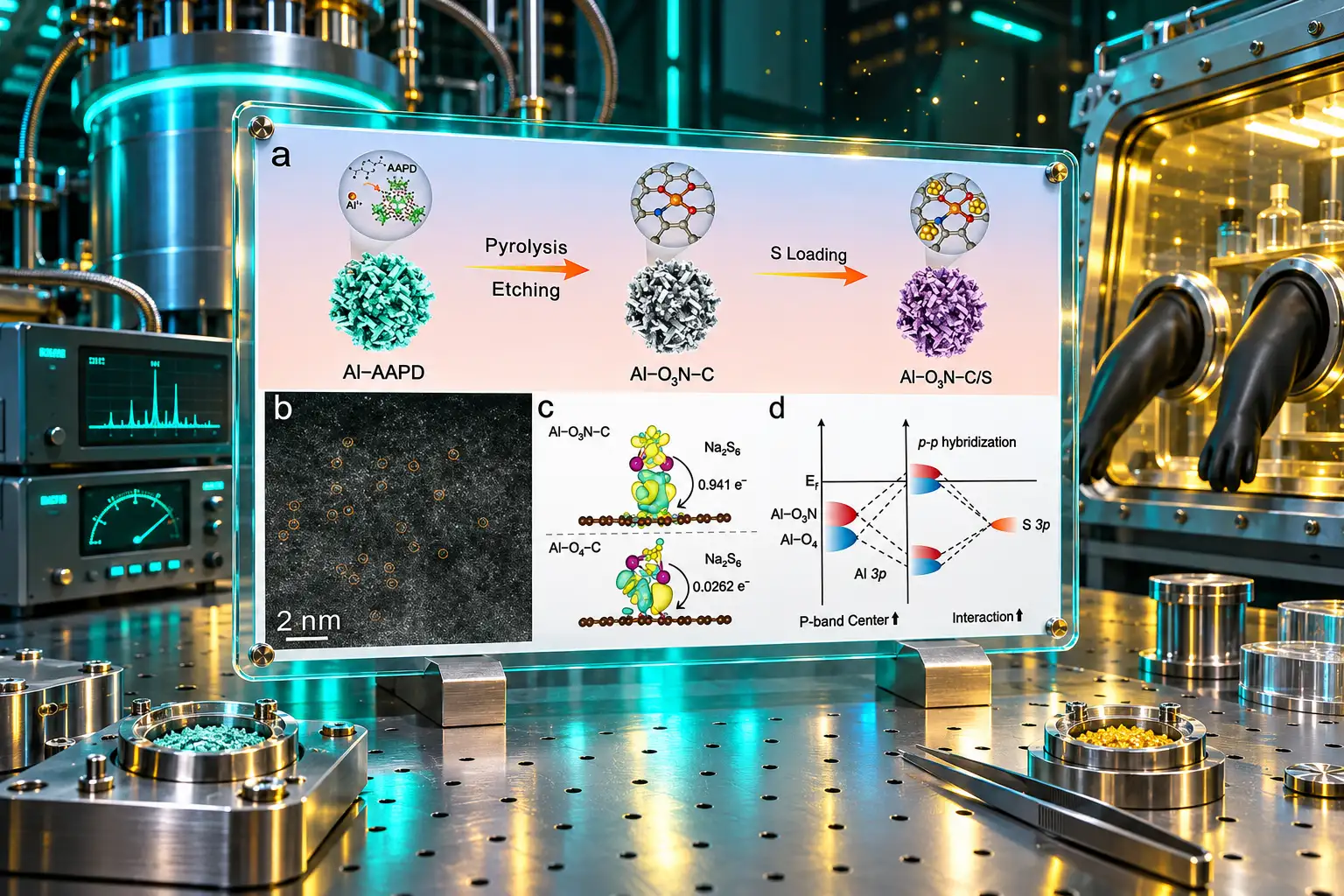
Isolated aluminum atoms on carbon usually sit in a tidy square of four oxygen atoms, written Al-O4. The Hefei group replaced one of those oxygens with nitrogen and pinned the new site to a carbon support. They call the product Al-O3N-C: three oxygens, one nitrogen, one aluminum, planar and uneven.
That missing symmetry is the whole design. Nitrogen pulls electron density in a way four identical oxygens do not, so charge piles up on the metal. X-ray spectra in the lab’s October 26 note show the Al 2p binding energy shifted 0.12 eV toward higher energy after the swap. The authors read that blueshift as localization at the aluminum site.
Localized charge lets the aluminum 3p orbitals mix with the sulfur 3p orbitals on sodium polysulfides, the sticky intermediates that form as sulfur is reduced. Stronger mixing holds those chains on the cathode and speeds the next redox step. Fewer chains drift into the electrolyte. More sulfur stays available for the next cycle.
HOW ONE NITROGEN CHANGES THE ALUMINUM SITE
- The starting square: Each aluminum atom sits in a planar Al-O4 pocket on carbon, a symmetric and weakly catalytic main-group site.
- The swap: One oxygen ligand is replaced with nitrogen, giving the uneven Al-O3N coordination the paper names Al-O3N-C.
- The charge pile-up: Broken symmetry localizes electrons on aluminum and shifts the Al 2p line by 0.12 eV.
- The hold: Aluminum 3p and sulfur 3p orbitals hybridize, so sodium polysulfides adsorb instead of dissolving away.
- The payoff: Shuttle current falls and sulfur redox runs faster, which is what the long cycle test is measuring.
Zheng Fangcai is first author. Wang Hui shares corresponding credit with Changlai Wang, an associate professor at Anhui University, and Zhiqiang Li. The Hefei Institutes is the first corresponding address. Funding came from China’s National Key R&D Program, the National Natural Science Foundation, Anhui’s science fund, and several Hefei campus grants.
Main-Group Metals Looked Like Lazy Catalysts
Single-atom catalysts put every metal atom on the surface, so a milligram of metal does the work of a nanoparticle. Most of the sodium-sulfur literature uses d-block centres such as iron, cobalt, nickel or vanadium, because empty d orbitals make a convenient place to park and release sulfur species.
Main-group metals, the s-block and p-block set that includes calcium, aluminum, tin and bismuth, are cheaper and less toxic. They also lack those empty d orbitals. Reviews of the field treat that missing d-band as a built-in ceiling: the metal can sit on carbon, but it does not catalyze sulfur the way cobalt does. Aluminum is the blunt case. It is the most abundant metal in Earth’s crust, and in a conventional single-atom pocket it is a weak catalyst for the reactions that matter here.
The Hefei argument is that the ceiling was a coordination problem. Keep the cheap metal. Change the atoms around it until charge sits where a d-orbital would have sat. If that holds, the catalyst bill for a sodium-sulfur cathode does not have to run through cobalt, nickel or platinum at all.
Hot Sodium-Sulfur Packs Never Had This Shuttle
Sulfur can theoretically store 1,675 mAh per gram on a two-electron reaction, which is why chemists keep returning to it. Pair it with sodium and the cell-level energy density the same Hefei group has cited is 1,274 Wh per kg, a materials number, not a pack number. Room-temperature versions of that cell still stumble on the same four problems: sulfur and its final sulfide are poor electronic conductors, sodium metal grows dendrites, liquid electrolytes are messy, and the middle species, sodium polysulfides, dissolve and drift.
That last failure has a name. Polysulfides leave the cathode, cross the separator, and react on the sodium anode. Active material vanishes from the positive electrode. The anode films over. Capacity falls in tens of cycles, not thousands. Catalysts are supposed to pin those chains and hurry them on to insoluble Na2S so they never get the chance to leave.
Grid hardware already solved the shuttle by refusing to use a liquid. Commercial NAS cells from NGK Insulators run between 300 and 340 degrees C, with molten sodium and molten sulfur split by a beta-alumina ceramic that conducts sodium ions and keeps the sulfur species on their own side. The company lists 222 Wh per kg and 367 Wh per litre, a 20-year calendar life, and 7,300 cycles. Those packs exist because the cell is hot enough to keep both electrodes liquid and the electrolyte solid. They are also large, insulated tanks. They are not a room-temperature battery, and they are not a car battery.
Room-temperature sodium-sulfur is the product people actually want from this chemistry, and it still needs a liquid or gel electrolyte. That is why a cheap catalyst that holds polysulfides at ambient temperature is the sleeper, not a rival to NGK’s hot boxes.
SODIUM-SULFUR FROM FORD TO HEFEI
- 1966: Joseph Kummer and Neill Weber at Ford Motor Company demonstrate a sodium-sulfur cell aimed at electric cars, a use the operating temperature later ruled out.
- 2002 onward: NGK Insulators sells high-temperature NAS modules for stationary storage, with molten electrodes and a ceramic electrolyte.
- May 12, 2025: The same Hefei pair reports calcium single-atom sites with an axial nitrogen ligand in Nature Communications, 1,211 mAh per gram after 100 cycles at 0.2 C.
- September 16, 2026: Angewandte Chemie posts the aluminum Al-O3N paper, extending the coordination trick from s-block calcium to p-block aluminum.
- October 26, 2026: Zheng Fangcai’s Hefei note adds the 0.12 eV Al 2p blueshift and names the Anhui University co-corresponding authors.
- November 2, 2026: The Hefei Institutes and the Chinese Academy of Sciences issue the English research notes that carried the work beyond the journal.
The hot cell and the cold cell share sodium and sulfur and almost nothing else in the stack. One is a ceramic furnace. The other is a coin cell with a liquid in it. Mixing their cycle numbers is how this literature gets over-read.
What the Hefei Coin Cells Delivered
The sulfur cathode built on Al-O3N-C, labelled Al-O3N-C/S in the paper, held 1,196 mAh per gram after 100 cycles at 0.1 C. That rate is a ten-hour charge or discharge. Relative to sulfur’s 1,675 mAh per gram theoretical capacity, 1,196 mAh per gram is 71% of the ceiling after those 100 slow cycles.
The long run is the figure that travelled. Over 2,500 cycles the authors report 0.017% capacity loss per cycle. They write that this beats most d-block single-atom catalysts already published for sodium-sulfur cells. That ranking is theirs, from their comparison table, not an independent league table.
THE HEFEI AL-O3N CELL ON PAPER
| Metric | Figure | Condition |
|---|---|---|
| Capacity after 100 cycles | 1,196 mAh per gram | 0.1 C, Al-O3N-C/S |
| Fade per cycle | 0.017% | 2,500 cycles |
| Share of S theoretical | 71% | 1,196 of 1,675 mAh per gram |
| Al 2p XPS shift | 0.12 eV | N-for-O swap, blueshift |
| Coordination | Al-O3N on carbon | Planar, three O, one N |
The 100-cycle number and the 2,500-cycle fade are different tests. Multiplying 0.017% by 2,500 and subtracting from 1,196 would mix a slow-rate capacity with a long-life rate that the abstract does not specify, so that remainder is not a number this paper gives.
The findings highlight the importance of the local atomic environment in determining the catalytic activity of single-atom catalysts and offer new possibilities for designing efficient catalysts based on main-group metals.
Wang Hui and Zheng Fangcai, High Magnetic Field Laboratory, Hefei Institutes of Physical Science English note
The last sentence of the paper is blunter still. Regulating p-orbital charge, the authors write, is a general guideline for other main-group metal single-atom catalysts, not a one-metal trick.
In 2025 They Tried This on Calcium
This aluminum paper is the second published act of the same argument. In May 2025 the group put axial nitrogen on calcium single-atom sites, a Ca-O4N pocket on carbon, and ran a sulfur cathode to 1,211 mAh per gram after 100 cycles at 0.2 C, which is 335 mA per gram. Sulfur loading was 1.0 mg per square centimetre. The electrolyte was 2 M sodium bis(trifluoromethylsulfonyl)imide in propylene carbonate and fluoroethylene carbonate, dosed at 70 microlitres per milligram of sulfur, a flooded lab ratio.
Calcium is s-block. Aluminum is p-block. The ligand trick is the constant: add nitrogen, break a tidy oxygen square, localize charge, hybridize p orbitals with sulfur, hold the polysulfides. The 2025 cell and the 2026 cell are not a head-to-head. Different rates, different metals, likely different loadings. Together they are a program. Main-group metals are inactive until the pocket around them is wrong in the right way.
Traditional teaching, the 2025 Hefei note said, is that delocalized s and p bands give main-group metals nothing to work with on sulfur. The two papers treat that teaching as incomplete. The band can be nudged by the first coordination shell. Once that is allowed, aluminum stops being a soda-can metal in a battery paper and becomes a legitimate catalytic centre.
A Coin Cell Is Not a Grid Battery
A 2,500-cycle coin cell is a materials result. It is not a module, a pack, or a tariff. Room-temperature sodium-sulfur still has to keep sodium metal from growing needles, cut the electrolyte volume far below a flooded lab cell, and raise sulfur loading until the cathode looks like a product. Those jobs do not yield to a better aluminum pocket. They are stack engineering, and they run on a different clock.
The quiet objection to papers like this is the lag. A coordination tweak can be drawn, calculated, and cycled in a year. A room-temperature sodium-sulfur product that utilities will buy has been “a few years away” for a decade, while lithium iron phosphate and a handful of 300 C NAS tanks do the actual shifting of solar power. That lag is not an argument against the chemistry. It is the reason a sleeper stays a sleeper.
WHAT WE KNOW
- The site: Al-O3N-C is a planar aluminum atom with three oxygen ligands and one nitrogen ligand on carbon.
- The spectroscopy: The Al 2p line blueshifts 0.12 eV after the nitrogen swap.
- The cell figures: 1,196 mAh per gram after 100 cycles at 0.1 C, and 0.017% fade per cycle over 2,500 cycles, in the authors’ tests.
- The claim versus d-block: The paper says this aluminum site outperforms most published d-block single-atom catalysts for sodium-sulfur cells.
WHAT IS UNCONFIRMED
- Sulfur loading: The aluminum abstract does not state milligrams per square centimetre, so a practical areal capacity is not on the record here.
- Electrolyte dose: The 2025 calcium cell used 70 microlitres per milligram of sulfur; the 2026 aluminum paper’s ratio is not in the public notes.
- Pouch or pack data: No large-format cell, lean-electrolyte test, or module from this catalyst has been described in the lab notes.
- The ranking: “Most reported d-block SACs” is the authors’ comparison, not a third-party survey.
What the two Hefei papers do put on the record is narrower and more useful. A main-group atom that textbooks call catalytically dull can hold sodium polysulfides if one ligand in its first shell is the wrong element. Calcium got that treatment in 2025. Aluminum got it in 2026. The grid still runs on other chemistries. The design rule is now in print for the cheapest metal on the periodic table that anyone would actually try.
Frequently Asked Questions
What Is the Polysulfide Shuttle in a Sodium-Sulfur Battery?
During discharge, sulfur is reduced through a chain of sodium polysulfides, Na2Sn species that dissolve in liquid electrolytes and can cross the separator to the sodium anode. There they react, stripping active material from the cathode and fouling the metal. High-temperature NAS packs dodge this by using a solid beta-alumina ceramic as the electrolyte, so the sulfur species never enter a liquid path; room-temperature cells that use liquid or gel electrolytes still have to pin or convert those chains on the cathode.
How Do Room-Temperature Sodium-Sulfur Cells Differ From Commercial NAS Packs?
NGK’s NAS modules keep both electrodes molten and list 222 Wh per kg, 367 Wh per litre, a six-hour discharge at rated power, 7,300 cycles, and a 20-year calendar life, all inside an insulated box held near 300 C. A room-temperature sodium-sulfur cell aims to do the same chemistry with solid electrodes and a liquid or polymer electrolyte, which is why polysulfide shuttling, sodium dendrites, and lean-electrolyte design dominate the papers, including this one.
Why Use Aluminum as the Catalyst Metal?
Aluminum makes up about 8% of Earth’s crust by mass, far above cobalt or nickel, and the metal is already refined at commodity scale with low toxicity relative to many d-block catalysts. The scientific reason for trying it here is the Hefei claim that a p-block centre can match d-block single-atom catalysts on sulfur once its first coordination shell is made asymmetric, so abundance and activity stop being a trade.
What Does Al-O3N-C Mean in This Paper?
It is the authors’ shorthand for a single aluminum atom bonded in a plane to three oxygen atoms and one nitrogen atom, anchored on a carbon support that collects current and hosts the sulfur. The C is the carbon, not a fourth ligand on aluminum. The paper treats that uneven O3N shell as the thing that localizes charge and turns a dull main-group site into a working catalyst for sodium polysulfides.

ACCC Margin Checks Bind Woolworths and Coles Alone

Meta Verified the Fake AI Doctor Selling Amazon Cures

Skydance Installs Film Chiefs to Hit a 30-Movie Quota

Apple Bets Slow Horses Can Outlast Mick Herron’s Novels

F.P. Journe Collectors Won Geneva as Jewels Slipped

Generation Lab’s Secret Youth Shot Has a Copycat Problem

Tesla Raises Dual Motor Prices as Texas Builds Cybercabs

The Nantucket Friendship Basket Boom Meets a Maker Shortage

Bristol Myers Quits Cellares as Autoimmune Doses Proceed

Okta Stock Jumps 20% on McKinnon’s Identity Bet
-
 NEWS3 months ago
Generation Lab’s Secret Youth Shot Has a Copycat Problem
-
 AUTO3 months ago
Tesla Raises Dual Motor Prices as Texas Builds Cybercabs
-
 LIFESTYLE3 months ago
The Nantucket Friendship Basket Boom Meets a Maker Shortage
-
 NEWS3 months ago
Okta Stock Jumps 20% on McKinnon’s Identity Bet
-
 BUSINESS3 months ago
Bristol Myers Quits Cellares as Autoimmune Doses Proceed
-

 BUSINESS3 months ago
Poland Closes Visa-Free Work for Three Fast-Growing Nationalities
-

 LIFESTYLE3 months ago
Labor Day Mattress Sales Repeat a Familiar Holiday Discount
-

 NEWS3 months ago
Google Ends EU Spam Demotions but Keeps the Ranking Split