
BUSINESS
PepsiCo Cuts 1,000 North America Jobs After Earnings Reset
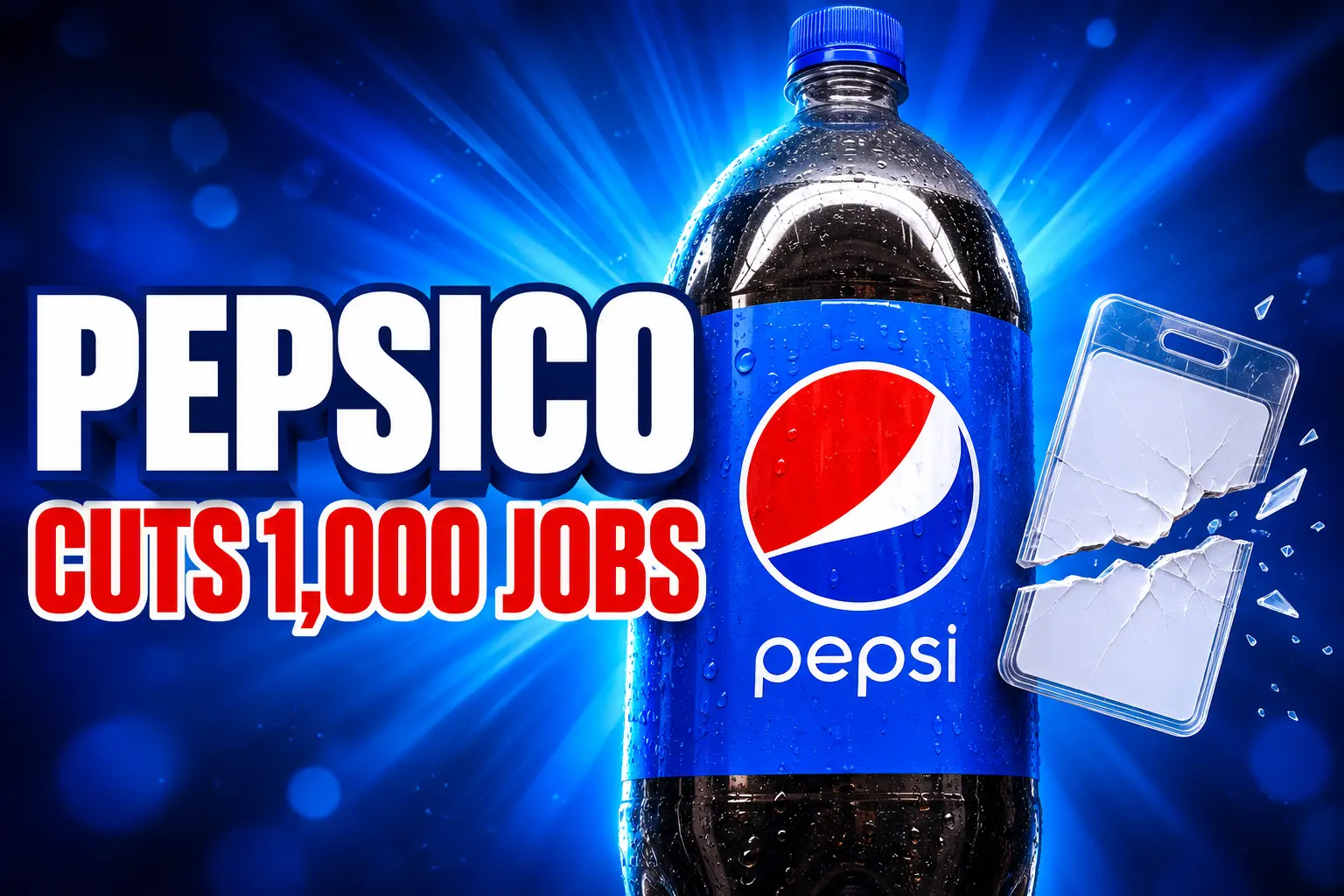
PepsiCo is cutting about 1,000 North America jobs after October’s earnings reset, on top of two years of plant shutdowns.

PepsiCo is cutting about 1,000 jobs in North America after North America chief executive Ram Krishnan told staff on November 9 that the company would change how it is structured.
The reductions follow an October 8 cut to full-year earnings guidance and sit on top of bottling-plant shutdowns that have already taken hundreds of shop-floor roles. PepsiCo has not issued a public statement confirming the 1,000 figure.
Ram Krishnan’s Memo Puts the Cuts on a One-Week Clock
Krishnan’s letter told North America employees that changes would come in the week after November 9. He said too much of the way the company works is still complex and split up, and that PepsiCo had room to simplify structures, make accountability clearer, and decide faster.
Too much of how we work today remains complex and fragmented.
Ram Krishnan, chief executive, PepsiCo North America, in a November 9 letter to staff
He wrote that the aim was a stronger North America business that could grow at the front of its category. That, he said, required the company to be faster, more connected, and more capable, while still putting money behind people, skills, and brands.
THE AIMS KRISHNAN NAMED
- Speed: He said the goal is to move faster, execute better, and put investment behind the work that will drive growth.
- Structure: He said PepsiCo will simplify how it operates, connect teams more tightly, and strengthen the skills it needs.
- Timing: He said the company would make changes across parts of the organization over the coming week to address the complexity he described.
The letter did not, in the versions described, list sites or job titles. That is the tell. After two years of named plant shutdowns, this round is written as an organization problem, which is how companies talk when the next cuts sit in management, support, and overlapping food-and-drink teams rather than on a filling line.
The October Guidance Cut Made the Payroll Math Obvious
On October 8, PepsiCo reported third-quarter results for the 12 weeks ended September 5 and cut the profit growth it had promised for 2026. Net revenue rose 5.6% to $25.27 billion. Organic revenue, which strips out currency and deals, rose 3.1%. Reported earnings per share rose 17% to $2.23. Core earnings per share, the measure the company uses for its own targets, rose 2% to $2.34, and 1.5% in constant currency.
The beat did not save the outlook. PepsiCo now forecasts core constant-currency earnings growth of 1% to 2% for 2026, down from the low end of 4% to 6%. Core earnings growth is now 2.5% to 3.5%, down from the low end of 5% to 7%. Organic revenue is now about 3%. Net revenue is now about 6%.
THE 2026 OUTLOOK PEPSI CO CUT ON OCTOBER 8
| Measure | New 2026 outlook | Prior outlook |
|---|---|---|
| Core constant-currency EPS growth | 1% to 2% | Low end of 4% to 6% |
| Core EPS growth | 2.5% to 3.5% | Low end of 5% to 7% |
| Organic revenue | About 3% | 2% to 4% |
| Net revenue | About 6% | 4% to 6% |
Core operating profit still rose 3% to $4.28 billion, but core operating margin was 16.9%, down 35 basis points. PepsiCo said tariff refunds added a 4-percentage-point lift to core operating profit in the quarter. Strip that out and the profit growth looks thinner, which is why the full-year guide moved.
Chairman and chief executive Ramon Laguarta used the release to say the international business was carrying the group and that North America needed faster work on innovation, brand support, and in-store execution. He also named the cost program that Krishnan’s letter now executes.
Additional structural cost reduction actions are being identified and will be implemented in the coming months to help fund investments that aim to accelerate organic revenue growth and mitigate the impacts of rising input cost inflation.
Ramon Laguarta, chairman and chief executive, PepsiCo third-quarter 2026 results, October 8, 2026
Thirty-two days later, Krishnan told North America staff that the structure itself would change within a week. In prepared remarks posted with the results, management said North America growth and core operating margin were taking more time than planned, and that the region’s core operating margin would stay under pressure in the fourth quarter. The 1,000 jobs are how that warning leaves the earnings deck and lands in inboxes.
North America Foods Profit Fell 12% as Soda Volume Slipped
PepsiCo Foods North America, the segment that includes Frito-Lay and Quaker, posted flat revenue, flat organic sales, and flat volume in the third quarter. Reported operating profit in that segment fell 13%. On PepsiCo’s core constant-currency measure, the drop was 12%. The company said North America convenient-foods sales got a lift from savory-snack volume and a bit more market share, then gave it back through lower effective net pricing.
PepsiCo Beverages North America raised net revenue 5%, mainly from acquisitions completed in 2025. Organic sales were about flat. Beverage volume fell 2%. Reported operating profit in the drinks unit jumped 45% because of items the company pulls out of its core figures; core constant-currency operating profit rose 4%. Carbonated soft drinks, the prepared remarks said, trailed the category, while zero-sugar drinks and functional hydration did better.
That split is the hole the job cuts are being asked to fill. Snacks still sell, but they make less money at the prices retailers will accept. Soda volume is shrinking even as deal-driven revenue rises. Advertising and marketing in the United States rose at a double-digit rate in the quarter, so the company is spending more to hold the shelf while it takes cost out of the office that sits behind it.
Plant Closures Already Took the Shop-Floor Jobs
The 1,000 roles sit on a trail of named bottling sites that have already gone. PepsiCo spent 2024 and 2026 shutting production and warehouse work in the United States while leaving local sales and delivery in place. The language in those notices is almost identical to Krishnan’s memo: a difficult decision, an optimized network, support for the people on the way out.
THE BOTTLING SITES PEPSI CO HAS ALREADY SHUT
- October 28 to 30, 2024: PepsiCo ends production at four U.S. bottling plants and says the moves will affect 136 workers in Cincinnati, 131 in Chicago, 127 in Harrisburg, Pennsylvania, and fewer than 50 in Atlanta, nearly 400 people in all. Chicago is the only full close. The other three keep a warehouse. PepsiCo said then it was investing in a more agile manufacturing network.
- September 14, 2026: CB Manufacturing, a PepsiCo subsidiary doing business as Pepsi Beverages, files a WARN letter to Cheverly and Maryland officials and lays off fleet, transport, manufacturing, and warehouse staff at 2611 Pepsi Place. The site employed 143 people in those jobs; about 98 of them are Teamsters Local 639 members and were listed as affected. Sales and delivery continue. Pay and benefits run through November 13, 2026.
- October 19, 2026: PepsiCo Beverages U.S. says it will immediately close our Knoxville, Tennessee plant. A Tennessee WARN notice puts the layoff at 112 jobs. Local sales and delivery keep serving the city. The company is paying workers through January 1, 2027.
- November 9, 2026: Krishnan tells North America staff that structure changes will roll through the following week, with the reductions described as about 1,000 jobs across food and drinks.
The plant wave and the memo wave are the same program at two altitudes. First the filling lines, then the layers that coordinate them. A familiar bag of Doritos on a shelf does not mean the same number of people will keep their jobs getting it there.
Who Loses a Role in PepsiCo’s U.S. Workforce
PepsiCo’s 2025 annual report, for the year ended December 27, 2025, listed about 306,000 employees worldwide, including roughly 125,000 in the United States. About 1,000 North America jobs is a small slice of that U.S. total, under 1%. It is not a small event for the people in it, and it is not the first cut of this cycle.
The same annual report implied a drop of 13,000 jobs in fiscal 2025, from 319,000 the year before. That decline landed before Cheverly, Knoxville, and the November memo. The new 1,000 are on top of a workforce that was already shrinking.
WHAT WE KNOW
- The letter: Krishnan told North America staff on November 9 that structure changes would start in the following week and that the work today is too complex and fragmented.
- The plants: Named U.S. bottling sites in Chicago, Cincinnati, Harrisburg, Atlanta, Cheverly, and Knoxville have already lost production jobs, with sales and delivery left in place.
- The earnings reset: PepsiCo cut 2026 core constant-currency earnings growth to 1% to 2% on October 8 and said structural cost cuts would follow in the coming months.
WHAT IS UNCONFIRMED
- The headcount: PepsiCo has not confirmed the 1,000 figure in a public statement, and the letter as described did not publish a table of roles.
- The job types: No official breakdown has been given for how many of the 1,000 sit in food versus drinks, or in corporate versus field jobs.
- The map: No city list has been attached to this round, unlike the WARN filings that named Cheverly and Knoxville.
The missing city list is why this round reads as overhead. When PepsiCo closes a plant, it files a letter with a street address. When it thins a structure, the names come later, one manager at a time, inside the week Krishnan flagged.
International Growth Is Paying for a Smaller Home Market
Outside North America the third quarter was a different company. International Beverages Franchise grew organic revenue 7% with beverage volume up 5%, and core constant-currency operating profit up 9%. Europe, the Middle East and Africa grew organic revenue 9% and core constant-currency operating profit 19%. Latin America Foods grew organic revenue 6%. Asia Pacific Foods grew organic revenue 9% and volume 11%.
Laguarta said the plan is to keep building on that international strength while acting with urgency in North America. The job cuts are the urgency, funded in part by the regions that are still growing. PepsiCo also kept, in the same reduced outlook, $8.9 billion of cash returns to shareholders for 2026, $7.9 billion of it in dividends and $1.0 billion in buybacks.
That is the bargain inside the memo. International volume and a still-large dividend sit on one side. A smaller North America payroll sits on the other. Krishnan’s language about being more capable does not change the sequence: first the plants, then the layers, then a fourth quarter in which North America margin is still expected to be under pressure.
The Structure Changes in the Week After November 9
Krishnan’s clock ran from November 9 through the following week, which means the notifications themselves are the news that remains. People inside food and drinks teams in the United States and Canada will learn, title by title, whether they are in the 1,000. PepsiCo has not said when it will publish a confirmed count, or whether it will publish one at all.
The October 8 outlook already assumed that cost would come out. The November 9 letter is that assumption with names attached. Guidance still counts on $8.9 billion of cash going back to shareholders while the North America payroll gets smaller, and the fourth-quarter margin warning is still on the books.

ACCC Margin Checks Bind Woolworths and Coles Alone

Meta Verified the Fake AI Doctor Selling Amazon Cures

Skydance Installs Film Chiefs to Hit a 30-Movie Quota

Apple Bets Slow Horses Can Outlast Mick Herron’s Novels

F.P. Journe Collectors Won Geneva as Jewels Slipped

Generation Lab’s Secret Youth Shot Has a Copycat Problem

Tesla Raises Dual Motor Prices as Texas Builds Cybercabs

The Nantucket Friendship Basket Boom Meets a Maker Shortage

Bristol Myers Quits Cellares as Autoimmune Doses Proceed

Okta Stock Jumps 20% on McKinnon’s Identity Bet
-
 NEWS3 months ago
Generation Lab’s Secret Youth Shot Has a Copycat Problem
-
 AUTO3 months ago
Tesla Raises Dual Motor Prices as Texas Builds Cybercabs
-
 LIFESTYLE3 months ago
The Nantucket Friendship Basket Boom Meets a Maker Shortage
-
 BUSINESS3 months ago
Bristol Myers Quits Cellares as Autoimmune Doses Proceed
-
 NEWS3 months ago
Okta Stock Jumps 20% on McKinnon’s Identity Bet
-

 BUSINESS3 months ago
Poland Closes Visa-Free Work for Three Fast-Growing Nationalities
-

 LIFESTYLE3 months ago
Labor Day Mattress Sales Repeat a Familiar Holiday Discount
-

 GAMING3 months ago
GTA 6 Bets Its Last Look on Netflix and $100