
BUSINESS
India’s Safety Push Grounded the Boom It Meant to Guard
India’s aviation boom ran into a 260-death crash, IndiGo’s rest-rule collapse, and a half-staffed regulator now facing an FAA review in November.

Ten days after Narendra Modi told global airline chiefs that India stood at a takeoff point, an Air India Dreamliner fell 0.9 nautical miles from the Ahmedabad runway. Flight 171 killed 260 people on June 12, 2025, the first fatal hull loss of a Boeing 787.
India’s aviation boom did not pause. IndiGo still carried about two in three domestic passengers by June 2026. The bill arrived as rest rules the state had delayed for a year, a regulator with half its posts empty, and a US safety review now fixed for November.
Ten Days After the Takeoff Speech
On June 2, 2025, the prime minister addressed IATA’s annual meeting in New Delhi and said India was the world’s third-largest domestic aviation market. He cited orders for over 2,000 new aircraft, passenger traffic of 240 million a year, and a jump from 74 operational airports in 2014 to 162. He also said aviation safety was the country’s top priority and that Indian rules tracked ICAO standards.
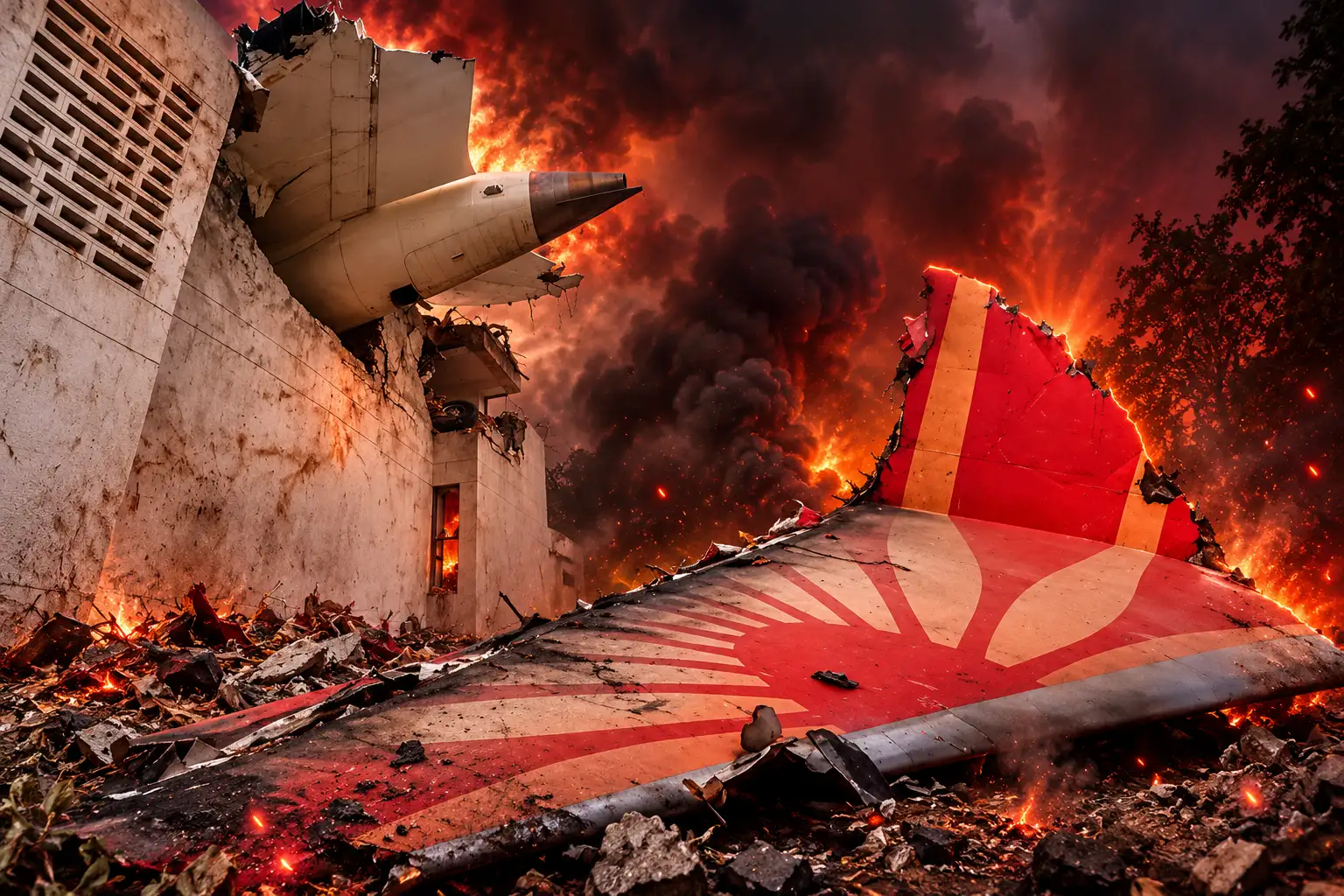
On June 12, Air India Flight 171, a Boeing 787-8 registered VT-ANB, left Ahmedabad for London Gatwick at 13:38 IST. It struck the BJ Medical College hostel complex 0.9 nautical miles beyond Runway 23 and was destroyed, along with five buildings. The Aircraft Accident Investigation Bureau’s injury table recorded 12 crew and 229 passengers dead, 19 people killed on the ground, 67 serious injuries on the ground, and one survivor from the cabin. That is 260 dead in total, 241 of them among the 242 people on board.
THE AHMEDABAD TOLL
- On board: 230 passengers and 12 crew, 242 people in all, of whom 169 were Indian, 53 British, 7 Portuguese and 1 Canadian.
- The aircraft: A 2013 Boeing 787-8 with 41,868 hours in the log, written off by impact and fire.
- The bulletin: FAA SAIB NM-18-33, dated December 17, 2018, warned that a locking feature on fuel control switches could be disengaged; Air India did not inspect VT-ANB because the note was advisory.
- The file: AAIB issued a preliminary report on July 12, 2025, and still lists an interim statement on the inquiry, with no final probable cause published.
The airline’s own notice the same afternoon set the passenger count and the hotline, and it remains the on-the-record account of who was on the jet.
Air India confirms that flight AI171, from Ahmedabad to London Gatwick, was involved in an accident today after take-off.
The flight, which departed from Ahmedabad at 1338 hrs, was carrying 242 passengers and crew members on board the Boeing 787-8 aircraft. Of these, 169 are…
— Air India (@airindia) June 12, 2025
Mark Martin of Martin Consulting later called 2025 and 2026 the darkest years for India’s aviation reputation. The crash did not close the boom story. It showed how little spare safety capacity sat under the takeoff speech.
IndiGo Ran Out of Night Crews
The Directorate General of Civil Aviation had rewritten flight duty time limits, known as FDTL, to cut pilot fatigue. Phase one took effect on July 1, 2025. Phase two, the night clauses, took effect on November 1, 2025, after a delay from a planned June 2024 start and after the Delhi High Court told the regulator to move.
Other airlines hired and recoded their roster software. IndiGo, which already ran more than 2,000 flights a day and made its money on red-eyes, did not have the captains the new night math required.
THE REST RULES THAT HIT THE NIGHT BANK
- Weekly rest: Mandatory rest rose from 36 hours to 48 hours.
- Night landings: Allowed landings in the night window fell from six to two.
- Night window: Night duty was redefined as any duty overlapping midnight to 6 am.
- Consecutive nights: Pilots were limited to two night duties in a row.
By early December the airline told the DGCA it needed 2,422 captains for the Airbus fleet and had 2,357, a gap of 65, while first officers sat just above the line. It called the mess a product of misjudgment and planning gaps. From December 3 to 5, 2025, it cancelled 2,507 flights and delayed 1,852 others. For the whole of December, the civil aviation ministry told Parliament, IndiGo cancelled 5,689 flights and stranded 902,384 passengers. All scheduled airlines cancelled 6,890 flights that month, affecting 966,864 people. IndiGo accounted for most of both totals.
The safety rule written to keep tired crews off the night shift had grounded the carrier that flies most of India after dark. Passengers still argue over refunds on that network because, with IndiGo at two-thirds of the domestic market, there is often no second airline on the same city pair at the same hour.
A Waiver for the Airline That Was Not Ready
The DGCA then loosened the same night limits it had just imposed. On December 6, 2025, it granted IndiGo temporary exemptions through February 10, 2026, including a return toward six night landings and relief on consecutive night duties. It also dropped a clause that had blocked airlines from counting leave as weekly rest. Civil Aviation Minister Kinjarapu Ram Mohan Naidu blamed IndiGo’s crew mismanagement and noted that other carriers had prepared. A four-member DGCA committee later listed over-optimisation, weak software support, and gaps in management control as the causes. The penalty was Rs 22.20 crore. The winter schedule was cut by 10 percent through March 28, 2026.
THE WINTER THAT BROKE THE ROSTER
- July 1, 2025: Phase one of the new duty limits, including 48-hour weekly rest, takes effect.
- November 1, 2025: Phase two tightens night duty and night landings.
- December 3-5, 2025: IndiGo cancels 2,507 flights in three days; Delhi loses a full day of its departures.
- December 6, 2025: DGCA grants FDTL exemptions until February 10, 2026, and opens an enforcement file.
- December 9, 2025: The airline is ordered to cut its winter schedule by 10 percent through March 28, 2026.
- January 19, 2026: IndiGo tells the DGCA it now has 2,400 Airbus captains against a need of 2,280, and 2,240 first officers against 2,050, and that the two exemptions will lapse on February 10.
Shakti Lumba, a former airline operations chief, told AFP the DGCA acts more like a facilitator than a regulator. In July 2026, IndiGo managing director and co-founder Rahul Bhatia was still asking the government to review FDTL against what he called global best practice, including US limits. The airline that missed the original deadline had been allowed to keep flying under the old night math, then used that chaos as an argument against the rule.
What the Defect Counts Show
While the roster fight played out, the ministry put a different number into the Lok Sabha. DGCA audits from January 2025 to February 3, 2026, found repetitive defects on 377 of 754 commercial aircraft checked, nearly half the sample. IndiGo had the highest count. Air India had the worst rate.
REPETITIVE DEFECTS FLAGGED BY DGCA
| Airline | Aircraft analysed | With repetitive defects |
|---|---|---|
| IndiGo | 405 | 148 |
| Air India | 166 | 137 |
| Air India Express | 101 | 54 |
| SpiceJet | 43 | 16 |
| Akasa Air | 32 | 14 |
| All scheduled airlines sampled | 754 | 377 |
Air India’s 137 flagged jets out of 166 analysed is an 83 percent hit rate in that sample. IndiGo’s 148 of 405 is lower as a share and larger as a pile, which is what a 400-plus aircraft fleet looks like when small defects repeat. A parliamentary panel, citing a July 2025 DGCA audit after Ahmedabad, said Air India logged about 100 safety lapses, including seven Level 1 findings that needed urgent fixes and recurrent training gaps on 787 and 777 crews.
The same panel listed the Ahmedabad crash, the December cancellations, a January 28, 2026, chartered-plane crash at Baramati, and a February 23, 2026, air-ambulance crash at Chatra among the failures it wanted a high-level committee to review. The defect ledger is not a crash report. It is the paper trail of a fleet that grew faster than the habit of closing findings.
Air India After Ahmedabad
Tata’s rebuilt flag carrier spent the next year under that audit cloud. On June 20, 2025, the DGCA cited repeated crew-duty violations and ordered three senior Air India officials removed. Widebody flying was trimmed. Integration of Vistara crews, already tense over pay, sat in the background as investigators worked the Ahmedabad wreckage.
On August 4, 2026, Air India flight AI2379, an Airbus A320 from Phuket to Delhi, lost about 300 feet in cruise. Twenty-four passengers were hurt. The DGCA classed it as a serious incident and sent it to AAIB. Both pilots were taken off the roster after psychoactive-substance screening. The captain’s result required confirmatory lab testing, which had not closed when Tewolde Gebremariam took over as chief executive in early August. Air India said it had not been given those results and that it already runs regular drug tests. Treating the screen as a finished positive would outrun the file. The drop itself is on the record.
At present, everyone is paying lip service to safety. By paying lip service, you do not create a safety culture.
Shakti Lumba, former airline operations chief, to AFP
Jitender Bhargava, a former Air India executive director, said a drug allegation of that kind raises a management question, because colleagues usually know. The carrier’s problem is no longer only the June wreckage. It is a year of audits, a midair plunge, and a new chief inheriting both.
Foreign Airlines Took the Long-Haul Seats
Domestic flying still grew, slowly. DGCA figures show scheduled domestic airlines carried 86.4 million passengers in the first half of 2026, up 1.44 percent from a year earlier, with 13.5 million in June. IndiGo’s domestic share in June 2026 hit a record 66.3 percent, up from 64.5 percent a year earlier. The Air India group, Air India plus Air India Express, fell to 23.9 percent from 27.1 percent. Together they still held more than 90 percent of the home market. Akasa Air, the distant third, reached 6.4 percent. India now lists 164 operational airports in 2026.
The international books moved the other way. In January-June 2026, Indian airlines’ share of passengers flying out of India fell to 39.7 percent from 46 percent a year earlier. Foreign carriers rose to 60.3 percent from 54 percent. Indian airlines carried 7.3 million outbound passengers, down 19.4 percent from 9.06 million. The whole outbound market shrank 7 percent, from 19.71 million to 18.40 million, so the home carriers took almost all of the drop. The Air India group’s international passengers fell 27 percent, to 3.30 million from 4.54 million, and its international departures fell 26 percent, to 39,136 from 53,487.
OUTBOUND TRAFFIC, FIRST HALF
| Measure | H1 2025 | H1 2026 |
|---|---|---|
| Indian airlines’ share of outbound passengers | 46% | 39.7% |
| Foreign airlines’ share | 54% | 60.3% |
| Indian airlines’ outbound passengers | 9.06 million | 7.3 million |
| Total outbound passengers from India | 19.71 million | 18.40 million |
Pakistani airspace has stayed shut, stretching long-haul tracks. Jet fuel rose with the Middle East war. IndiGo closed its wide-body flying in July 2026. OAG counted 23.5 million seats in and from India in August 2026, down 1.5 percent from a year earlier, with 11.73 million IndiGo seats in August still the largest single pile. The domestic machine kept humming because IndiGo, even after the winter cut, still owns the short haul. The long-haul seats India said it would take from Gulf and Asian hubs went back to those hubs.
Why the FAA Visit Matters
The Civil Aviation Ministry ordered fresh safety audits of IndiGo, Air India, Akasa Air and SpiceJet in the run-up to a US review of the regulator itself. Those airline audits were completed in August 2026. A five-member Federal Aviation Administration team is due in India from November 16 to 20, 2026, under the International Aviation Safety Assessment programme. The last such check was in 2021. India still holds Category 1 under the FAA programme, the grade that lets its airlines fly to the United States on the strength of DGCA oversight. The FAA will not inspect IndiGo’s cabins. It will ask whether the DGCA has enough qualified inspectors, a working licensing system, and the staff to watch a market that just added airports and aircraft by the hundred.
On July 31, 2025, Minister of State Murlidhar Mohol told the Rajya Sabha there were 823 of 1,644 DGCA posts vacant, with 821 people in place. Technical posts sat at 529 filled against 1,075 sanctioned, a gap of 546. Mohol said the shortfall had not hurt the annual surveillance plan. A parliamentary panel later called that claim hard to reconcile with the number of airlines and aircraft now under watch. An RTI snapshot of the Directorate of Airworthiness in May 2026 found 136 of 310 posts empty, including every one of the 18 director-level jobs.
WHAT WE KNOW
- The date: FAA assessors are scheduled in India from November 16 to 20, 2026.
- The grade: India remains Category 1 on the IASA list, last reviewed in 2021.
- The staff file: 823 DGCA posts were vacant against 1,644 sanctioned as of July 31, 2025.
WHAT IS UNCONFIRMED
- Audit details: Findings from the August 2026 carrier audits have not been published.
- AI171 cause: AAIB has not issued a final probable-cause report.
- Phuket screen: Confirmatory lab results on the AI2379 captain have not been released.
The boom is still visible in the June load factors and in IndiGo’s 66.3 percent share. The safety system that was supposed to grow beside it is the file the FAA team will open in November, with 823 empty chairs on the regulator’s own chart and a crash inquiry that has not yet landed.

Maharashtra Grants Nana Patekar a State Funeral at His Farm

Nifty Tests 22,600 as Banks Carry a Fragile Rebound

India’s 13.3 Crore Voter Cut Lands on the Election Commission

Reflection Bets $25 Billion on Beam’s Cheaper Open Weights

India Finishes Fourth Again, 21 Medals Short of Hangzhou

Generation Lab’s Secret Youth Shot Has a Copycat Problem

Tesla Raises Dual Motor Prices as Texas Builds Cybercabs

The Nantucket Friendship Basket Boom Meets a Maker Shortage

Bristol Myers Quits Cellares as Autoimmune Doses Proceed

Okta Stock Jumps 20% on McKinnon’s Identity Bet
-
 NEWS2 months ago
Generation Lab’s Secret Youth Shot Has a Copycat Problem
-
 AUTO2 months ago
Tesla Raises Dual Motor Prices as Texas Builds Cybercabs
-
 LIFESTYLE2 months ago
The Nantucket Friendship Basket Boom Meets a Maker Shortage
-
 NEWS2 months ago
Okta Stock Jumps 20% on McKinnon’s Identity Bet
-
 BUSINESS2 months ago
Bristol Myers Quits Cellares as Autoimmune Doses Proceed
-

 BUSINESS2 months ago
Poland Closes Visa-Free Work for Three Fast-Growing Nationalities
-

 LIFESTYLE2 months ago
Labor Day Mattress Sales Repeat a Familiar Holiday Discount
-

 NEWS2 months ago
Google Ends EU Spam Demotions but Keeps the Ranking Split