
NEWS
India’s 13.3 Crore Voter Cut Lands on the Election Commission
A 2023 appointment law put Gyanesh Kumar in charge. The Special Intensive Revision then cut 13.3 crore names, and the Election Commission is now the target.

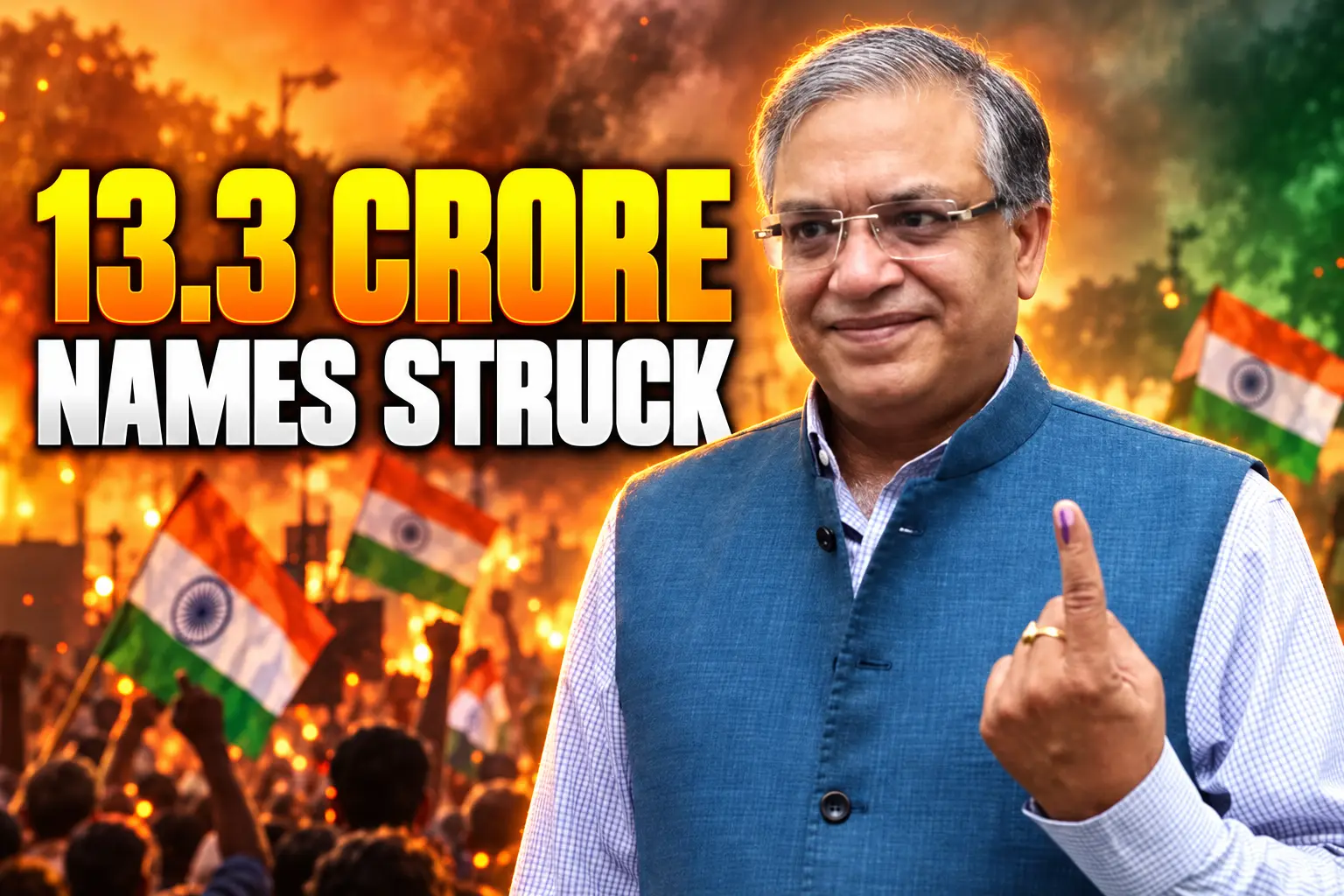
India’s Election Commission has struck 13.3 crore names off draft voter lists in a Special Intensive Revision that has pushed the institution into open conflict with the street. The figure, drawn from Commission data compiled in late September 2026, is 133 million people, more than the population of Mexico.
Chief Election Commissioner Gyanesh Kumar, the first person named to that post under a 2023 appointment law, now faces resignation marches, a Supreme Court notice, and a written split inside his own three-member bench. The Commission still calls the exercise a cleanup of dead, duplicate and shifted entries. The fight is over who got swept out with them, and over who had the power to decide.
13.3 Crore Names Left the Draft Rolls
The Special Intensive Revision, or SIR, rebuilds a roll rather than patching it. An elector who was on the old list does not automatically land on the new one. Booth Level Officers walk house to house with pre-printed enumeration forms. A form that does not come back is treated as a probable case of absent, shifted, dead or duplicate, the ASDD list that then feeds the draft.
Election Commission data covering the first two phases and the third phase so far put draft deletions at 13.3 crore names. Of those, 71.5 percent, about 9.5 crore people, were marked absent, permanently shifted or “other.” About 2.8 crore names, 21 percent, were removed as registered deaths. About 1.01 crore, 7.5 percent, were cut as multiple enrolments. The first two phases accounted for 7.2 crore of the draft cuts; the third phase had added 6.16 crore by late September.
Those death and duplicate counts are the part of the cleanup almost no one defends keeping on the roll. The 9.5 crore absent-and-shifted bucket is the live dispute, because absence at the moment a booth officer knocks is not the same thing as ineligibility to vote.
WHERE THE DRAFT CUTS LANDED
| Place | What changed | Scale |
|---|---|---|
| 31 states and UTs combined | Electorate before SIR to draft after deletions | 952 million down to 817.9 million |
| Same 31 states and UTs, 2015 | Electorate a decade earlier | 816.9 million |
| Delhi | Excluded from the 31 August draft of 1,45,10,299 electors | 47,56,722 names, 32.78 percent |
| Uttar Pradesh | Final roll against the October 2025 pre-SIR count | 154.4 million to 133.9 million, net 20.4 million, 13.21 percent |
| Bihar | Final roll against 24 June 2025 | 78.9 million to 74.2 million, net 4.7 million, about 6 percent |
| Chandigarh | Share of electors left off the draft | 40 percent |
| Maharashtra | Share of electors left off the draft | 21 percent |
The 952 million to 817.9 million drop is the change in the combined electorate of those 31 states and Union Territories, a different measure from the 13.3 crore names taken off draft lists. After the draft cuts, that combined electorate sat only about 1 million above the 816.9 million recorded in 2015. Delhi’s 32.78 percent draft exclusion was the highest share the Commission itself described at that stage, with 43.32 lakh recorded as shifted or absent, 2.82 lakh as deceased and 1.41 lakh as duplicates.
The 2023 Law That Put Gyanesh Kumar in Charge
The people running this revision were chosen under a statute that did not exist three years ago. On 2 March 2023 a five-judge Supreme Court bench in Anoop Baranwal v. Union of India held that appointments made solely by the executive could undercut the Commission’s independence. Until Parliament wrote a law, the Court said, the President should appoint the Chief Election Commissioner and the Election Commissioners on the advice of the prime minister, the Leader of the Opposition in the Lok Sabha, and the Chief Justice of India.
Parliament then passed the Chief Election Commissioner and Other Election Commissioners (Appointment, Conditions of Service and Term of Office) Act, 2023, Act No. 49 of 2023, dated 28 December 2023 and brought into force on 2 February 2024. The selection committee became the prime minister, a cabinet minister and the Leader of the Opposition. The chief justice was dropped. A search committee headed by the Union law minister prepares a panel of five names. The selection committee may look outside that panel, and a vacancy on the committee does not void an appointment.
That design gives the executive a two-to-one executive majority on the panel. Petitions by the Association for Democratic Reforms and others argue the 2023 law restores the executive dominance the Baranwal bench tried to check. The Supreme Court has questioned the exclusion of the chief justice and has sent the challenge toward a Constitution Bench. It has not struck the Act down. Gyanesh Kumar, Sukhbir Singh Sandhu and Vivek Joshi were all named under it. Kumar was elevated as Chief Election Commissioner on 18 February 2025, the first CEC appointed under the new law.
FROM THE BARANWAL ORDER TO THE SIR
- March 2, 2023: The Supreme Court installs an interim panel of the prime minister, the Leader of the Opposition and the Chief Justice of India.
- December 28, 2023: Parliament enacts Act No. 49 of 2023, replacing the chief justice with a Union cabinet minister nominated by the prime minister.
- February 2, 2024: The Act comes into force.
- February 18, 2025: Gyanesh Kumar becomes Chief Election Commissioner, the first person named to that post under the Act.
- June 2025: The SIR begins in Bihar.
- October 27, 2025: Phase 2 opens across a dozen states and Union Territories.
- February 28, 2026: West Bengal publishes its final SIR roll ahead of the assembly election.
- October 5, 2026: A three-judge bench led by Chief Justice of India Surya Kant issues notices on how SIR decisions were taken and who changed Form 6.
Removal of a sitting CEC still follows the path used for a Supreme Court judge, under Article 324(5) of the Constitution and Section 11(2) of the 2023 Act. In March 2026, 130 Lok Sabha members and 63 Rajya Sabha members signed notices seeking Kumar’s removal. The Speaker and the Chairman refused to admit them. The street can demand a resignation. The law almost never delivers one.
Why a 2002 Entry Now Decides a 2026 Vote
The SIR does not start from a blank page. It asks each elector to map themselves, or a parent or grandparent, to the last intensive revision in that state. In Delhi that last intensive revision was in 2002, and the Chief Electoral Officer’s own FAQ tells people to search that old roll before they fill the new form. A daughter-in-law is told to use her own parents’ 2002 entries, not her in-laws’. A person who settled in the city after 2002 will not appear on Delhi’s 2002 list at all.
No document is collected at the door during enumeration. Aadhaar on the form is optional. If the mapping fails, the Electoral Registration Officer can issue a notice, and the elector then has to produce papers from a list the Commission calls indicative, not exhaustive. The Delhi FAQ sets out the 12 documents the notice phase accepts.
PAPERS THE NOTICE PHASE WILL TAKE
- Government service: An identity card or pension payment order issued to a regular employee or pensioner of the Centre, a state or a public sector unit.
- Old government paper: An identity card, certificate or document issued in India by the government, a local body, a bank, a post office, LIC or a PSU before 1 July 1987.
- Birth and school: A birth certificate from a competent authority, or a matriculation or other certificate from a recognised board or university.
- Passport and residence: A passport, or a permanent residence certificate issued by the competent state authority.
- Caste, forest, land: An OBC, SC or ST certificate, a Forest Rights certificate, or a land or house allotment certificate from the government.
- Local registers: A family register prepared by state or local authorities, or the National Register of Citizens where it exists.
- Aadhaar: Only as the Commission directed in its 9 September 2025 letter, not as a stand-alone substitute at every stage.
If the enumeration form never comes back, the name does not appear on the draft. In Delhi the FAQ is blunt: names of only those electors whose filled forms are received will be included in the draft published on 31 August 2026. The way back is Form 6, the statutory application written for first-time voters and for people who have moved, now also used by people the SIR has already dropped. Software sitting on top of that paperwork flags “logical discrepancies,” including a parent’s name that does not match, a parent-child age gap under 15 or over 50 years, an age that does not move correctly between the old roll and the new, or a form filed with no document. Unmapped electors are people the software could not link to the last intensive revision at all.
That is a heavy filter for a country where spellings shift across scripts and clerks, and where millions of workers are not at the address printed on an old card on the day a booth officer visits. Researchers looking at flagged names have described systems that treated Md and Mohammed, or Sk and Sheikh, as different people. Women were a larger share of the deletions than men in 11 states, which follows from a method that punishes absence at a listed address.
Sandhu and Joshi Objected 14 Times
The national SIR has been described as a three-commissioner project. Election Commissioners Sukhbir Singh Sandhu and Vivek Joshi put a different record on paper. Over 10 months they formally objected at least 14 times to decisions and orders on roll management and the SIR, including steps they said were taken without their knowledge or recommendation. In one written objection Sandhu said the Commission had acted against the written advice of two commissioners and called the action unauthorised and illegal.
The Commission has said SIR-related orders had the unanimous approval of all three. That claim is now in front of the Court. On 5 October a bench of Chief Justice of India Surya Kant and Justices Joymalya Bagchi and V. Mohana heard petitions by Patna resident Rakesh Kumar Singh and advocate Shailendra Mani Tripathi seeking action against Kumar, including an interim suspension. The bench issued notices to the Centre, the Election Commission, Kumar, Sandhu, Joshi, Deputy Election Commissioner Maneesh Garg and Director General (IT) Seema Khanna. It refused to suspend Kumar without hearing the other side.
“Any modified Form 6 has not been approved by us. Let’s be clear. When the record is produced, we would like to see who has modified,” Chief Justice Kant said. The Commission had, on 26 September, said a declaration attached to Form 6 for the SIR had been upheld by the Supreme Court, and that non-SIR states would go back to the form in the Registration of Electors Rules, 1960. The Chief Justice separated those two things. The Court also said it would examine the decisions and annul any that did not accord with the law.
That is a narrower point than the street is making, and it is the one the government can still argue. The Commission has residual authority to design an SIR. The open question is whether this Form 6 add-on, and a string of SIR orders, were Commission decisions at all.
The heart of our democracy, which is the right to vote, is at great peril. You cannot have an Election Commission which functions or malfunctions like this.
Rohinton Nariman, former Supreme Court judge and former solicitor general, speaking in Rajkot
Nariman, in that lecture, tied the peril to the 2023 appointment law and to West Bengal, where he said 90 lakh voters were off the roll when the assembly election was held. He said about 22 lakh of them filed appeals and that of the appeals already decided, 93 percent went in the voter’s favour. “Can you imagine this was a completely illegal knocking out of the common man, of the citizen of India,” he said.
Bengal Tribunals Restore 93 Percent of Heard Appeals
West Bengal is where the SIR’s two clocks are easiest to see: the speed of deletion, and the crawl of getting a name back. West Bengal Chief Electoral Officer Manoj Agarwal said on 28 February 2026 that more than 63 lakh voters had been deleted from the final list as absentee, shifted, dead or duplicate, and that another 60 lakh sat “under adjudication,” their rights to be decided by judicial officers. The draft had stood at 7.08 crore; the final roll came down to 7.04 crore after further cuts and 1.82 lakh new inclusions. Assembly polls then went ahead in two phases on 23 and 29 April, with those adjudication cases still open.
A later Commission affidavit in the Supreme Court put the appeals pile higher. By early September, of more than 38 lakh appeals filed with SIR appellate tribunals in the state, just over 1,22,000 had been disposed of, a 3.2 percent disposal rate. Of those heard, 1,13,943 electors were added back, an inclusion rate of 93 percent. If nine in ten heard cases restore the elector, the first filter was not catching only the ineligible. It was catching people who, once a judge looked, belonged on the list.
WEST BENGAL AFTER THE FINAL ROLL
- ASDD deletions at publication: About 63.66 lakh names removed as absentee, shifted, dead or duplicate, per the state CEO.
- Still in hearings: About 60 lakh electors left under adjudication when the final roll came out on 28 February.
- Appeals later on file: More than 38 lakh, with just over 1,22,000 decided by early September, 3.2 percent of the pile.
- Heard cases restored: 1,13,943 electors put back, 93 percent of those disposed of.
Three UN-appointed specialists wrote to the government on 1 May 2026 about the same revision. Nicolas Levrat, the special rapporteur on minority issues, Irene Khan, on freedom of opinion and expression, and Nazila Ghanea, on freedom of religion or belief, said they were concerned that the SIR had removed millions of names and that Muslims and people of Bengali descent were at particular risk of being treated as foreigners. Their letter, AL IND 8/2026, put Phase 2 deletions at about 52 million. In Nandigram, they recorded, an alleged 95 percent of deleted voters were Muslim, against about 25 percent of the local electorate. Union Law Minister Arjun Ram Meghwal, in a 30 July Rajya Sabha reply, said the exercise followed due process. India’s Muslim population is about 200 million. A concentration of deletions in some Muslim-majority districts does not, by itself, prove a central communal quota. It does show the burden is not falling evenly, which is what the rapporteurs asked New Delhi to explain with a religious and ethnic breakdown it has not published.
The Street Wants a Resignation That Article 324 Blocks
Anger that sat in party offices through the summer moved onto the road after the 14 objections became public in late September. On 3 October police stopped a sit-in at Jantar Mantar demanding Kumar’s resignation. Hyderabad demonstrators at Dharna Chowk asked for three things: Kumar’s exit, a selection process that puts the chief justice back on the panel, and a scrap of the SIR. They called the revision an NRC by other means. In Mysuru, Goa and Delhi, Congress units used the same demand. On Tuesday, 6 October, the INDIA bloc tried to march from Parliament toward the Commission’s headquarters at Nirvachan Sadan. Leaders including Rahul Gandhi sat down when the march was stopped. The Biju Janata Dal, which keeps its distance from both the INDIA bloc and the NDA, joined that Delhi protest, citing more than 25 lakh deletions in Odisha and a cluster of Form 7 deletion requests in Dhamnagar that it said hit a minority neighbourhood.
𝐕𝐨𝐭𝐞 𝐂𝐡𝐨𝐫, 𝐆𝐚𝐝𝐝𝐢 𝐂𝐡𝐡𝐨𝐝!!
Opposition MPs gathered at Makar Dwar to protest against vote chori, the undemocratic SIR, and to demand Gyanesh Kumar's resignation.
📍 New Delhi pic.twitter.com/5G9Dv7WhDH
— Congress (@INCIndia) October 6, 2026
Rahul Gandhi wrote, “Gyanesh, it’s done, bro. Time to resign.” Congress president Mallikarjun Kharge listed three demands: Kumar’s resignation, a rollback of the SIR, and a return to ballot papers. Aam Aadmi Party convenor Arvind Kejriwal said Kumar must resign and that the BJP had “made a mockery of democracy by winning polls by deleting votes through SIR.” Maharashtra Chief Minister Devendra Fadnavis called that a “blatant falsehood,” noting that Kumar became CEC in 2025, that Maharashtra’s assembly election was in 2024, and that the SIR in the state is a 2026 exercise. The timeline is correct for that one poll. It does not touch Karnataka’s final roll, due on 27 October, or Delhi’s, due on 4 November, or the Bengal election that already happened on a stripped list.
Youth groups under the Cockroach banner have made Kumar the face of the fight, which is why so much of the argument has collapsed onto one man. That is also a trap. Sandhu and Joshi were named by the same 2023 committee. The SIR’s legal authority sits in Article 324 and Section 21 of the Representation of the People Act, 1950, not in a single office. A CEC who will not go, and whom Parliament will not remove, leaves the Court as the only body that can still unwind the paperwork.
Form 6 Is Now the Only Way Home
On 1 October, after a meeting with all chief electoral officers, the Commission told states to run a special drive for left-out and first-time electors. Under-secretary Sandeep Kumar’s letter instructs booth officers to compare the current roll with the pre-SIR roll, list everyone who vanished, and make house visits for electors dropped after SIR. Officers are to cover at least 20 to 25 such electors a week, take Form 6 where the person is eligible, share the list with party booth agents, and hold camps for people in night shelters, labour colonies and among the homeless. Enrolment, the letter says, is continuous. Anyone deleted can apply again.
That drive is an admission that the first pass left eligible people off. It is also a transfer of burden. The state that struck the name now asks the same booth officer to find the person and hand them a form written for new voters. In Karnataka, where the draft dropped about 1.08 crore of 5.55 crore electors and more than 43 lakh people were put on notice, the window to clear a name runs to 12 October and the final roll is due on 27 October. In Delhi the claims period ran from 31 August to 30 September, with final publication on 4 November. A name that misses those dates can still be added later. It cannot vote in an election called in between.
The Commission can still show a cleaner roll on the death and duplicate lines, and it can still say that 9.5 crore people marked absent or shifted include genuine migrants. What it cannot show, on the Bengal numbers it filed itself, is that the first filter was accurate. Ninety-three percent of the appeals a judge has actually heard have put the elector back. The 2023 law made this the Commission that would run that filter. The SIR is the bill coming due.

India’s 13.3 Crore Voter Cut Lands on the Election Commission

Reflection Bets $25 Billion on Beam’s Cheaper Open Weights

Denza Comes to India After Mercedes Walked Away

CJP Sets an October 10 March Over Voter-Roll Cuts

Amazon Drops Data Center NDAs but Leaves Older Deals Intact

Generation Lab’s Secret Youth Shot Has a Copycat Problem

Tesla Raises Dual Motor Prices as Texas Builds Cybercabs

The Nantucket Friendship Basket Boom Meets a Maker Shortage

Okta Stock Jumps 20% on McKinnon’s Identity Bet

Bristol Myers Quits Cellares as Autoimmune Doses Proceed
-
 NEWS1 month ago
Generation Lab’s Secret Youth Shot Has a Copycat Problem
-
 AUTO1 month ago
Tesla Raises Dual Motor Prices as Texas Builds Cybercabs
-
 LIFESTYLE2 months ago
The Nantucket Friendship Basket Boom Meets a Maker Shortage
-
 NEWS1 month ago
Okta Stock Jumps 20% on McKinnon’s Identity Bet
-
 BUSINESS1 month ago
Bristol Myers Quits Cellares as Autoimmune Doses Proceed
-

 LIFESTYLE1 month ago
Labor Day Mattress Sales Repeat a Familiar Holiday Discount
-

 NEWS1 month ago
Google Ends EU Spam Demotions but Keeps the Ranking Split
-

 BUSINESS2 months ago
Poland Closes Visa-Free Work for Three Fast-Growing Nationalities