
NEWS
LZ’s Single Recoil Joins a Long Dark Matter Pattern
LUX-ZEPLIN logged one 248 keV recoil at 2.6 sigma. The same 220 live days already ruled out ordinary WIMPs, and earlier xenon excesses have faded.

The LUX-ZEPLIN detector recorded a single 248 keV nuclear recoil that its background model cannot explain. The collaboration showed the 2.6-sigma result on Sept. 1 in Japan and is not claiming a dark matter discovery.
Sam Eriksen of the University of Bristol presented the work at the TeV Particle Astrophysics meeting in Tendo. The same 220 live days had already been searched for ordinary WIMPs and found none. This pass opened a higher-energy window, and one leftover flash is now the experiment’s strongest hint.
One Recoil Landed at 248 keV
The event is tagged LZ.230616, for the day it hit. At 21:22:39 UTC on June 16, 2023, the central xenon chamber recorded a pulse consistent with a nuclear recoil of 248 keV, with 23 keV statistical error and 23 keV systematic error. The light signal, S1c, was 540.1 phd, far above the 3 to 80 phd window used in the simplest WIMP hunt on this run.
It sits 1.5 sigma below the nuclear-recoil band median, 26.4 cm above the cathode and 26.9 cm inward from the true tank wall. Hugh Lippincott, a UC Santa Barbara physics professor who led the internal review, said, “We can’t explain LZ.230616 with the backgrounds we know about.”
THE FLASH LZ CANNOT PLACE
- Recoil energy: 248 keV, with 23 keV statistical and 23 keV systematic uncertainty.
- When it hit: 21:22:39 UTC on June 16, 2023, during 220 live days from March 27, 2023 to April 1, 2024.
- How strong: 2.6 sigma global after look-elsewhere corrections, 3.4 sigma at most locally.
- If a WIMP: mass of at least 200 GeV/c2, more than 200 times the mass of a proton, and not the simplest scatter.
The team’s official note on the 2.84 tonne-year search says known background in that region is low. Nuclear-recoil efficiency averages 96 percent between 14 keV and 250 keV. Eriksen, the lead author, said the group spent months on extra background checks in a region this dataset had not been mined for these models.
The Same 220 Days Already Returned a Null
That is the twist the press line skips. In 2025 the collaboration published world-leading spin-independent WIMP limits from 4.2 tonne-years and 280 live days, of which 220 live days and 3.3 tonne-years were new. After fake “salt” events were pulled out, that search found no excess over expected backgrounds. The tightest spin-independent exclusion was 2.2 × 10-48 cm2 at 40 GeV/c2.
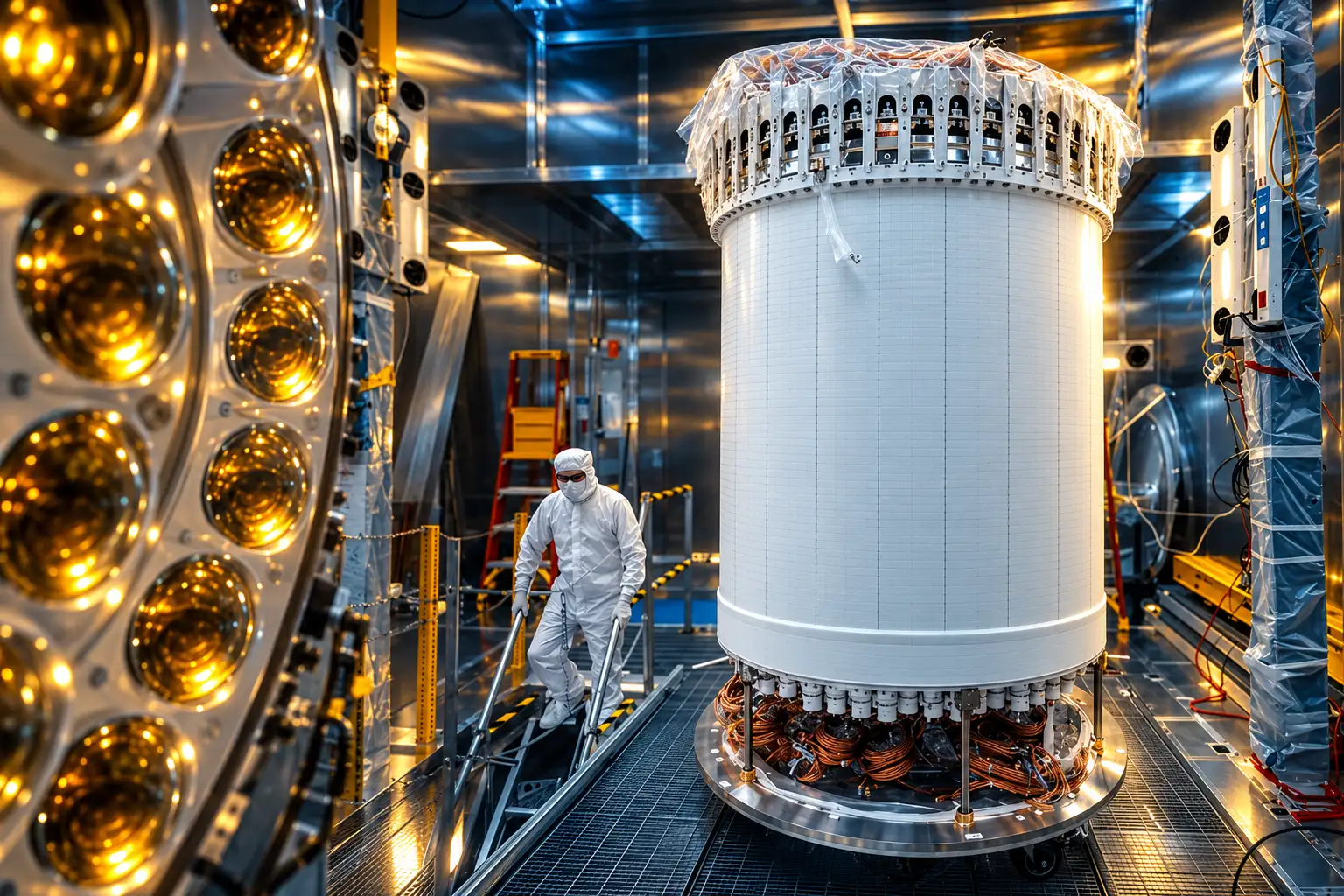
The new study reuses those 220 days with a smaller fiducial mass of 4.71 tonnes (plus or minus 0.08 tonnes), 14.5 percent smaller than the earlier cut, for 2.84 tonne-years. The point was not another pass at the vanilla scatter. It was an extended nuclear recoil window up to 270 keV aimed at effective field theory operators and inelastic models, which dump more of their spectrum at high energy.
TWO READS OF THE SAME LIVE DAYS
| Search | Energy window | Exposure | Outcome |
|---|---|---|---|
| Spin-independent WIMPs (2025) | Low-energy nuclear recoils, S1c 3 to 80 phd | 4.2 tonne-years, 280 live days | No excess; 2.2 × 10-48 cm2 at 40 GeV/c2 |
| EFT and inelastic models (2026) | Nuclear recoils up to about 270 keV | 2.84 tonne-years, 220 live days | One 248 keV event; 2.6 sigma global |
A bid to hide fake signals in the high-energy band, a method called salting, did not work. The preprint treats this as a non-blind analysis. The selections above 55 keV were kept as they were in the earlier paper, which is honest practice and also a reason to wait for a second event.
Why 2.6 Sigma Falls Short of a Discovery
A 2.6-sigma global result means there is about a 0.5 percent chance the event came from known backgrounds, once the team accounts for having scanned many models. Particle physics does not call that a discovery. The five-sigma discovery threshold in particle physics is the line used for the Higgs boson, a one-sided fluctuation as rare as about 0.00003 percent, or 3 in 10 million.
Locally the best model reached 3.4 sigma. The look-elsewhere correction, which asks how often a background wiggle this large would show up somewhere in the scan, brought the headline number down to 2.6 sigma. Rick Gaitskell, a Brown University physics professor and LZ spokesperson, said, “With only one event, we don’t want to get ahead of ourselves. We are not claiming to have seen dark matter.”
WHERE THE SIGMA LADDER SITS
- 2.6 sigma: This result, about a 1-in-200 chance under known backgrounds after the look-elsewhere cut.
- 3 to 4 sigma: The band where past “hints” in dark matter and collider searches have often been shown, then faded.
- 5 sigma: The discovery line; LZ’s own boron-8 solar-neutrino measurement in 2025 reached 4.5 sigma, still short of that bar.
Martin Bauer, a particle physicist at Durham University’s IPPP, put the professional instinct in one line after the announcement: many discoveries have begun with a single odd event, but even more false alarms have too, so the field waits. Direct-detection groups usually know their backgrounds well, which is why one clean outlier still moves people, and why one outlier is not enough.
XENON1T’s Excess Lasted Two Years Then Vanished
Dark matter is still unseen as a particle. It makes up roughly 85 percent of the mass in the universe, inferred from galaxy motions, lensing, and the microwave background. Weakly interacting massive particles, or WIMPs, have been the leading laboratory target for a generation. The detectors keep getting quieter. The hints keep arriving just below the line.
A SHORT LEDGER OF SUB-THRESHOLD HINTS
- 1998 onward: DAMA/LIBRA claims a yearly modulation in sodium iodide, still unmatched by other targets.
- 2020: XENON1T reports a low-energy electron-recoil excess, 3.4 sigma as solar axions and 3.2 sigma as tritium, and a 3.0 sigma global peak for bosonic dark matter.
- 2022: XENONnT, with a cleaner xenon fill, finds no new physics in that band. Jingqiang Ye, then data-analysis coordinator, said the old excess was not new physics.
- 2025: COSINE-100’s full 6.4-year sodium iodide set sits 3.57 sigma away from DAMA in 1 to 3 keV; a COSINE plus ANAIS-112 combination excludes DAMA’s 1 to 6 keV modulation at 4.7 sigma.
- July 2025: LZ’s own 4.2 tonne-year spin-independent search on these live days finds no WIMP excess.
- Sept. 1, 2026: LZ shows one 248 keV nuclear recoil at 2.6 sigma global in the high-energy window.
The XENON1T story is the closest cousin. It was a real excess in a world-class xenon tank. It survived long enough to spawn a stack of theory papers. The next detector, with tritium better controlled, closed the new-physics reading. DAMA is the other pole: a claim that has lasted decades and is now in multi-sigma tension with experiments that use the same crystal.
LZ.230616 is a nuclear recoil, not an electron recoil, and it sits where electron and nuclear bands pull apart. That is why Aaron Manalaysay and Lippincott sound more unsettled than the XENON1T authors did in 2020. It is still one count, at 2.6 sigma, shown before the rest of the exposure is in.
High-Energy Recoils Point Past Ordinary WIMPs
If the flash is dark matter, it is not the particle LZ was built to catch first. A vanilla spin-independent WIMP that could dump 248 keV would have left a trail of lower-energy recoils. The detector did not see that trail. JiJi Fan, a Brown theorist whose effective-field-theory work is cited in the paper and who is not on the experimental team, called the finding “very intriguing” and pointed to inelastic scattering and momentum-dependent elastic scattering as ways to get one high-energy hit without a low-energy pileup.
To me, the most interesting thing about this event is its rather high energy. It is inconsistent not only with known backgrounds, but also with the simplest dark matter model that LZ was designed to search for.
Chami Amarasinghe, UCSB postdoc and LZ co-deputy physics coordinator, UC Santa Barbara
The preprint tests non-relativistic effective field theory operators and inelastic models in which a WIMP jumps to a heavier state. Those inelastic models can also produce a yearly rate that peaks around June 2. LZ.230616 arrived 14 days later, on June 16, which is a date, not a modulation measurement. A theory note posted the same day argued that an endothermic particle fitting a recoil this high would need a mass above 500 GeV and a split of order 300 keV.
XENONnT and PandaX-4T have not claimed a matching high-energy nuclear recoil. Any real WIMP in this window has to show up in those tanks too, or the reading dies. Amarasinghe’s further point is the useful one: more unexplainable high-energy events would teach the particle’s nature; one event teaches almost nothing about couplings.
4,850 Feet of Rock and a Tank of Xenon
LZ runs at the 4850-foot level of the Sanford Underground Research Facility in Lead, South Dakota, almost a mile of rock above the Davis Cavern. The heart of the detector is a dual-phase time projection chamber with 7 tonnes of active liquid xenon, drawn from a 10-tonne ultrapure inventory. A 2-tonne xenon skin veto wraps the core. Outside that sits an outer detector of 17 tonnes of gadolinium-loaded scintillator and 229 tonnes of water. About 250 scientists at 39 institutions built and run it. Berkeley Lab manages the experiment. The name fuses two older tanks, LUX and ZEPLIN. Science running started in 2021.
The collaboration posted the result the morning of the Tendo talk.
Our new results are out! We have observed a single nuclear recoil in our detector that we find difficult to explain with our background model. Could it be a hint of dark matter? It’s far too early to say, but it’s certainly intriguing! #darkmatter pic.twitter.com/FACAlcELls
— LZ Dark Matter (@lzdarkmatter) September 1, 2026
HOW A FAKE WIMP IS SUPPOSED TO DIE
- Overburden: 4,850 feet of rock to cut cosmic-ray muons.
- Outer detector: 17 tonnes of gadolinium scintillator plus 229 tonnes of water to tag neutrons, gamma rays, and muons.
- Xenon skin: 2 tonnes of instrumented liquid xenon around the core, the layer Lippincott’s group built, used to reject impostors that could have faked LZ.230616.
- Neutron tag: 92 percent efficiency for (α,n) neutrons that scatter in the chamber.
A WIMP would make a single scatter: a prompt flash in the liquid, then a second flash when drifted electrons reach the gas. Neutrons and gamma rays usually leave extra light in the skin or the outer detector. Software then sorts nuclear recoils from electron recoils. Manalaysay, a Berkeley Lab physicist and chair of LZ’s institutional board, has seen outliers before. They usually look like background once you stare.
This is the first example in any experiment I’ve worked on of an outlier that appears valid in every way. Of course, we’re still twisting our brains trying to think if there’s a rare background mechanism we could’ve missed, but it’s thrilling to wonder if this could be the first hint of a dark-matter observation.
Aaron Manalaysay, physicist and LZ Institutional Board chair, Berkeley Lab
LZ Is Already Sitting on a Larger Sample
The planned exposure is 1,000 live days. This analysis used 220 of them, 22 percent of that goal. Lippincott’s group says a sample roughly twice the size used to find LZ.230616 is already on disk, in calibration. Those days will either grow this flash into a cluster or leave it alone.
Eriksen’s warning is the operating rule: dark matter events are expected to be extremely rare, so only a handful could mark a first WIMP detection. Gaitskell will walk the Brown physics department through the plots on Sept. 11. The paper is slated for arXiv and Physical Review Letters. Until a second recoil lands in the same band, LZ.230616 is what the last thirty years of this search keep producing, a well-documented maybe, left on the table for the next batch of xenon time.

Maharashtra Grants Nana Patekar a State Funeral at His Farm

Nifty Tests 22,600 as Banks Carry a Fragile Rebound

India’s 13.3 Crore Voter Cut Lands on the Election Commission

Reflection Bets $25 Billion on Beam’s Cheaper Open Weights

India Finishes Fourth Again, 21 Medals Short of Hangzhou

Tesla Raises Dual Motor Prices as Texas Builds Cybercabs

Generation Lab’s Secret Youth Shot Has a Copycat Problem

The Nantucket Friendship Basket Boom Meets a Maker Shortage

Bristol Myers Quits Cellares as Autoimmune Doses Proceed

Okta Stock Jumps 20% on McKinnon’s Identity Bet
-
 NEWS2 months ago
Generation Lab’s Secret Youth Shot Has a Copycat Problem
-
 AUTO2 months ago
Tesla Raises Dual Motor Prices as Texas Builds Cybercabs
-
 LIFESTYLE2 months ago
The Nantucket Friendship Basket Boom Meets a Maker Shortage
-
 NEWS2 months ago
Okta Stock Jumps 20% on McKinnon’s Identity Bet
-
 BUSINESS2 months ago
Bristol Myers Quits Cellares as Autoimmune Doses Proceed
-

 LIFESTYLE2 months ago
Labor Day Mattress Sales Repeat a Familiar Holiday Discount
-

 BUSINESS2 months ago
Poland Closes Visa-Free Work for Three Fast-Growing Nationalities
-

 NEWS2 months ago
Google Ends EU Spam Demotions but Keeps the Ranking Split