
BUSINESS
Sensex Falls 555 Points as $98 Oil Hits Banks
Sensex fell 555 points to 75,577.58 as $98 oil and a still-on-hold RBI hit banks, while domestic funds and defence names held the bid.

The BSE Sensex fell 555.23 points to 75,577.58 on Tuesday, September 8, as banks and Reliance Industries sold off with Brent crude at $98.36 a barrel. The NSE Nifty 50 dropped 144.05 points, or 0.61 per cent, to 23,635.10, a second straight loss on weekly options expiry.
Private banks carried the slide because $98 oil feeds the import bill, the rupee and the inflation path the Reserve Bank of India has already refused to ease against. Domestic funds and a handful of defence and port names still bought.
Banks Ate the 555-Point Slide
The 30-share Sensex opened at 75,970.28, traded as high as 76,012.11, and bottomed at 75,553.35, down 579.46 points, or 0.76 per cent, before settling 0.73 per cent lower. ICICI Bank led the Sensex losers, falling 2 per cent, and Axis Bank lost 1.72 per cent.
Kotak Mahindra Bank dropped 1.20 per cent, HDFC Bank 1.11 per cent and Reliance Industries 1.16 per cent. UltraTech Cement fell 1.23 per cent. The Nifty Bank closed at 56,777.55, down 0.54 per cent, or 310.75 points, from 57,088.30, and the Nifty Financial Services index lost 0.93 per cent.
Thirty Nifty stocks finished lower. The Nifty Private Bank index dropped 0.98 per cent. That is the rate-sensitive end of the market marking down a longer stretch of dear oil, not a one-stock scare.
SENSEX CLOSERS ON SEPTEMBER 8
| Stock | Move | Role in the tape |
|---|---|---|
| ICICI Bank | -2.00% | Largest Sensex drag |
| Axis Bank | -1.72% | Private-bank follow-through |
| UltraTech Cement | -1.23% | Rate and cost sensitive |
| Kotak Mahindra Bank | -1.20% | Bank basket |
| Reliance Industries | -1.16% | Index heavyweight |
| HDFC Bank | -1.11% | Largest private lender |
| Bharat Electronics | +1.48% | Top Sensex gainer |
| Adani Ports | +1.06% | Trade-route bid |
| Hindustan Unilever | +0.84% | Defensive staple |
| InterGlobe Aviation | +0.49% | Gainer despite jet fuel |
Vinod Nair, head of research at Geojit Investments, said the benchmarks kept booking profits at higher levels, and that the fall was concentrated in several large-cap stocks even as some broader indices held up. Breadth still favoured declines, with the advance-decline ratio at 4:5.
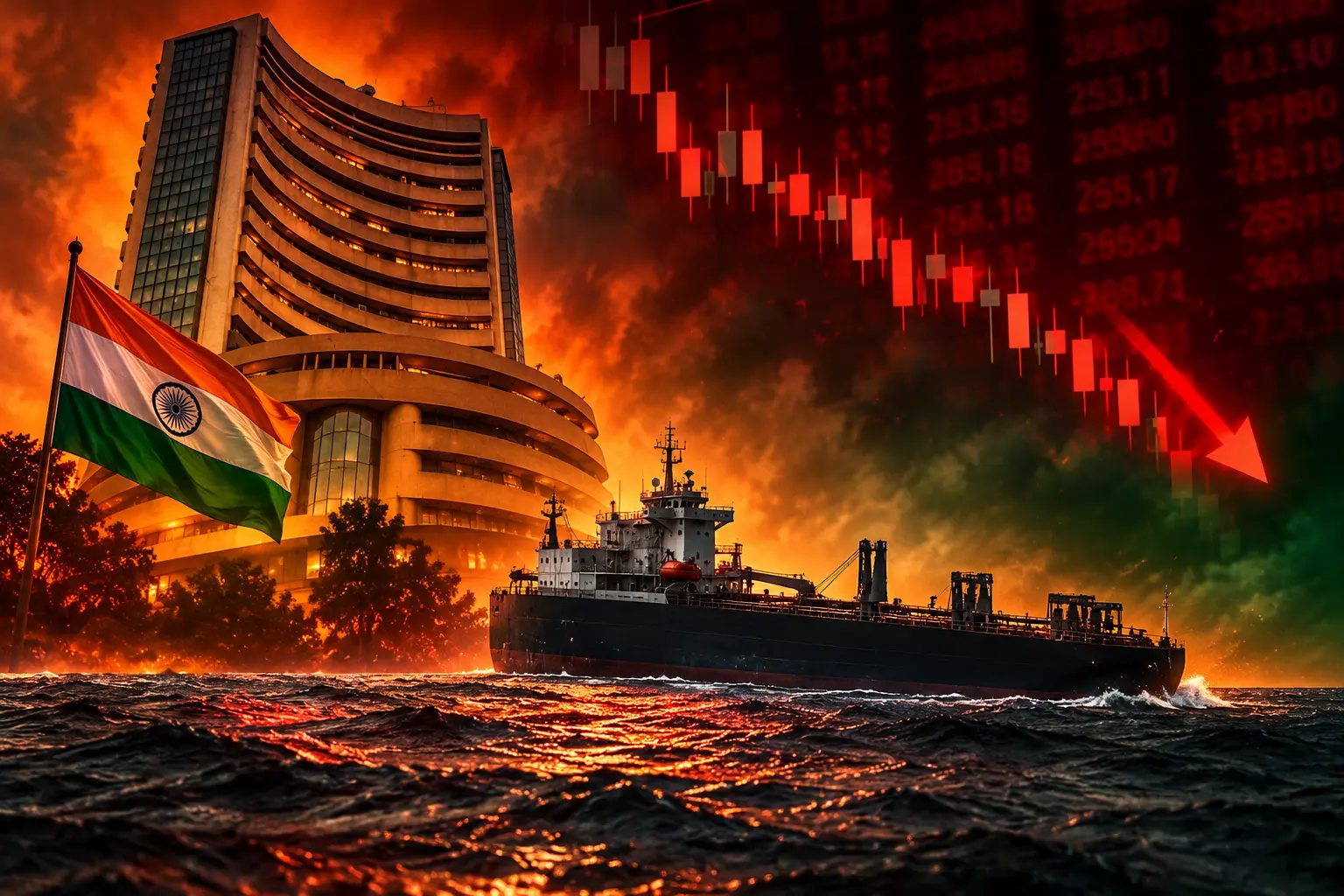
$98 Oil Lands on the Import Bill
Brent, the global benchmark, jumped 1.45 per cent to $98.36 a barrel as US-Iran fighting and a fresh alert from Saudi Arabia’s energy ministry kept supply risk in the price. India imports over 88 per cent of the crude its refineries run, so the local bill moves with that tape, not with a single session’s points.
The Oil Ministry’s Petroleum Planning and Analysis Cell put the Indian crude basket monthly prices at $106.26 a barrel on Monday, September 7. The September average stood at $100.75, against $90.19 in August and $82.04 in July, in a 77.81:22.19 mix of sweet and sour grades.
THE OIL MATH INDIA IS PAYING
- April-July bill: Crude imports cost $63.4 billion, up 56.5 per cent from $40.5 billion a year earlier, while volumes were almost unchanged at 81.9 million tonnes against 81.5 million.
- Per-dollar hit: C. Uday Bhaskar, director of the Society for Policy Studies, has put the annual add at $1.5 billion to $2 billion for every $1 rise in the average crude price.
- Pump freeze: Retail petrol and diesel have been frozen for more than three months; the last change was on May 25, when petrol rose Rs 2.61 a litre and diesel Rs 2.71, part of four instalments that added Rs 7.35 and Rs 7.53.
- Delhi pumps: As of September 7, petrol at an IOCL Delhi outlet was Rs 102.12 a litre and diesel Rs 95.20, per PPAC.
Prashant Vasisht, senior vice president at Icra Ltd, said marketing margins on auto fuels are likely to turn negative, and that domestic LPG under-recoveries could rise from Rs 200 a cylinder. Indian Oil, Bharat Petroleum and Hindustan Petroleum already sit on losses from not passing through the full West Asia spike, so the next move is either thinner OMCs or another pump hike.
The rupee fell 0.35 per cent to 94.8175 per dollar from 94.4850, after two unchanged sessions. Dilip Parmar, senior research analyst at HDFC Securities, said aggressive dollar buying outstripped liquidity as oil rose and risk appetite faded, and he put near-term resistance at 95.10 with support at 94.45.
The RBI Is Still on Hold Until October
Banks are the transmission because the Monetary Policy Committee has already chosen patience. At its 62nd meeting from August 3 to 5, the panel voted unanimously to keep the policy repo rate unchanged at 5.25 per cent, with the standing deposit facility at 5.00 per cent and the MSF and Bank Rate at 5.50 per cent, and it kept a neutral stance.
There is a need for greater clarity to emerge, especially regarding inflation, its path and composition before taking any policy action.
Reserve Bank of India, Monetary Policy Statement, August 5, 2026
Governor Sanjay Malhotra’s committee projected CPI inflation at 5.0 per cent for 2026-27, with 4.7 per cent in the second quarter, 5.9 per cent in the third and 5.5 per cent in the fourth. Real GDP growth is put at 6.7 per cent. June CPI had already risen to 4.4 per cent after 16 months below the 4 per cent target, driven by food and fuel, while core inflation held at 3.9 per cent.
The next meeting is scheduled for October 5 to 7, 2026. Until that week, a $98 Brent print does not invite a cut. It invites another quarter in which fuel and food can push headline inflation toward 5.9 per cent, which is why ICICI Bank and Axis Bank took the first hit on September 8.
Who Is Buying When Foreigners Hedge?
Foreign funds bought Indian shares worth Rs 280.13 crore on Monday, September 7, according to exchange data, a modest cash print after heavier selling last week. Domestic institutions stayed net buyers, with combined tallies around Rs 567 crore, and they have been the bid for weeks.
Ponmudi R, chief executive of Enrich Money, said the market remains in a “sell on rise” mode, and that DII buying remains the only real cushion preventing a sharper fall. He also said the Nifty’s slide had extended to a seven-week low. The cash FII figure still sat beside selling in index futures, so the headline purchase did not mean foreigners were covering the tape.
THE BID THAT SHOWED UP IN CASH
- September 7: FIIs bought Rs 280.13 crore and DIIs about Rs 567 crore, a thin two-way session while US markets were shut for Labour Day.
- September 4: FIIs sold Rs 3,112 crore and DIIs bought Rs 8,930 crore, the pattern that has kept the index from a faster break.
- The official file: Daily FII and DII cash-market reports on the NSE still show foreigners oscillating around small prints while domestic funds absorb the supply.
A heavy IPO calendar is also pulling rupees out of listed names, which leaves the Nifty’s largest banks and Reliance doing more of the index’s work on a weak day. India VIX closed at 11.10, so this was a grind, not a panic spike.
BEL, Ports and the Midcap Split
The same session that knocked 555.23 points off the Sensex left the broader market mixed. The Nifty Midcap 100 rose 0.21 per cent to 62,915.80, the Nifty Next 50 gained 0.52 per cent to 72,950.65, and the Nifty Smallcap 100 added 0.17 per cent to 20,133.75.
Bharat Electronics rose 1.48 per cent, the top Sensex gainer, after Defence Acquisition Council approvals put money back into the defence basket. Hindustan Aeronautics jumped 4 per cent. Adani Ports gained 1.06 per cent and Hindustan Unilever 0.84 per cent. The Nifty Pharma index rose 0.77 per cent.
InterGlobe Aviation, the IndiGo parent, still closed 0.49 per cent higher even as jet fuel tracks Brent. That bid does not cancel a $98 oil print for airlines; it shows the day’s selling was in the index heavyweights, not a uniform risk-off across every book.
ONGC found buyers as the oil tape firmed, a clean split from Reliance, which is priced as much as a retail and telecom compounder as a refiner. HAL, BEL and ports are where the market is paying for a longer West Asia conflict. Banks are where it is charging for that same conflict.
How Tuesday’s Expiry Met a Two-Day Slide
US markets were closed on Monday, September 7, for the Labour Day holiday, so Mumbai traded without a Wall Street lead for a day and then sold again on the expiry open. From Friday’s implied close, the Sensex is down 937.85 points in two sessions and the Nifty is down 262.60 points.
On the Nifty 50’s official closing board, the index opened at 23,743.10, high 23,758.95, low 23,623.10, previous close 23,779.15. It is 935.55 points, or 3.81 per cent, below its August 7 close of 24,570.65. The 52-week range remains 22,182.55 to 26,373.20.
THE TWO SESSIONS THAT CUT 938 POINTS
- September 7: Sensex settles at 76,132.81, down 382.62 points or 0.50 per cent, and the Nifty at 23,779.15, down 118.55 points, with US markets shut.
- September 8 open: Sensex starts at 75,970.28 and Nifty at 23,743.10 as Brent holds the high $90s and weekly Nifty options expire.
- September 8 low: Sensex prints 75,553.35 and Nifty 23,623.10, then recovers only a few points into the close at 75,577.58 and 23,635.10.
The closing auction session, in place since August 3, has added extra noise on weekly and monthly expiry days. Tuesday combined that plumbing with a crude spike, which is why the large-cap indices did the falling while midcaps and smallcaps still closed green.
Hormuz Traffic Sets the Next Move
The oil number on the Indian screen is a six-month war price, not a one-day headline. The United States and Israel struck Iran in late February, and the Strait of Hormuz, which in peacetime carries about one-fifth of the world’s oil and liquefied natural gas, has run well below normal traffic since.
US Central Command said US forces struck three Iranian oil tankers on Saturday. Iran has talked of a new restricted maritime zone beyond the strait, a warning voiced by Mohsen Rezaei, secretary of the Supreme National Security Council. Kpler counted about 10 commodity ships a day through Hormuz over 10 days, the lowest since May.
Saudi Arabia’s energy ministry said energy facilities in the kingdom’s southern province came under attack on Tuesday morning, with injuries reported. West Asian oil shipments have fallen to about 11 million barrels a day from roughly 18 million, according to energy-flow tallies circulating with the price spike.
The renewed hostilities between Iran and the US pose a challenge for the limited crude oil supplies coming through the Strait of Hormuz. Further, as Iran threatens to establish a new restricted maritime zone extending beyond the Strait of Hormuz, additional energy flows beyond the latter could be at risk.
Prashant Vasisht, senior vice president, Icra Ltd
Daan Struyven, co-head of global commodities research at Goldman Sachs, has said that if shipping attacks broaden and intensify, Brent could reach $120. Wood Mackenzie has said Asia-Pacific oil demand is not expected back at pre-conflict levels until late 2027. Those are the dates that sit behind a 2 per cent drop in ICICI Bank, more than the 555.23 Sensex points.
The MPC meets again on October 5 to 7. Until Hormuz traffic rises from about 10 ships a day, the cash bid in this market remains the domestic one, and the stocks that pay for $98 oil remain the banks.
Disclaimer: This article is news reporting and analysis of market closes, oil prices and policy statements, and it is for information only. It is not investment advice, a recommendation to buy or sell any share, index, currency, oil contract or fund, and it is not a forecast of future returns. Readers should consult a SEBI-registered investment adviser or their broker before acting on any market move. Index levels, stock moves, crude prints and fund-flow figures reflect the exchange, company and official sources cited for September 8, 2026, and those figures can change in the next session.

Maharashtra Grants Nana Patekar a State Funeral at His Farm

Nifty Tests 22,600 as Banks Carry a Fragile Rebound

India’s 13.3 Crore Voter Cut Lands on the Election Commission

Reflection Bets $25 Billion on Beam’s Cheaper Open Weights

India Finishes Fourth Again, 21 Medals Short of Hangzhou

Tesla Raises Dual Motor Prices as Texas Builds Cybercabs

Generation Lab’s Secret Youth Shot Has a Copycat Problem

The Nantucket Friendship Basket Boom Meets a Maker Shortage

Bristol Myers Quits Cellares as Autoimmune Doses Proceed

Okta Stock Jumps 20% on McKinnon’s Identity Bet
-
 NEWS2 months ago
Generation Lab’s Secret Youth Shot Has a Copycat Problem
-
 AUTO2 months ago
Tesla Raises Dual Motor Prices as Texas Builds Cybercabs
-
 LIFESTYLE2 months ago
The Nantucket Friendship Basket Boom Meets a Maker Shortage
-
 NEWS2 months ago
Okta Stock Jumps 20% on McKinnon’s Identity Bet
-
 BUSINESS2 months ago
Bristol Myers Quits Cellares as Autoimmune Doses Proceed
-

 LIFESTYLE2 months ago
Labor Day Mattress Sales Repeat a Familiar Holiday Discount
-

 BUSINESS2 months ago
Poland Closes Visa-Free Work for Three Fast-Growing Nationalities
-

 NEWS2 months ago
Google Ends EU Spam Demotions but Keeps the Ranking Split