
BUSINESS
Cal-Maine Culls 1.76 Million Birds After Florida Flu Test
Cal-Maine will depopulate 1.76 million birds in Okeechobee after HPAI, another hit since 2024, arriving after a $58.6 million loss on cheap eggs.

Cal-Maine Foods will kill about 1.4 million laying hens and 360,000 pullets at an Okeechobee County, Florida, farm after a bird flu test. The cull is 2.7% of the flock at the largest U.S. egg company, which just booked a $58.6 million quarterly loss on cheap eggs.
Shares still closed up 8% the day Ridgeland, Mississippi-based Cal-Maine told investors, because this trade has watched the same virus empty barns and then reprice the eggs that remain.
The Okeechobee Barn Goes Quiet
On Nov. 18, 2026, Cal-Maine said one of its Florida farms tested positive for highly pathogenic avian influenza, the strain the trade calls HPAI. The U.S. Department of Agriculture’s Animal and Plant Health Inspection Service logged the case the same day as a commercial table-egg layer flock in Okeechobee County. Production at the farm has stopped while the company follows USDA protocols.
The company said it is shifting orders across other plants so retail, foodservice and industrial customers still get eggs, including cage-free, organic and free-range packs sold under brands such as Eggland’s Best. It gave no date for a restart and said later numbers will land in the next quarterly filing with the Securities and Exchange Commission, with no interim updates unless the facts are material.
No eggs have been pulled from stores. USDA guidance holds that HPAI is not passed through safely handled and properly cooked eggs, and the Centers for Disease Control and Prevention says the public health risk is low for people who do not work around infected animals. CDC has counted 75 reported human A(H5) cases in the United States since February 2024, most in dairy and poultry workers, and it has not identified person-to-person spread in the country.
Dr. Monica Gandhi, an infectious disease specialist at the University of California, San Francisco, said the whole flock goes because the virus moves faster than any barn crew can sort sick birds from healthy ones.
It spreads so quickly among birds, and because of that rapid spread, they can’t tell if a bird has it or not, and so they cull the whole flock.
Dr. Monica Gandhi, infectious disease specialist, University of California, San Francisco
How the virus entered this house is still open. Wild birds carry it, and dirty boots or shared equipment can walk it from one barn to the next. Cal-Maine said it runs biosecurity programs at every site and also said no farm is immune, especially in migration season.
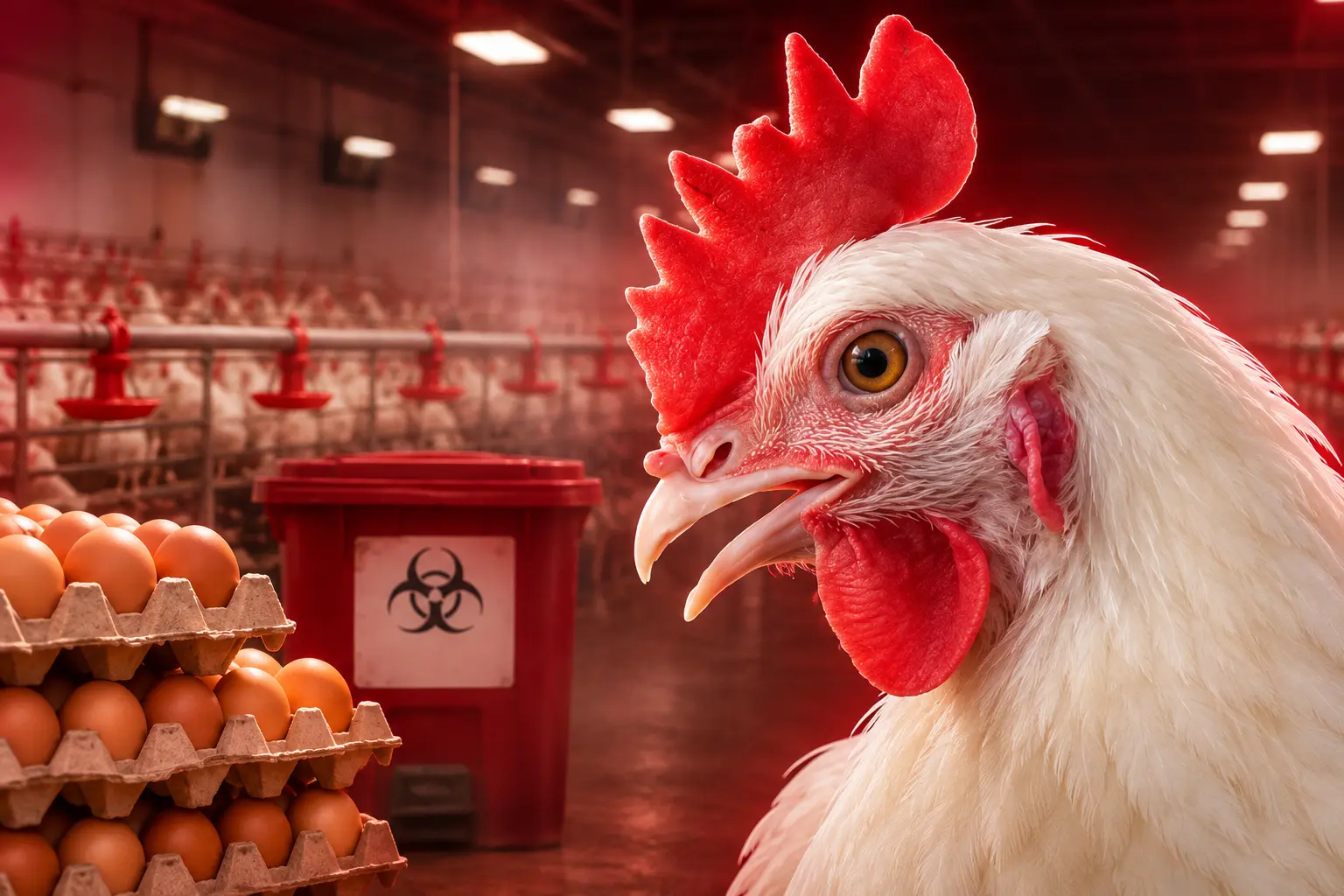
1.76 Million Birds, 2.7% of the Flock
The condemned flock is 1.4 million laying hens and 360,000 pullets, about 1.76 million birds in total. Pullets are young females that have not yet entered the laying rotation, so the lost output is both eggs now and eggs that were months away.
THE OKEECHOBEE FLOCK
- Laying hens: About 1.4 million birds, the birds already producing table eggs.
- Pullets: About 360,000 young females that had not yet joined the laying flock.
- Company share: Combined, 2.7% of Cal-Maine’s total flock, per the Nov. 18 statement.
- Status: Production at the Florida farm has stopped; the company has not said when it restarts.
Two point seven percent is a manageable hole if the rest of the map stays clean. Cal-Maine’s pitch is that it can move cartons from other states and keep shelves filled. That math only holds if Okeechobee is a single spark. Fall migration is when wild birds and commercial houses overlap, and the company’s own language leaves that door open.
Why Cal-Maine Shares Rose on the Cull
Nasdaq-listed Cal-Maine shares closed at $70.43 on Nov. 18, up 8% from $65.24 on Nov. 17. Killing 1.76 million birds is a cost. Investors still bid the stock because a thinner national flock has, more than once, been the event that lifts the price of every remaining dozen.
That bid sits on a fresh bruise. For the quarter ended Aug. 29, 2026, Cal-Maine posted a net loss of $58.6 million, against net income of $199.3 million a year earlier. Net sales fell 41.5% to $539.6 million from $922.6 million. Gross profit collapsed to $403,000 from $311.3 million. The operating loss was $82.2 million, compared with operating income of $249.2 million. Diluted loss per share was $1.26, against earnings of $4.12.
President and Chief Executive Officer Sherman Miller put the hole on conventional eggs after the industry restocked layers through fiscal 2026. Conventional shell-egg sales fell 59.5% to $201.7 million, almost entirely because the average selling price per dozen dropped 59.3% while volume slipped only 0.7%. That segment lost $71.0 million after earning $168.2 million a year earlier.
Our first-quarter results reflect both the current point in the conventional shell egg cycle and the continued evolution of Cal-Maine Foods’ earnings model. Conventional Shell Egg pricing remains under pressure from an industry supply imbalance, while underlying demand remains healthy.
Sherman Miller, president and chief executive officer, Cal-Maine Foods, first-quarter fiscal 2027 results
Specialty shell eggs and prepared foods rose to 54.1% of net sales from 37.1%, which is the company’s attempt to live less by the wholesale tape. Conventional eggs still dug the quarter’s hole. An HPAI headline that tightens supply is, for that book, a price event as much as a production event. The 8% pop on cull day is that reading, priced in a session.
Texas, Maryland and Now Florida
Okeechobee is not Cal-Maine’s first empty house in this outbreak wave. The company reported a positive test at Parmer County, Texas, in April 2024, and it lost a Maryland pullet farm in March 2026. A Kansas house was idled in December 2023 after about 684,000 laying hens were hit. The press language has barely changed: stop the plant, follow USDA rules, point to other states, and say no farm is safe while wild birds keep moving.
CAL-MAINE HPAI HITS
| Site | Disclosed | Birds condemned | Share of flock |
|---|---|---|---|
| Parmer County, Texas | April 2, 2024 | 1.6 million laying hens and 337,000 pullets | 3.6% as of March 2, 2024 |
| Maryland pullet farm | March 2026 | About 352,000 pullets | Not stated |
| Okeechobee County, Florida | Nov. 18, 2026 | 1.4 million laying hens and 360,000 pullets | 2.7% |
Maryland has since returned to full operation, which is the recovery path the company will try to copy in Florida: empty the houses, clean, wait on USDA, then restock. Pullets take months to reach lay, so even a clean bill does not put 1.4 million hens back on the belt in a few weeks.
The national ledger is larger than one company. A USDA-based tracker at Innovate Animal Ag, drawing on APHIS HPAI detections in commercial poultry and backyard flocks, counted 2,316 flocks and 213.9 million birds affected since February 2022, as of Nov. 20, 2026. Calendar 2026 was already 330 flocks and 28.8 million birds. In the 30 days to Nov. 20, APHIS confirmed 32 flocks and 3.8 million birds, with the most birds in Florida, California and Maryland.
That 30-day pile is why a 2.7% hole at Cal-Maine is being read as a season, not a stray barn. If more commercial layer houses go dark through winter, the Okeechobee math stops being a company footnote and becomes the supply line for grocery eggs.
Florida Draws a Two-County Quarantine
Florida’s Department of Agriculture and Consumer Services posted a quarantine on Nov. 19, the day after Cal-Maine’s statement. The zone runs from Okeechobee County into western St. Lucie County, north of State Road 70 near the county line, and the order carries no end date. People can still drive through. Birds cannot.
THE ZONE RULES
- Movement: Written state permission is required to move poultry or poultry products into, out of, or inside the zone, including a few backyard hens walked to a neighbor.
- Map: The state points owners to its live quarantine map and to RAD@FDACS.gov for permits.
- Local knock-on: The Saturday animal auction at Emerald Oaks Ranch in Okeechobee barred birds from inside the zone and told sellers to check the map before loading trailers.
- Reporting: Flock owners are told to keep poultry away from wild birds and to report sudden deaths, breathing trouble, or a drop in egg production.
The agency called avian influenza a serious disease concern for the poultry industry and animal health officials. That is the quiet cost sitting beside Cal-Maine’s 2.7% slide: hobby flocks, small sellers, and a county auction now need paperwork to move a crate. The company’s national network can reroute cartons. A backyard coop in the zone cannot.
Wholesale Prices Jumped Before Thanksgiving
USDA’s Agricultural Marketing Service, in its Nov. 20, 2026, Egg Markets Overview, put national trading of truck-lot graded loose white large eggs at $1.18 a dozen, $0.45 higher on the week, with a steady undertone. Offerings were light. Retail demand was fairly good to good. That print is still far below the spikes of the last HPAI crush, and it is already off the floor that produced Cal-Maine’s first-quarter loss.
Q1 FY2027 AT THE BOTTOM
| Metric | Quarter ended Aug. 29, 2026 | Year-earlier quarter |
|---|---|---|
| Net sales | $539.6 million | $922.6 million |
| Gross profit | $403,000 | $311.3 million |
| Operating result | Loss of $82.2 million | Income of $249.2 million |
| Net result attributable to Cal-Maine | Loss of $58.6 million | Income of $199.3 million |
Miller told investors on the Sept. 30 call that hatch numbers were down and that high-path AI could change the timing of any rebalance, with activity historically rising as fall migration starts. Okeechobee is that line arriving in a single county. Thanksgiving week is when grocers already need more eggs for baking and breakfast. A 1.76 million-bird hole at the largest producer does not empty the country’s cases by itself. Stacked on 3.8 million birds lost nationally in 30 days, it is the first hard commercial-layer shock of this migration season.
The tape can run up in weeks. Rebuilding a layer house does not. That asymmetry is why a cull notice and a green stock day can share a date, and why a $58.6 million loss on oversupply can sit only a few months behind a new HPAI headline.
Cal-Maine Will Wait Until the Next Filing
Cal-Maine said it will put updated information in its next quarterly report and does not expect to talk in between unless the facts are material. Until that filing, the public record is the Nov. 18 statement, the APHIS confirmation, the Nov. 19 Florida quarantine, and the USDA price tape.
WHAT WE KNOW
- The farm: A commercial table-egg layer site in Okeechobee County tested positive on Nov. 18, 2026.
- The cull: About 1.4 million laying hens and 360,000 pullets, 2.7% of Cal-Maine’s flock, with production stopped at that farm.
- The food: No recall; USDA says properly handled and cooked eggs are not a transmission route.
- The zone: Florida’s Nov. 19 order covers Okeechobee and western St. Lucie County, with no end date posted.
WHAT IS UNCONFIRMED
- Restart: Cal-Maine has not said when the Florida farm returns to lay.
- Earnings hit: The company has not quantified the second-quarter cost of the lost flock or the idle plant.
- Further barns: Whether other Cal-Maine sites, or other large layer complexes, test positive this migration season is still open.
- Price path: USDA has printed $1.18 a dozen on the loose large tape; how far that run goes depends on the next detections, not on Okeechobee alone.
The Okeechobee houses are now a cleanup job with a two-county fence around them. The rest of Cal-Maine’s map is still laying, and the shares already moved as if that were the point. The next number that matters is not another press release. It is whether APHIS keeps adding commercial layer lines after Thanksgiving, and what that does to the $1.18 dozen the wholesale tape just printed.
Disclaimer: This article is news reporting on a company disclosure, federal animal-health data, and wholesale egg prices, and it is for information only. It is not investment advice, a recommendation to buy or sell Cal-Maine Foods or any other security, and it is not food-safety or medical advice about handling or eating eggs. Readers who are considering an investment decision should consult a licensed financial adviser, and anyone with questions about cooking, storage, or exposure should follow USDA and CDC guidance or speak with a qualified clinician or state agriculture official. Bird counts, quarantine boundaries, share prices, and egg quotes reflect the cited statements and reports as dated above and can change as tests, filings, and markets update.

Cal-Maine Culls 1.76 Million Birds After Florida Flu Test

GTA 6 Took 24 Percent of Comcast Peak Traffic

Harvard’s 403 Data Centers Leave Four States on the Hook

Rockstar Staff Ballot for a Union After GTA VI’s Record Launch

Hyatt Trades Globalist Parking for Stackable 2027 Awards

Tesla Raises Dual Motor Prices as Texas Builds Cybercabs

Generation Lab’s Secret Youth Shot Has a Copycat Problem

The Nantucket Friendship Basket Boom Meets a Maker Shortage

Bristol Myers Quits Cellares as Autoimmune Doses Proceed

Okta Stock Jumps 20% on McKinnon’s Identity Bet
-
 AUTO3 months ago
Tesla Raises Dual Motor Prices as Texas Builds Cybercabs
-
 NEWS3 months ago
Generation Lab’s Secret Youth Shot Has a Copycat Problem
-
 LIFESTYLE3 months ago
The Nantucket Friendship Basket Boom Meets a Maker Shortage
-
 BUSINESS3 months ago
Bristol Myers Quits Cellares as Autoimmune Doses Proceed
-
 NEWS3 months ago
Okta Stock Jumps 20% on McKinnon’s Identity Bet
-

 LIFESTYLE3 months ago
Labor Day Mattress Sales Repeat a Familiar Holiday Discount
-

 BUSINESS3 months ago
Poland Closes Visa-Free Work for Three Fast-Growing Nationalities
-

 GAMING3 months ago
GTA 6 Bets Its Last Look on Netflix and $100