
BUSINESS
ACCC Margin Checks Bind Woolworths and Coles Alone
ACCC margin checks on eight grocery groups bind only Woolworths and Coles, leaving every grocer under A$30 billion outside the new rules.

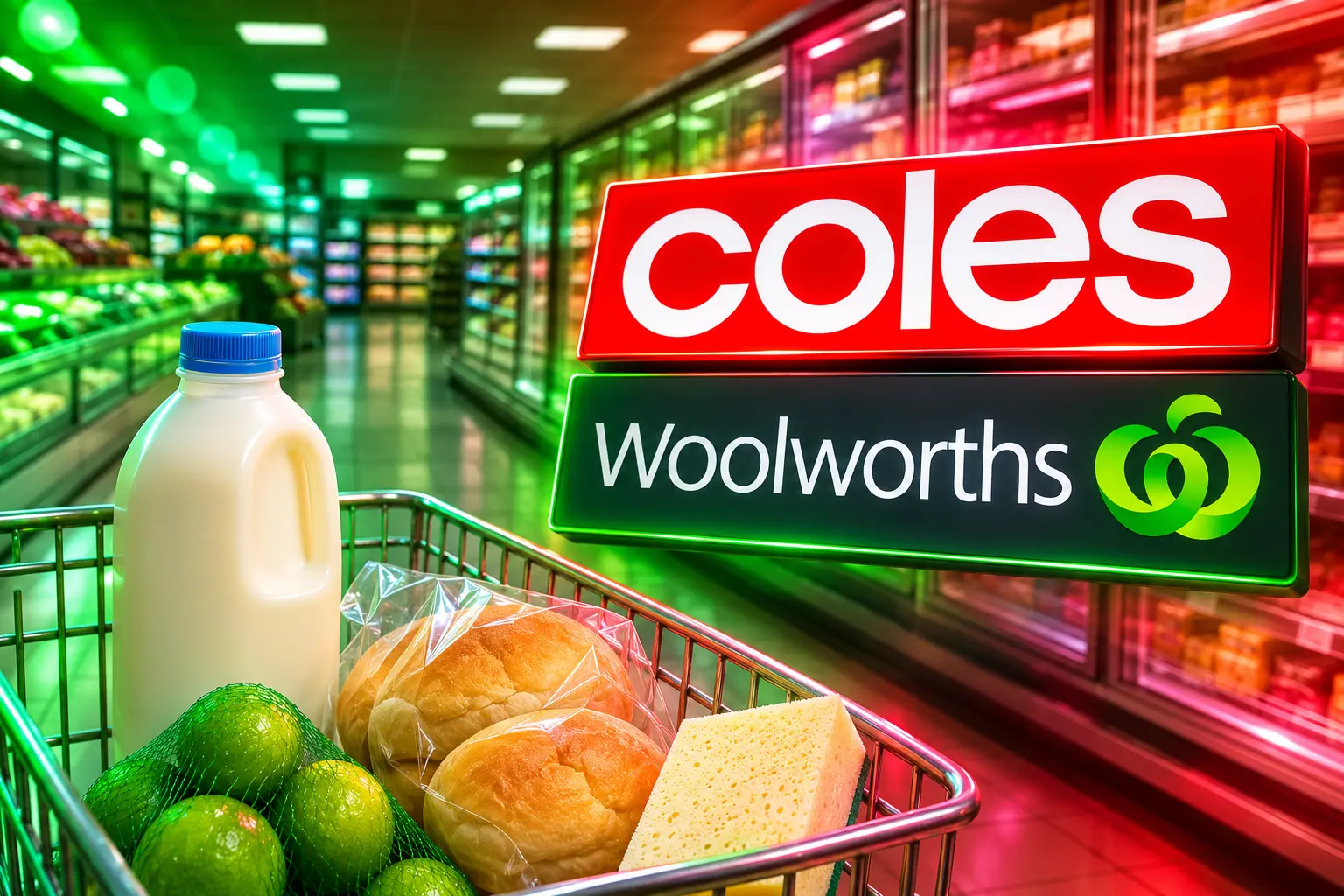
The ACCC will examine retail margins on eight grocery groups at Woolworths and Coles, covering more than 1,000 items, under a law that currently binds only those two chains.
Deputy chair Mick Keogh said a place on the list is not a finding of unreasonable margins. The first public report is due in early 2027, and it will use prices set before the ban began on 1 July 2026.
Milk, Limes and Kitchen Sponges Share One List
On 13 November 2026 the ACCC published the first eight product groups named in November for closer margin checks in the 2026/27 financial year. The mix is not a standard staple basket. Two lines are fresh produce, one is meat, one is dairy and one is bakery. Chocolate and coffee sit with them. The eighth group is not food.
THE EIGHT FOCUS GROUPS
- Potatoes
- Limes
- Chicken, bone-in
- Unflavoured fresh milk
- Bread rolls
- Chocolate (blocks and snack bars)
- Coffee
- Kitchen sponges and scourers
Those groups represent more than 1,000 items on Coles and Woolworths shelves. The ACCC said it chose them using reports from consumers and suppliers, whether a product is essential or discretionary, and prices, margins and sales revenue in the 2024/25 and 2025/26 financial years. Those two years ended the day before the ban started, so the data that built the list was set under the old rules.
It’s important to note that just because a product is on our focus list, it doesn’t mean that we currently consider supermarkets are obtaining unreasonable margins on these products. It signals that we think the pricing of the product warrants closer examination.
Mick Keogh, ACCC Deputy Chair, 13 November 2026 statement
Keogh also said monitoring is not limited to the named groups. The ACCC will keep taking margin and price information for all grocery products at Coles and Woolworths, and it may add more focus products during 2026/27. Kitchen sponges on the same sheet as milk make that breadth concrete: the net is a compliance file, not a campaign poster of bread and butter.
Only Two Grocers Clear the $30 Billion Line
The Albanese government announced the supermarkets excessive pricing prohibition on 14 December 2025 and wrote it into the Food and Grocery Code of Conduct. It applies to a very large retailer that runs a supermarket business in Australia and whose Australian revenue from that business, with related bodies corporate, exceeded A$30 billion (US$20.7 billion) in the previous financial year. For 2025/26, the ACCC says that test currently captures Coles and Woolworths.
A corporation that crosses or falls below the line must notify the ACCC within 5 business days after its Corporations Act reporting deadline. Until that happens, Aldi, Costco, IGA and every other grocer can set prices without this record-keeping and penalty regime. Shoppers who already walk a discounter aisle for a price check are using the one large competitor the statute does not cover.
WHO THE BAN COVERS
| Retailer | Why it sits in or out | Covered |
|---|---|---|
| Woolworths | Australian Food sales of A$53,852 million in the 2026 financial year | Yes |
| Coles | Named by the ACCC as a very large retailer now in scope | Yes |
| All other grocers | Revenue below the A$30 billion line for 2025/26 | No |
Woolworths reported Australian Food sales of $53,852 million for the 2026 financial year, up 4.6 per cent, well clear of the threshold. The ACCC’s 2024/25 supermarkets inquiry estimated Woolworths at 38 per cent of national supermarket grocery sales and Coles at 29 per cent. That is 67 per cent under the new file. The other 33 per cent of the market, including the discounter shoppers already treat as the live comparison, is not.
The inquiry also found Coles and Woolworths have limited incentive to compete vigorously with each other on price, which is the reason Canberra aimed the ban at the two largest chains. The design still leaves a third of grocery sales outside the same margin microscope.
What Counts as a Reasonable Margin?
A very large retailer engages in excessive pricing only if, in all the circumstances, the price is significantly excessive when compared with the cost of supply plus a reasonable margin. There is no fixed percentage. The ACCC says it will weigh all relevant circumstances rather than a published cap, a choice the government said was meant to stop the test being gamed.
Supply cost, on the ACCC’s own page, is not just the invoice from a milk processor or a cocoa buyer. It includes buying or producing the goods, transport to the store, staff wages, rent, research on new lines, and investment in equipment. Margin is the profit left after those direct and indirect costs come off the retail price.
That construction cuts both ways. A chain can argue wages, freight and rent before anyone calls a shelf price excessive. The regulator can still treat a gap that survives those costs as significantly excessive. Neither side gets a number they can manage to, which is the point of the design and the hole in it. Category teams at two companies now price milk, limes and scourers knowing a later file may ask them to justify the spread, while a rival under A$30 billion does not keep the same three-year pack.
Very large retailers must keep pricing information for at least 3 years. The file includes retail price, sales volume, purchase costs, the operating cost of the Australian supermarket business, and payments or other financial benefits from suppliers tied to retail sale. The ACCC can request that material, and it can ask for more documents if a compliance check raises a concern. It does not settle individual shopper complaints about a single ticket.
The First Report Is a Pre-Law Baseline
The ACCC’s initial focus is monitoring, not a courtroom raid. It says it may take enforcement action if the evidence supports it. The public product of this first round is a report in early 2027 on focus-product prices, costs and margins, drawing on data from before 1 July 2026 to set a baseline for later comparisons. Additional focus products will be announced next year. No shelf price has to move because a group appeared on the 13 November 2026 list.
THE ROAD TO THE 2027 REPORT
- 1 April 2025: The Food and Grocery Code becomes mandatory.
- 14 December 2025: The government announces the excessive pricing prohibition.
- 1 July 2026: The ban takes effect for retailers above A$30 billion, currently Coles and Woolworths.
- 13 November 2026: The ACCC names the first eight focus groups, covering more than 1,000 items.
- Early 2027: The first monitoring report is due, using pre-ban figures as the baseline.
The list therefore arrived months after the legal duty began, and the first document the public will see is a starting line, not a verdict. That lag is why a discounter still does more daily price work for a household than this watchlist will do before early 2027. The ACCC already collects information beyond the eight groups, so the quiet pressure on Coles and Woolworths is the standing data request, not a fine dated November.
Coles Already Lost a Discount Case in May
The same two chains, and the same regulator, are already in Federal Court over how advertised discounts were built. On 14 May 2026 Justice Michael O’Bryan found Coles Supermarkets Australia made false or misleading representations about ‘Down Down’ tickets. The ACCC’s case covered 245 common products sold between February 2022 and May 2023, including Arnott’s Shapes, Weet-Bix and Cadbury chocolates. Chocolate blocks and snack bars now sit on the margin list as well.
The liability hearing used 12 sample products, two of them placed on Down Down twice. The court found 13 of the 14 Down Down tickets misleading because the goods had not been sold at the stated ‘Was’ price for a reasonable period, so the discount on the ticket was not genuine. The ACCC had alleged Coles lifted each of the 245 lines by at least 15 per cent for a short period, then promoted a Down Down price that was still higher than, or the same as, the earlier selling price. Penalties and other orders are still to be set. Coles operates more than 840 stores. It introduced Down Down in June 2010.
The ACCC brought this case in the public interest because we considered that Coles’ pricing practices within its ‘Down Down’ program made it harder for customers to identify genuine value for money while shopping for household essentials.
Gina Cass-Gottlieb, ACCC Chair, 14 May 2026 statement
Woolworths faces separate proceedings over its Prices Dropped campaign. The ACCC has said it will not comment on that matter while it remains before the court. The two fights sit beside the new margin file rather than inside it. One regime asks whether a ‘Was/Now’ ticket was a genuine cut. The other asks whether the everyday price, after costs, is significantly excessive. Promotional language is already a legal risk for the only two companies that also have to justify a reasonable margin on more than 1,000 items.
Penalties Can Reach 10% of Turnover
If a court finds a breach of the excessive pricing rules, the maximum penalty per contravention is the greater of $10 million per contravention, three times the value of the benefit derived, or, if that value cannot be determined, 10 per cent of the company’s turnover in the preceding 12 months. The ACCC can also use infringement notices, court-enforceable undertakings and other code tools. Record-keeping failures carry their own penalty risk.
THE PENALTY FORMULA
- Flat rate: A$10 million per breach.
- Benefit limb: Three times the value derived from the breach.
- Turnover limb: 10 per cent of turnover for the preceding 12 months, if the benefit cannot be worked out.
Political language around the ban often led with A$10 million. The regulation is a greater-of test, so 10 per cent of turnover is the limb that can dwarf the headline figure. For a chain whose Australian food sales already print in the tens of billions, that is a different threat from a A$10 million ticket, and it still applies to two companies only.
The ACCC will name more focus products next year and publish the early 2027 baseline. Until then the legal duty is already live for Woolworths and Coles on every grocery line, while every grocer under A$30 billion keeps pricing without that file.

ACCC Margin Checks Bind Woolworths and Coles Alone

Meta Verified the Fake AI Doctor Selling Amazon Cures

Skydance Installs Film Chiefs to Hit a 30-Movie Quota

Apple Bets Slow Horses Can Outlast Mick Herron’s Novels

F.P. Journe Collectors Won Geneva as Jewels Slipped

Generation Lab’s Secret Youth Shot Has a Copycat Problem

Tesla Raises Dual Motor Prices as Texas Builds Cybercabs

The Nantucket Friendship Basket Boom Meets a Maker Shortage

Bristol Myers Quits Cellares as Autoimmune Doses Proceed

Okta Stock Jumps 20% on McKinnon’s Identity Bet
-
 NEWS3 months ago
Generation Lab’s Secret Youth Shot Has a Copycat Problem
-
 AUTO3 months ago
Tesla Raises Dual Motor Prices as Texas Builds Cybercabs
-
 LIFESTYLE3 months ago
The Nantucket Friendship Basket Boom Meets a Maker Shortage
-
 BUSINESS3 months ago
Bristol Myers Quits Cellares as Autoimmune Doses Proceed
-
 NEWS3 months ago
Okta Stock Jumps 20% on McKinnon’s Identity Bet
-

 BUSINESS3 months ago
Poland Closes Visa-Free Work for Three Fast-Growing Nationalities
-

 LIFESTYLE3 months ago
Labor Day Mattress Sales Repeat a Familiar Holiday Discount
-

 GAMING3 months ago
GTA 6 Bets Its Last Look on Netflix and $100