
BUSINESS
Valeo Hands Ireland’s Pantry Brands Back to a Former Boss
Valeo Foods is selling Jacob’s, Odlums and Batchelors to former Ireland boss Hilliard Lombard, a much bigger bet than his other European food buys.

Valeo Foods Group has agreed to sell its Irish grocery business, including Jacob’s biscuits and Odlums flour, to a consortium led by former managing director Hilliard Lombard. The Dublin group, ultimately controlled by Bain Capital, said the carve-out fits a plan to become a “sweet treats champion.” Financial terms were not disclosed, and Irish regulatory approval is still required.
The buyer is not a stranger to these plants. Lombard ran Valeo Foods Ireland from 2016 to 2019. He is now coming back, with family offices, for the brands that still sit in Irish cupboards, while Bain keeps the continental bakeries and a finance bill that wiped out last year’s operating profit.
The Buyer Already Knows These Factories
Lombard left the Irish unit in 2019 and spent seven years as an executive at bakery group Aryzta. In 2021 he co-founded BiaVest with David McKernan as a food-only investment firm. Warren Codd, a BiaVest director who once headed grocery finance at Valeo, sits on the same side of the table. The people bidding for the Irish business used to sign its invoices.
BiaVest’s published yardstick is modest. On 1 July 2025, when Kerga, the vehicle BiaVest shares with Development Capital, bought German drinks maker Münsterland J. Lülf, Lombard said the firm proven revenues of €20 million-plus as the filter for targets, along with a clear route to grow. Kerga also said BiaVest’s revenue under management already exceeded €100 million, with over 450 people across its European companies.
With Münsterland joining the group, we expect to sell over 100 million units across Europe next year, representing a strong foundation for further growth.
Hilliard Lombard, Kerga chairperson and BiaVest co-founder, company statement, 1 July 2025
Valeo Foods Ireland is a different animal. Filed accounts for Valeo Foods UC put Ireland sales at €307.87 million in the year to 31 March 2025. That is more than triple BiaVest’s stated funds under management, and it is an order of magnitude above the €20 million-plus floor Lombard described. He is not bolting on another specialist plant. He is taking the Irish mothership home.
What Valeo Is Handing Over
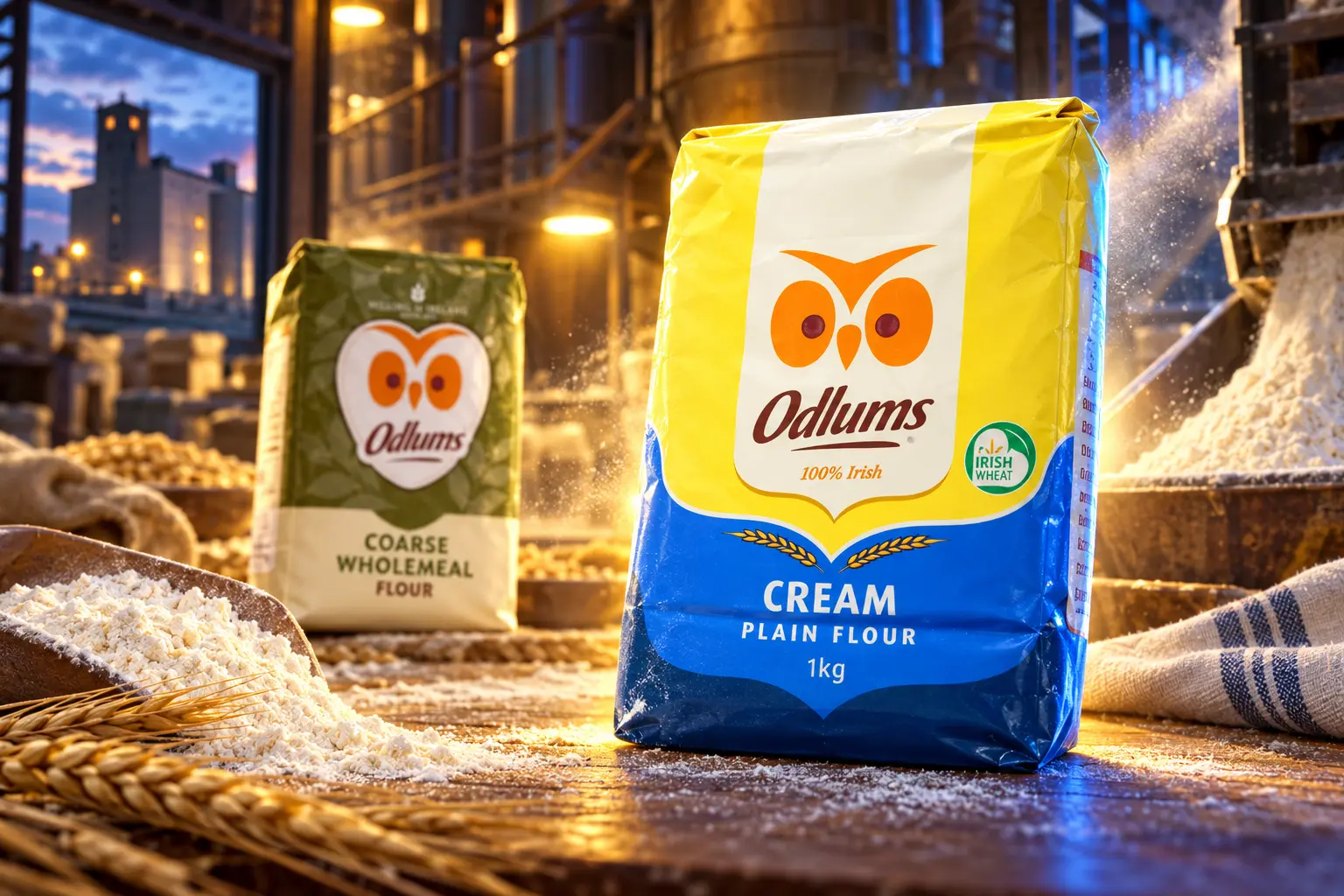
Valeo was built on these brands. The group began in 2010 with the merger of Origin Foods and Batchelors, which brought Odlums, Shamrock and Roma into the same house as Ireland’s canned-goods name. Jacob Fruitfield followed in 2011, adding Jacob’s biscuits, Chef sauces and Fruitfield preserves. Kelkin, the health-food range, arrived in 2015. Valeo Foods Ireland has been inside that group for 16 years.
The Irish site still lists Jacob’s as having been in Irish homes for over 150 years, and it puts Kelkin, Batchelors and the rest of the domestic roster beside it. Deal accounts of the sale name Jacob’s, Odlums flour, Batchelors baked beans, Chef beetroot and Kelkin as moving with the Irish company. Valeo said the unit also has four factories in Ireland, a logistics site in Dublin and an office in Northern Ireland.
BRANDS AND SITES IN THE CARVE-OUT
- Jacob’s: Ireland’s leading biscuit brand, made inside the Irish division now being sold.
- Odlums: Home-baking flour and mixes, in Irish kitchens since 1845.
- Batchelors: Baked beans and canned goods, made in Dublin since 1935.
- Chef and Kelkin: Sauces, beetroot and the health-food range that Valeo added in 2015.
- The plants: Factories in Cabra, Portarlington, Broomhill and Mulhuddart, plus a logistics hub in Ballymount and an office in Northern Ireland.
The Irish operation has more than 500 staff and is split across grocery, food service and healthcare. Valeo said the company will keep running on its own after completion, and that the group “intends to maintain a close commercial relationship,” including distribution of Valeo’s international brands in Ireland. The factories do not move. The name on the invoice does.
The Sweets Plan Has Not Paid Off the Debt
Bain Capital bought Valeo from CapVest in 2021 in a deal put at €1.7 billion. Since then the group has piled into wafers, cakes, honey and confectionery across Europe and North America, and it now lists 80 consumer brands. Directors of Valeo Foods UC, in accounts for the year to 31 March 2025, said growth came from “further recovery of our UK business, strong growth in Italy and Canada” and from three deals in Europe and North America.
Those deals were not cheap. On 8 January 2025 Valeo paid €297.43 million for Slovakian wafer group IDC Holding, €187 million in cash and €110.4 million deferred. In June 2024 it paid €19.33 million in cash for Italian croissant and panettone maker Dal Colle. On 24 July 2025 it sold meat-snacks business New World Foods Europe, also called Meat Snacks Group Limited, to Kepak, including the Freshers Foods line. On 17 July 2026 it completed the buy of Bulgarian biscuit and wafer maker Prestige-96. Ireland became the piece that did not fit the sweets slide.
The accounts show why a cash sale would be useful. Group sales rose 6 per cent from €1.52 billion to €1.62 billion, and operating profit rose 24 per cent to €85.3 million. Net finance costs of €114.1 million still left a pre-tax loss of €28.75 million, after exceptional costs of €17.7 million. Directors wrote that “the loss before tax has increased largely due to finance costs.” A Moody’s note later put group EBITDA at €240 million in the 12 months to December 2025, up from €231 million, and flagged hard trading in Ireland and the UK.
WHERE VALEO MADE ITS MONEY, YEAR TO 31 MARCH 2025
| Region | Sales | Change |
|---|---|---|
| Ireland | €307.87 million | Down 10 per cent from €340.68 million |
| United Kingdom | €647.5 million | Up from €644.4 million |
| Rest of Europe | €507.76 million | Up 34 per cent from €378.04 million |
| Group | €1.62 billion | Up 6 per cent from €1.52 billion |
Ireland still made 19 per cent of group sales even after that 10 per cent drop. Europe, stuffed with the new bakeries, was the growth engine. Headcount at the group rose by 664 people, from 4,546 to 5,210, and staff costs rose from €193.4 million to €272.76 million. The Irish unit was the part of the map that was shrinking while the sweets machine expanded.
This Deal Is a Different Size for Lombard
Until this sale, Lombard’s shopping list looked like a string of specialist European plants, not a national grocery group. BiaVest took an 80 per cent stake in German pasta maker Riesa Nudeln in 2023, a business with sales exceeding €40 million, 150 staff and a factory in Saxony that it planned to take from 25,000 tonnes of pasta a year toward 50,000. The site even runs a pasta museum that draws over 200,000 visitors a year.
Kerga, owned with Development Capital, bought Donegal chilled-snacks firm Nomadic Dairy in 2021 and added Münsterland in July 2025. Münsterland, more than a century old, makes iced coffees, protein drinks and energy teas in over 20 countries and posts sales in excess of €25 million. Kerga said the combined businesses were on track for sales in excess of €60 million from 2026. Offbeat Donuts and Nobó also sit in the wider BiaVest set. None of those names is in the same league as Valeo Foods Ireland.
LOMBARD’S FOOD BETS BESIDE THE IRISH UNIT
| Business | Year | Scale at the deal |
|---|---|---|
| Nomadic Dairy (via Kerga) | 2021 | Donegal chilled snacks, UK and Irish retail |
| Riesa Nudeln (BiaVest 80 per cent) | 2023 | Sales exceeding €40 million, 150 staff |
| Münsterland J. Lülf (via Kerga) | 2025 | Sales in excess of €25 million, over 20 countries |
| Valeo Foods Ireland (agreed) | 2026 | €307.87 million sales, more than 500 staff |
That table is the point of the sale for anyone watching the buyer rather than the seller. Lombard has been assembling pasta, yogurt drinks and German co-packing. Valeo Ireland is flour, beans, biscuits and sauces with four Irish factories and a national logistics hub. If the deal closes, BiaVest’s centre of gravity shifts from continental speciality food to the Irish grocery aisle it used to manage for someone else.
Who Else Wanted the Irish Brands
Houlihan Lokey was hired last year to run a sale of the Irish division. Bain’s plan to sell the unit had already been circulating earlier in 2026. Other names in the process included Brussels private-equity firm Syntagma Capital, Edward McCloskey’s Boyne Valley, and London-listed Princes Group, whose own range runs from tinned fish to Branston pickle and Napolina pasta. Lombard’s group of wealthy people and family offices beat that field.
Trade buyers would have folded Jacob’s and Batchelors into existing ambient ranges. A fund would have looked for the same margin work Bain has already tried. Lombard offers something narrower: a former managing director, a grocery finance lieutenant from the same building, and Irish capital that has been buying food assets since 2021. Valeo, in its statement, said the new ownership would give the Irish business a “strong platform” and a “clear ambition to support its continued development and growth.”
A deal that moves Jacob’s, Odlums and Batchelors has barely surfaced as a public argument, which fits brands people treat as fixtures rather than assets on a PE spreadsheet. The cupboard does not change when the holding company does. The factories, the flour mill and the bean line are what change hands, and they rarely trend.
Ireland’s Top Biscuit Brand Goes Too
Valeo’s own brand pages still call Jacob’s the number one biscuit brand in Ireland, with a heritage of about a century and a half. Biscuits are a sweet treat. The group is selling them anyway, because they live inside the Irish ambient company rather than inside the Italian cake plants, the Bulgarian wafer lines or Barratt in the UK.
What stays with Valeo is the cross-border sweets and snacks kit: Rowse honey, Barratt sweets, Kettle chips, Balconi cakes, Tangerine confectionery, Matthew Walker puddings, and the newer wafer and panettone buys in Italy, Slovakia and Bulgaria. The “sweet treats champion” line is a description of that remaining map. It is also why a Dublin-based group can sell the Irish business it was named around and still claim focus.
Odlums has been an Irish baking staple since 1845. Batchelors has been made in Dublin since 1935. Those are not growth stories in the way Melegatti panettone or IDC wafers are growth stories. They are volume, listing fees and factory utilisation in a market where Valeo’s own filings show sales falling. For Bain, they are capital tied up in a 19 per cent slice of the group that is going the wrong way. For Lombard, they are the brands he already knows how to run.
Irish Approval Still Stands Between the Parties
The agreement was announced on 28 August 2026. Completion is still subject to customary regulatory approvals in Ireland, so the plants have not changed owner yet. Bain declined to comment beyond the group line. Lombard has not issued a public remark on this deal. Valeo said only that the sale was “consistent” with a plan to “optimise the portfolio” and “sharpen [its] focus on the ambition to be the sweet treats champion,” and that it has put money in recent years into honey, confectionery and sweet bakery.
WHAT WE KNOW
- The agreement: Valeo has agreed to sell Valeo Foods Ireland to a consortium led by Hilliard Lombard, with family offices in the buyer group.
- The brands named: Jacob’s, Odlums, Batchelors, Chef and Kelkin move with the Irish company, alongside four factories, Ballymount logistics and a Northern Ireland office.
- The tie that remains: Valeo says it will keep distributing its international brands in Ireland through the sold company after completion.
WHAT IS UNCONFIRMED
- The price: No figure has been disclosed, and there is no public split of debt, cash or earn-out.
- The proceeds: It is not confirmed whether sale cash will go to cut the group’s finance bill.
- The close date: Irish approval has no public deadline attached, and other Irish grocery names in the old Origin set have not been listed brand by brand.
If clearance comes through, Ireland’s grocery aisle will still look the same on Monday morning. The difference will be the owner. A sweets group in Lucan will keep Kettle, Rowse and Barratt, and a former managing director will hold the flour, the beans and the biscuit tin he used to run for Bain.

Maharashtra Grants Nana Patekar a State Funeral at His Farm

Nifty Tests 22,600 as Banks Carry a Fragile Rebound

India’s 13.3 Crore Voter Cut Lands on the Election Commission

Reflection Bets $25 Billion on Beam’s Cheaper Open Weights

India Finishes Fourth Again, 21 Medals Short of Hangzhou

Tesla Raises Dual Motor Prices as Texas Builds Cybercabs

Generation Lab’s Secret Youth Shot Has a Copycat Problem

The Nantucket Friendship Basket Boom Meets a Maker Shortage

Bristol Myers Quits Cellares as Autoimmune Doses Proceed

Okta Stock Jumps 20% on McKinnon’s Identity Bet
-
 NEWS2 months ago
Generation Lab’s Secret Youth Shot Has a Copycat Problem
-
 AUTO2 months ago
Tesla Raises Dual Motor Prices as Texas Builds Cybercabs
-
 LIFESTYLE2 months ago
The Nantucket Friendship Basket Boom Meets a Maker Shortage
-
 NEWS2 months ago
Okta Stock Jumps 20% on McKinnon’s Identity Bet
-
 BUSINESS2 months ago
Bristol Myers Quits Cellares as Autoimmune Doses Proceed
-

 LIFESTYLE2 months ago
Labor Day Mattress Sales Repeat a Familiar Holiday Discount
-

 BUSINESS2 months ago
Poland Closes Visa-Free Work for Three Fast-Growing Nationalities
-

 NEWS2 months ago
Google Ends EU Spam Demotions but Keeps the Ranking Split