NEWS
US Clouds Capture GLM-5.3-Flash After Ox Alpha’s Free Week
Ox Alpha was GLM-5.3-Flash, a 57-point model at nine cents a task. OpenRouter and US hosts, not Z.ai’s brand, now carry the cheap Chinese weights.
Z.ai confirmed on August 26 that Ox Alpha, the mystery model that chewed through more than 20 trillion tokens on OpenRouter, is GLM-5.3-Flash. The 320 billion-parameter mixture-of-experts model, with 18 billion active per token, now sells at 15 cents per million input tokens and 50 cents per million output tokens, with MIT weights and a 1 million-token context window.
The cheap score is real. The parties who actually carry that traffic are a router, a queue of US hosts, and the security teams who can still say no.
Twenty Trillion Tokens Without a Name
Ox Alpha showed up on August 20 as stealth/ox-alpha, free, with OpenRouter saying only that a third-party provider wanted to stay anonymous during a preview. Hobbyists ran tokenizer traces and guessed Gemini, Anthropic, even xAI. Z.ai later said the silence was the point.
In its launch post, the lab wrote that it had run an anonymous OpenRouter and OpenCode preview “to gather user feedback,” and that the listing “quickly became the most popular model of the week, with all of this traffic served on Chinese AI chips.” The South China Morning Post, citing Zhipu, put the combined preview at 62 trillion tokens and said OpenRouter alone took more than 11 trillion in the first three days.
THE STEALTH WEEK
- August 20, 2026: OpenRouter lists stealth/ox-alpha as a free reasoning model for coding and long agent jobs, with no vendor name.
- August 26, morning: Z.ai tells Bloomberg the ghost is a new GLM-series model and that weights will ship that evening.
- August 26, 13:59 UTC: the OpenRouter production catalog listing appears as z-ai/glm-5.3-flash, with the same 1,048,576-token context and 131,072-token output cap the stealth card had shown.
- August 26, same day: Z.ai publishes the launch blog and puts MIT-licensed weights on Hugging Face.
Hong Kong-listed Zhipu shares closed more than 12 percent higher at HK$1,160 the next session, according to the South China Morning Post. Weibo carried a hashtag about the claim that Business Insider said had been viewed more than 13 million times in under 24 hours. The lab got a week of global load before the brand went on the box.
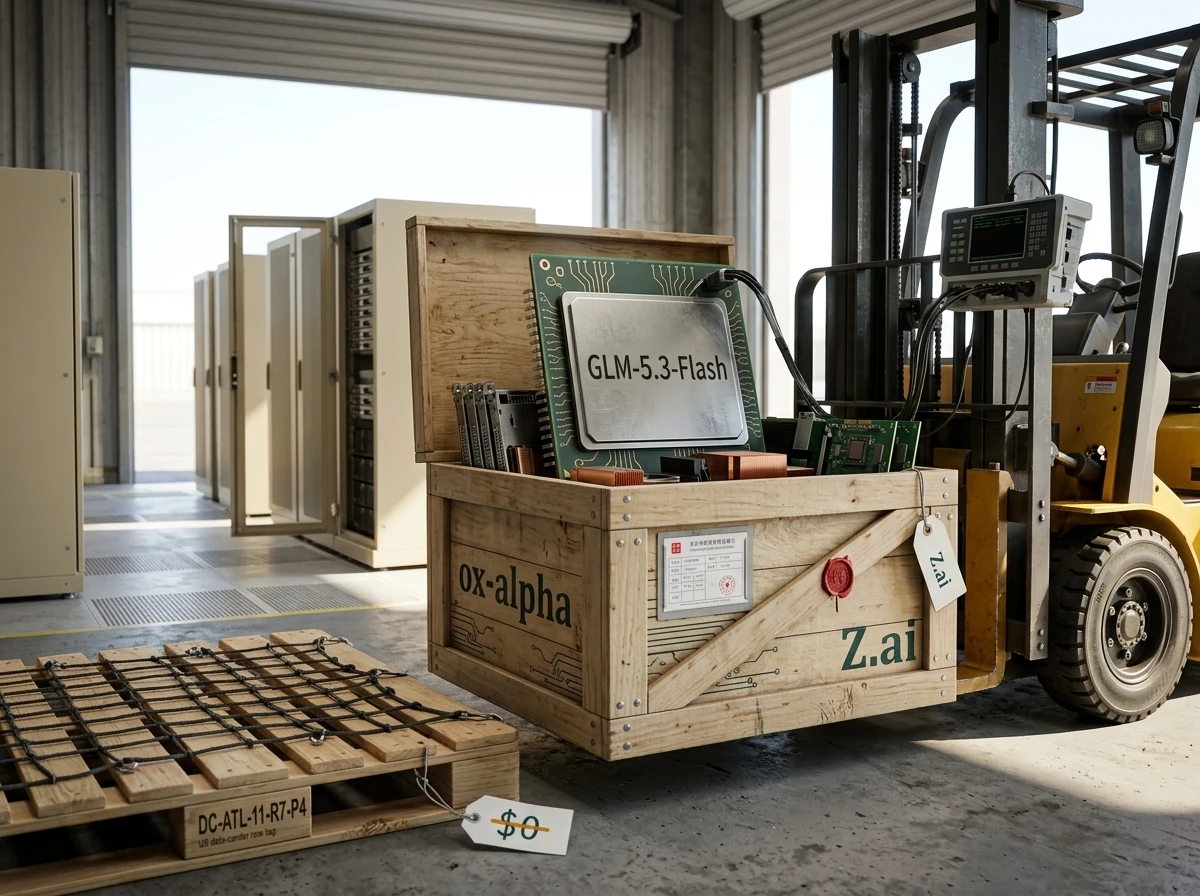
OpenRouter Became the Kingmaker
OpenRouter is not a model lab. It is the switchboard. More than 400 models sit on it, with roughly 10 new ones a week, and a free mystery entry that is quietly good still gets used like a default. That is the job the router now does, whether Z.ai planned the folklore or not.
WHAT THE PREVIEW MOVED
- OpenRouter total: the company said Ox Alpha was the biggest model ever on the platform, processing over 20 trillion tokens in 6 days.
- Coding share: the South China Morning Post, citing OpenRouter data on August 27, said the system ranked first among coding models at 10.3 trillion tokens, nearly 31 percent of weekly coding volume.
- Chinese share already: by mid-2026, Chinese-origin models held about 46 percent of identified OpenRouter volume, up from under 2 percent a year earlier, with US labs’ combined share on one Bloomberg cut falling from about 70 percent to about 30 percent.
DeepSeek, Xiaomi, MiniMax, Tencent, and Qwen had already taught developers that a good-enough open-weight model at cents on the dollar beats a famous US name on the tasks that burn tokens. GLM-5.3-Flash did not start that shift. It showed that a lab can borrow the router’s audience for a week, take the traces, and only then print a price list.
Ox Alpha revealed: @Zai_org’s GLM-5.3-Flash, the first native multimodal model in the GLM-5 series.
Ox Alpha was the biggest model ever on OpenRouter, processing over 20 trillion tokens in 6 days.
Continue to use the model now: https://t.co/avBrUW8BfZ pic.twitter.com/BUUi14iuoM
— OpenRouter (@OpenRouter) August 26, 2026
Cloudflare, GMI, and the American Pipe
The nationalist line in the blog is that the free week ran on Chinese chips. The commercial line is that the weights are MIT, and US companies started selling the same checkpoint on day one. Hugging Face lists Together AI, Fireworks, Novita, Baseten, and Z.ai itself among inference providers. Artificial Analysis counted 11 APIs by August 26, and several of the cheap ones are not in Beijing.
Cloudflare shipped @cf/zai-org/glm-5.3-flash on Workers AI the day of the reveal, billed at the same $0.15 / $0.50 list, on a paid plan. GMI and Bitdeer posted the lowest blended rates in Artificial Analysis’s cut, at $0.05 per million tokens, undercutting Z.ai’s own $0.10 blended figure. Databricks showed 267 output tokens per second on the same model Z.ai’s first-party API ran at 50.
| Host | Blended price per 1M tokens | Median output speed |
|---|---|---|
| GMI | $0.05 | 82 tok/s |
| Bitdeer AI | $0.05 | 61 tok/s |
| Z.ai (first party) | $0.10 | 50 tok/s |
| Databricks | $0.09 | 267 tok/s |
| Baseten | $0.10 | 191 tok/s |
| FriendliAI | $0.10 | 252 tok/s |
Those rows are the stakeholder map. A MIT dump lets a US host sell Chinese weights on American pipes, often faster and cheaper than the lab’s own API. OpenRouter’s launch promo cuts Z.ai’s list in half through September 9 at 16:00 UTC, to 7.5 cents / 25 cents per million, which is a router discount on a lab price that other clouds are already beating.
DigitalOcean told customers on August 28 that GLM-5.3-Flash was live on its Inference Engine. The Cloudflare Workers AI model page is the same pattern in docs form: US compute, Chinese checkpoint, list price copied across. Self-hosting is legal under MIT, but the Hugging Face repo is 328 GB and lists 321 billion parameters. That is an eight-GPU job, not a laptop. Most of the 20 trillion tokens will keep landing on someone else’s rack.
Homegrown Chips Carried the Free Week
Z.ai never named the accelerator. The blog talks only about “a large-scale cluster of Chinese AI chips” on a high-bandwidth interconnect, with a custom engine on top of SGLang, Encode-Prefill-Decode pools, W8A8 quantization, and hybrid INT8/FP8/BF16 cache. The South China Morning Post, citing the company, called it a cluster of 100,000 domestically produced chips. The lab’s own English post stays vaguer, “tens of thousands of domestically developed accelerators” in the developer docs.
The efficiency claim is specific. Versus GLM-5.3, Flash cuts attention compute by 3.0× and KV cache by 4.4×, with 45 layers against 92 and 18 billion active parameters against 40 billion on the bigger GLM-5.3. Versus GLM-4.5, total size stays in the same band (320B against 355B) while active parameters fall from 32 billion to 18 billion. Z.ai says a 3× end-to-end serving gain on the same Chinese hardware brought per-token cost in line with mainstream Nvidia GPUs.
Compared with our initial baseline on the same hardware, we achieved a 3× improvement in end-to-end serving performance, reaching hardware efficiency and per-token cost comparable to mainstream NVIDIA GPUs. This demonstrates that Chinese chips can support frontier-model inference efficiently and economically at scale.
Z.ai, GLM-5.3-Flash launch post, August 26, 2026
That paragraph is the export-control argument dressed as a product note. Washington has spent years trying to keep advanced Nvidia parts out of Chinese training clusters. A week of public, global inference on unnamed domestic chips is Z.ai’s proof that the serving side of the stack can be done without them. The MIT upload then lets US clouds rerun the same weights on whatever GPUs they already own, which is why the chip story and the hosting story split.
What GLM-5.3-Flash Costs on the Index
Artificial Analysis put GLM-5.3-Flash at 57 on the Intelligence Index the day of the reveal, with a cost of $0.09 per task at list rates. Z.ai quotes $0.045 on the discounted OpenRouter promo. Either figure sits on the cheap side of the Pareto line for that score. GLM-5.3 at max reasoning is 60 and $0.68 a task. GPT-5.6 Terra and Muse Spark 1.2 also sit at 57, at $0.51 and $0.40.
| Model | Intelligence Index | Cost per task | Output speed |
|---|---|---|---|
| GLM-5.3-Flash | 57 | $0.09 | 49.8 tok/s |
| GLM-5.3 (max) | 60 | $0.68 | 66 tok/s |
| GPT-5.6 Terra | 57 | $0.51 | – |
| Muse Spark 1.2 | 57 | $0.40 | – |
Two points of index for a 7.5× cost jump is the math finance teams will print. The catch in the same scorecard is speed and talkativeness, which Artificial Analysis flags without hedging: 49.8 tokens per second ranks 47th of 110 in class, and the index run burned 150 million output tokens against a 110 million median. About 90 percent of those tokens were reasoning traces, 134 million of 149 million in Artificial Analysis’s writeup, so the sticker price only stays low because each token is cheap.
Z.ai’s own table is kinder. On DeepSWE v1.1, Flash scores 63.4 against GLM-5.2’s 46.2 and Claude Opus 4.8’s 58.0, though GPT-5.6 Terra is at 69.6. AutomationBench is 48.8 against 26.2 for GLM-5.2. GDPval-AA v2, scored by Artificial Analysis, is 1773 for Flash against 1504 for GLM-5.2 and 1582 for Opus 4.8. On Z.ai’s in-house Code Bench at max effort, Flash is 29.0 against Opus 4.8 at 29.5. Those are vendor benches plus one independent index, not a blank check for every repo.
Kilo ran the same “build a spectral audio visualizer” prompt through Flash and Gemini 3.7 Flash and said the bills were $0.01 and $0.17. An independent tester with two real repositories and 105 planted bugs had Flash recover 13, behind Gemini 3.7 Flash at 18 and DeepSeek V4-Flash at 14, and ahead of Opus 4.8 at 9. Price is doing more work than raw bug-finding in those snapshots, which is exactly when a host’s blended rate starts to matter more than a lab’s blog.
Can US Companies Route This Work?
Indie developers already did, for a week, at zero dollars. A bank, a hospital, or a federal contractor cannot copy that path just because the index is 57. The live split is not “Chinese model versus US model.” It is “weights on your own GPUs or a US host” versus “prompts on a Beijing API.”
THE CONSTRAINTS THAT SURVIVE THE PRICE CUT
- China API risk: prompts sent to Z.ai’s first-party endpoint sit inside PRC jurisdiction. China’s 2017 National Intelligence Law requires organizations to support state intelligence work, a point US security briefs keep attaching to Zhipu, DeepSeek, and their peers.
- Open weights are different: once the MIT checkpoint is on a company’s own machines, or on Cloudflare, GMI, Databricks, or DigitalOcean, the inference session no longer has to leave that operator’s region. That is the path Airbnb’s CEO pointed to when lawmakers asked about Qwen and Kimi: the company said it was not sending data to the model makers.
- Federal and critical-infrastructure bans: US House members opened an inquiry in May 2026 into Chinese models in critical infrastructure and named Zhipu alongside DeepSeek, MiniMax, and ByteDance. Booz Allen has already argued for a default block on untrusted models in government and critical infrastructure.
- Self-hosting is not free: a 328 GB FP8 dump and a 1 million-token context make this a datacenter model. Teams that lack eight-GPU nodes will buy an American API of a Chinese checkpoint, which is cheaper than Opus and still a vendor-review item.
The 45 percent workhorse plan that has been making the rounds assumes volume can move the moment the cents look right. Volume already moved on OpenRouter. Enterprise volume has to pass a counsel, a CISO, and often a government contract clause, and those people do not score GDPval. They score where the bits sit. Flash’s MIT license is the lever that makes a US-hosted path possible. It is also why Z.ai cannot keep the serving margin just because it proved the chips.
After the Reveal, a Quiet Config Patch
Introducing GLM-5.3-Flash
– Leading capabilities at a highly competitive price
– Natively multimodal with a 1M-token context window
– A 320B-A18B model released under the MIT License
– Previously previewed as Ox Alpha, running entirely on Chinese AI chipsBlog:… pic.twitter.com/KOCG4dkay3
— Z.ai (@Zai_org) August 26, 2026
The showroom build did not match the ghost. Zixuan Li, who leads work on the serving stack at Z.ai, wrote on August 28 that the lab had rolled out a configuration update “to improve performance in some agentic use cases,” and asked anyone who saw Flash underperform Ox Alpha between August 26 and 27 to try again. That is an official admission that the named, paid model lagged the nameless free one on the jobs that made the 20 trillion-token week.
Thinking cannot be turned off. Z.ai’s docs say thinking.type only supports enabled, and reasoning_effort defaults to max. Combined with 49.8 tokens per second on the first-party API, long agent loops will feel like a wait even when the bill is small. Unsloth promised GGUF builds for local play; those help hobbyists, not a 1 million-token production agent.
September still has a pile of expected releases from Google, xAI, Anthropic, OpenAI, and DeepSeek, and any one of them can move the 57 / $0.09 pair. The cheaper fact on the table right now is narrower. OpenRouter can make a Chinese lab famous in six days. US clouds can sell the MIT dump the same afternoon, sometimes faster and cheaper than the lab. Security teams can still park the whole idea in a review queue. GLM-5.3-Flash is already in that queue, with a patch note on top.


Google Splits EU Search Rankings to Avert a Fine

US Clouds Capture GLM-5.3-Flash After Ox Alpha’s Free Week

Generation Lab’s Unnamed Shot Runs on Drugs It Cannot Own

Sid Iyer Puts a South Asian Voice in the Low-A Booth

The Roman Space Telescope Puts a Sky Census on Falcon Heavy

The Nantucket Basket Boom Hits Its Aging Weavers

Poland Closes the Visa-Free Door Into Work Permits

Disney Bets Its D23 2026 Night on Sequels

Bristol Myers Ends the Cellares Deal After a Scale Test
